




Home / Board / Railway Route Builder
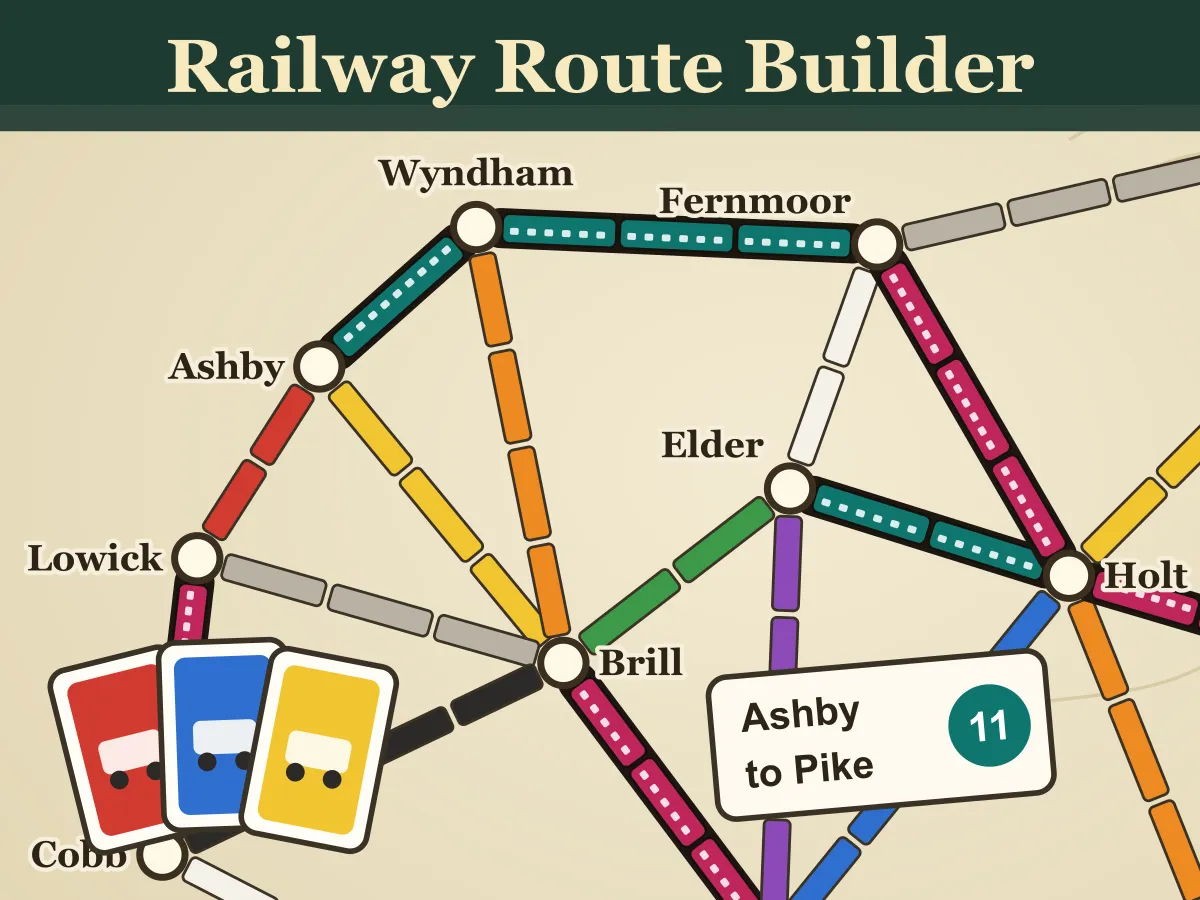
Railway Route Builder is a free online train route board game you play against the computer on two maps of its own: Hollow Vale, a small valley of 14 towns for two, and Northreach, 22 towns for up to four. On your turn you do one thing: draw two train cards, claim a line between two towns by paying its length in cards of its colour, or take new tickets. Each ticket names two towns; join them with your own lines by the end and it pays its points, miss and it costs them. Long lines pay far more than short ones, and the longest unbroken railway earns a bonus. When someone is down to two trains, everyone plays one last turn and the most points wins. The computer railways get sharper table by table, up to a master that plays the game out dozens of times before it takes or keeps a ticket.
How to play Railway Route Builder
- Press Play and pick a table. The first seats you against one beginner on the small Hollow Vale map; each table you win opens the next, up to four railways on the big Northreach map.
- You start with four train cards (the last player in turn order gets five) and three tickets. Keep at least two: each names two towns and the points it is worth. Tap a ticket to keep it, then Keep.
- On each turn do one of three things. Draw two train cards: tap face-up cards or the deck. A face-up engine is wild and counts as both your cards, so it can only be the first one you take.
- Or claim a line: tap it on the map, then Claim (or tap it again). Pay as many cards as it has cars, all of its colour — grey lines take any one colour, and engines stand in for any card. Your trains go onto it and nobody else can use it.
- Lines score as you claim them: 1 point for one car, 2 for two, 4 for three, 7 for four, 10 for five and 15 for six.
- Or take three new tickets and keep at least one of them. More tickets mean more points, but only if you can finish them.
- When anyone ends a turn with two trains or fewer, every player — them included — plays one last turn. Then each ticket your lines join adds its points, each one they do not join takes them away, and the longest unbroken railway gets a bonus (8 points on Hollow Vale, 10 on Northreach). The most points wins.
- Win for one star; finish far enough ahead of the best rival for two and three — the result card says how far. Hint (or H) suggests a move.
Tips
- Choose tickets that share towns. Two tickets whose lines overlap cost little more than one, and the shared lines count for both.
- Long lines are worth far more per card: a six-car line pays 15 points, six one-car lines only 6. Save up for the long ones your tickets need.
- Claim the narrow places first. If only one line runs into a town your ticket needs, a rival can block it with a single claim — and then you have to go the long way round, or miss the ticket.
- Watch what your rivals take from the face-up cards. A run of the same colour usually means they are about to claim a line of that colour near their railway.
- Do not hoard engines. They are wild, but a face-up engine costs your whole turn; take it only when two ordinary cards would help you less.
- Once your tickets are done and you still have plenty of trains, more tickets are often worth it — towns your railway already reaches are cheap to finish.
- Keep an eye on the train counts. When a rival gets low, stop taking tickets and turn your cards into lines while you still can.
FAQ
Is Railway Route Builder free to play?
Yes. It runs in your browser for free, with no download, no install and no account.
Does Railway Route Builder work on a phone?
Yes. Held upright the map fills the top of the screen with your cards, tickets and the buttons below it; held sideways it lays out like the desktop. Tap a line on the map to choose it. On a keyboard, 1-5 take a face-up card, 6 draws from the deck, the arrow keys step through the lines you can claim, Enter claims, T takes tickets and H gives a hint.
How do you win Railway Route Builder?
Have the most points after the last round. Lines pay as you claim them (1, 2, 4, 7, 10 or 15 points for one to six cars), every ticket your own lines join adds its points and every one they do not join takes them away, and the longest unbroken railway gets a bonus. A tie goes to whoever finished more tickets, then to the longer railway.
How are the tickets valued?
Each ticket is worth exactly the number of cars on the shortest way between its two towns on an empty map, from 5 to 12 points on Hollow Vale and 6 to 15 on Northreach. Hollow Vale has 20 tickets and Northreach 29, and every town is on at least one.
When does the game end?
When a player ends a turn with two trains or fewer, everyone — that player too — gets one more turn, and then the game is scored. Everyone starts with 30 trains on Hollow Vale and 28 on Northreach, which makes for about 25 turns each.
How good are the computer players?
There are three. The novice knows where its tickets lead but keeps the easiest ones and draws cards half at random. The planner works out the cheapest railway joining all its tickets and collects exactly the colours it needs; played on the same cards with the seats swapped, it beat the novice in 220 of 300 games on Hollow Vale. The master plays like the planner but tries its ticket decisions out first, playing each choice to the end many times with the cards it cannot see dealt at random; it beat the planner in 141 of 240 games, about three in five.
How hard are the tables?
On the first 60 deals of each table, a stand-in that plays like the planner wins 40 at the first table, 35 at the second and 13 at the last, a table of four with two masters. The master wins 45 at the first and 20 at the last. The star targets come from the same games: two stars at the master's typical winning lead, three at a lead only its best fifth of wins reach.
Does going first help?
A little — about as much as one card — so the last player in turn order starts with five cards instead of four. With identical computer players in every seat, over 400 games each, every seat won within two points of its fair share at tables of two, three and four. You always choose tickets and move first.
What happens when the cards run out?
The 110 train cards are 12 of each of eight colours plus 14 engines. Cards paid for lines go to a discard pile, which is shuffled back in when the deck runs out. Whenever three engines lie face up at once, all five are swept away and five new cards are dealt.