
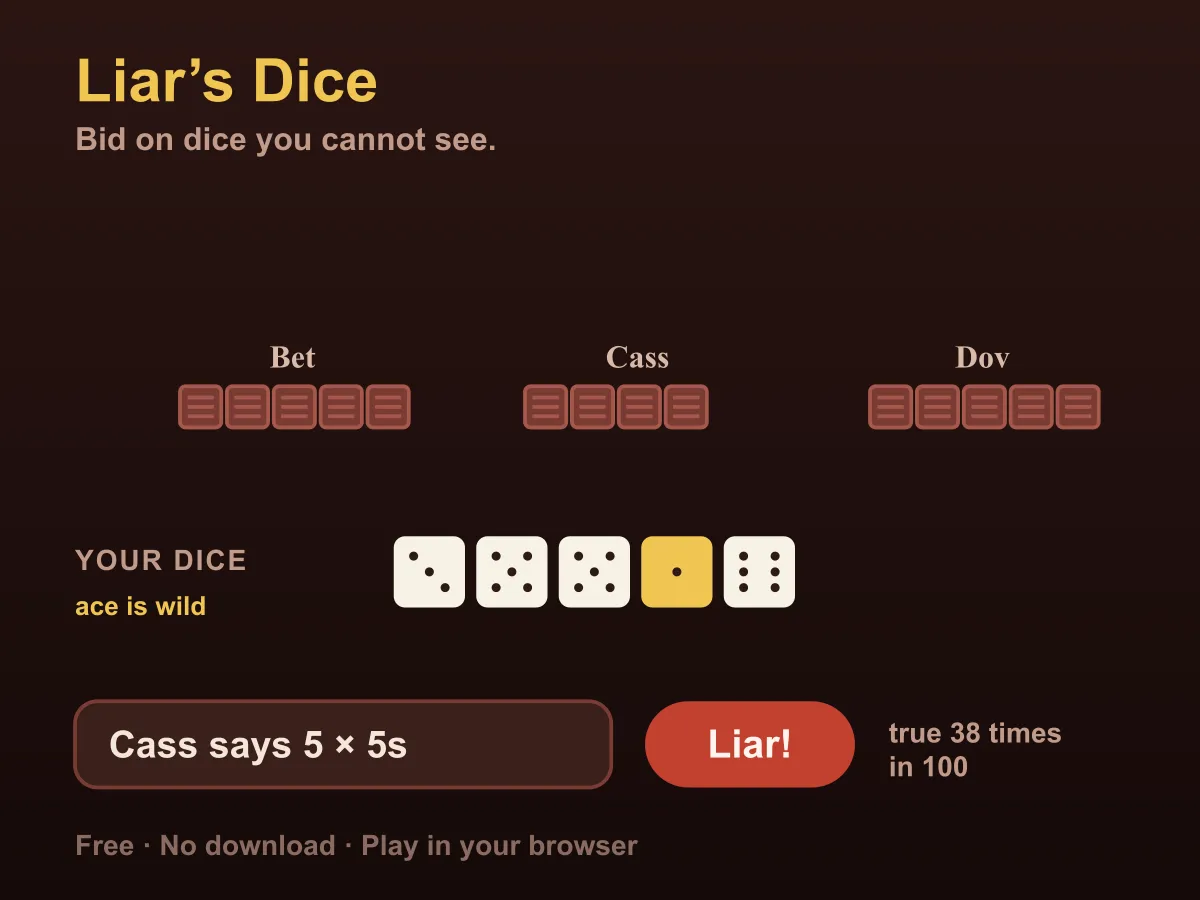


Liar's Dice is a free online bluffing dice game for one player against three computer opponents. Everyone rolls five dice behind their hand, and a bid names a quantity and a face: four fives claims there are at least four fives on the table, counting everybody's dice and not just your own. Each bid must raise the last, so the number climbs until somebody stops believing it and calls Liar. Every hand comes up, the face is counted, and whoever was wrong loses a die. Run out and you are out; take every die and the table is yours. These are the Perudo rules, which means aces are wild: a one counts as whatever face the bid names, so four fives is satisfied by two fives and two ones. That one rule is what makes the arithmetic hard to do in your head, and it is why a bid on aces sits on its own rung of the ladder — an ace bid counts only the real ones, coming down to aces halves the quantity, and climbing back out of them costs double plus one. The game shows you the odds rather than making you feel for them: under every bid you are offered, it prints the exact chance it is true from where you sit, counting your own dice as known and pricing every unseen die at one in three. The three opponents read the table the same way and call when a bid drops below roughly a third — so bluffing works on them, but only for about as long as it should.
How to play Liar's Dice
- Press Play. You and three computer players each roll five dice behind your hand. You can see your own; the other fifteen stay face down.
- A bid names a quantity and a face — say four fives. It claims there are at least that many on the whole table, everybody included.
- Aces are wild. A one counts as any face the bid names, so four fives can be met by two fives and two ones.
- Use the − and + buttons to set the quantity and the row of dice to pick the face, then press the Bid button.
- Every bid must raise the last: the same quantity on a higher face, or a higher quantity on any face.
- A bid on aces is its own thing — it counts only real ones. Coming down to aces halves the quantity, and leaving them again costs double plus one.
- If you think the bid standing against you is a lie, press Liar. Every hand is turned over and the face is counted, wilds included.
- If there really were that many, you lose a die for calling. If there were not, the bidder loses one. A tie goes to the bidder, because a bid claims at least.
- Whoever lost the die opens the next round. Everyone rerolls, with one die fewer on the table.
- Lose all five and you are out. Take the last die off the last opponent and the table is yours.
Tips
- Read the number under the bid rather than guessing at it. It is the exact chance the bid is true from your seat, so "23 times in 100" means what it says — it is not a mood.
- Price an unseen die at one in three, not one in six. It matches the face itself or it is a wild ace, and forgetting the ace is the single most common way to under-bid.
- With twenty dice on the table, about a third of them match any face you name. Six or seven of something is an ordinary claim; eleven is a bluff.
- Bid what you are actually holding. If you have three fours in your hand, four fours only needs one more from fifteen unseen dice, and that is nearly certain.
- Aces are the escape hatch from a bid you cannot raise cheaply. Coming down to aces halves the number, so five sixes can be answered with three aces.
- Remember that leaving aces costs double plus one. Three aces means the next ordinary bid is seven of something, which is usually where a round ends.
- Watch what a player bids just after rerolling. An opening bid is made blind to everyone else, so it is the closest thing to an honest look at their hand.
- As dice come off the table, the same quantity gets much less likely. Four of something is easy with twenty dice and a bluff with eight.
FAQ
Is Liar's Dice free to play?
Yes. It runs free in your browser with no download, no install and no account.
What does a bid actually claim?
That at least that many dice on the whole table show that face, counting every player including you. It is never about your own hand alone, which is what makes the game a bluff rather than a guess.
What does aces are wild mean?
A one counts as whatever face the bid names. A bid of four fives is satisfied by four fives, or by two fives and two ones, or by four ones. It is why a third of the table matches any face you pick rather than a sixth.
Why can I not just bid aces every time?
Because a bid on aces counts only the real ones, so it is a much rarer claim. The ladder prices that in: coming down to aces halves the quantity, and climbing back out of them costs double plus one.
Who loses the die when somebody calls Liar?
Whoever was wrong. If the count meets or beats the bid, the caller loses a die; if it falls short, the bidder does. An exact tie goes to the bidder, since a bid only ever claims at least that many.
What is the number under my bid?
The chance the bid is true, worked out exactly rather than estimated. Your own dice are counted as known, and every unseen die is priced at one in three for an ordinary face or one in six for aces.
How good are the computer players?
They read the table the same way you can: they call when the standing bid drops below about a one-in-three chance, and they raise with the safest bid that is still plausible. Measured over six hundred tables, all four seats win about a quarter each, so nobody is favoured by the turn order.
Does Replay this game deal the same dice?
It does. Each round draws from its own stream keyed to the seed, so the same table comes back and you can find out whether a call you regret was really the wrong one.