
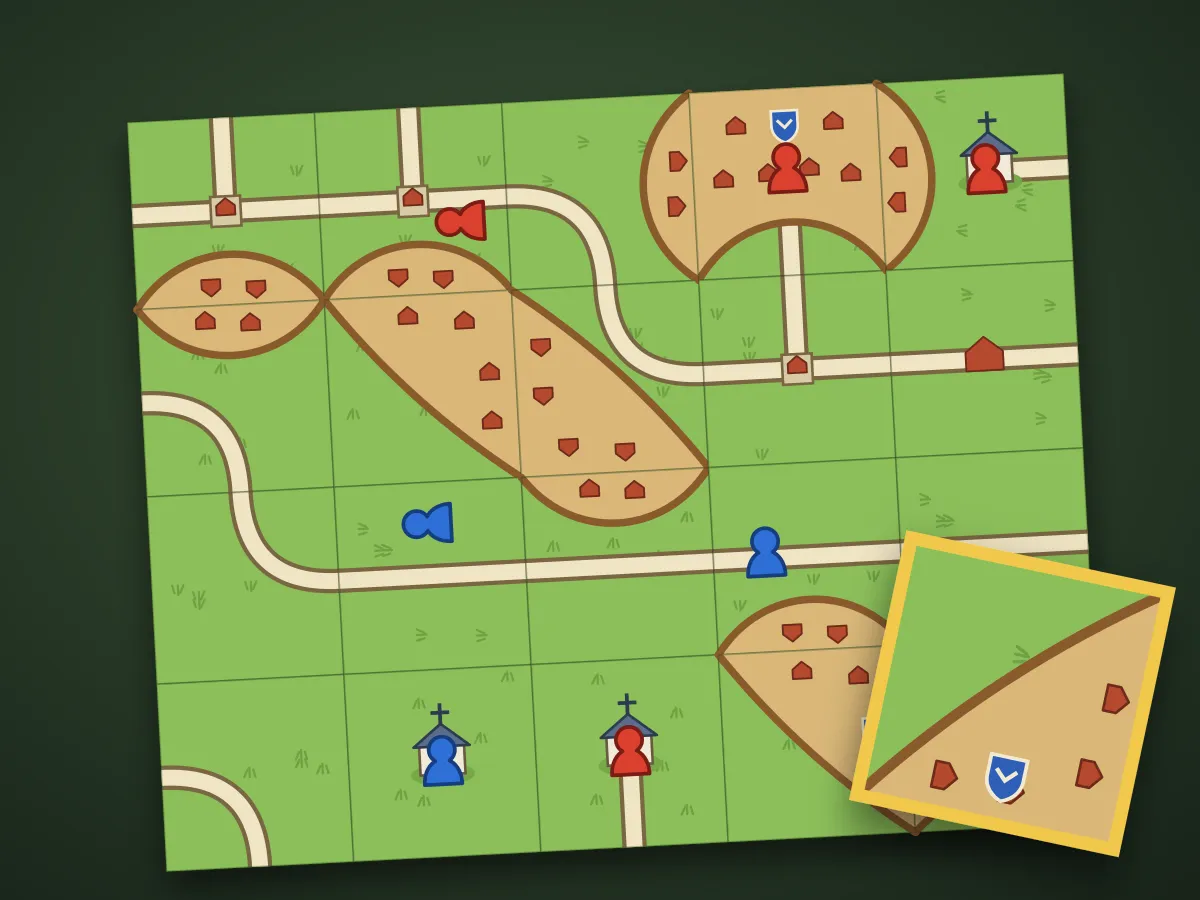




Tile Kingdom is a free online tile placement board game you play against the computer at six tables, from one easy rival up to a full table of four. Every turn you draw one square tile — a piece of city, road, chapel or meadow — and lay it next to the others so every edge matches: city meets city, road meets road, grass meets grass. Then you may stand one of your seven pawns on something the tile shows, as long as nobody holds it yet. A finished road pays a point a tile, a finished city two a tile and two for each banner, and a chapel nine once all eight squares around it are filled; the pawn then comes home to be used again. When the bag is empty, unfinished cities pay half, unfinished roads and chapels still pay a point a tile, and a pawn lying in a meadow pays three for every finished city that meadow touches. The 67 tiles are the game's own set of 26 kinds. The computer players get sharper table by table, up to a master who counts the tiles left in the bag before it builds.
How to play Tile Kingdom
- Press Play and pick a table. The first seats you with one beginner; each table you win opens the next, up to a table of four.
- Your tile for this turn is shown beside the board. The squares where it fits are lit on the board; the brighter ones fit it as it is turned now. Turn it with the arrow buttons, or R and Q.
- Tap a lit square to lay the tile there. Every edge must match its neighbours: city to city, road to road, meadow to meadow. Tap the tile again to try the other turns that fit there.
- If you like, put a pawn on the tile: tap one of the numbered spots (or press its number) to stand a pawn on that city, road, chapel or meadow. You can only claim a feature nobody holds yet — counting everything it already joins.
- Press Place tile (or Enter). Anything the tile finishes is scored at once and its pawns come home.
- A finished road scores 1 point a tile. A finished city scores 2 a tile and 2 for each banner. A chapel scores 9 once all eight squares around it hold a tile.
- If two players have pawns on one feature, whoever has more takes the points; a tie pays both in full.
- When the bag is empty, unfinished roads and cities score 1 a tile (and 1 a banner), unfinished chapels 1 for themselves and each tile around them, and a pawn in a meadow scores 3 for every finished city that meadow touches. The most points wins.
- Win for one star. Finish far enough ahead of the best rival for two and three: the result card says how far. Hint (or H) suggests a move; drag the board to look around, pinch or use + and − to zoom.
Tips
- Small cities are quick points: a city edge facing another city edge closes a two-tile city worth 4 straight away, and your pawn is back for the next turn.
- Keep a pawn or two in hand. Seven pawns go fast, and a turn with a great tile and no pawn left is a turn wasted.
- Before you claim a big city, look at the holes it still needs. A hole surrounded on three sides may need a tile that is rare or already used up, and a pawn can sit there until the end.
- Chapels are safe points: they score something even unfinished, and every tile anyone lays around them adds one.
- Meadow pawns never come back, but they can be the biggest score in the game. Claim a meadow late, next to cities that are already finished or nearly so.
- You can join a rival's city by building towards it from a city you hold. If you end up with more pawns there, the points are yours; level, and you both score.
- A tile that finishes a rival's feature gives them points. When you can, lay it somewhere else.
FAQ
Is Tile Kingdom free to play?
Yes. It runs in your browser for free, with no download, no install and no account.
Does Tile Kingdom work on a phone?
Yes. Held upright the board fills the top of the screen with your tile, the scores and the buttons below; held sideways it lays out like the desktop. Tap a lit square to lay a tile, drag to look around and pinch to zoom. On a keyboard the arrow keys move a cursor, R turns the tile, the number keys place a pawn and Enter lays it.
How do you win Tile Kingdom?
Have the most points when the bag is empty. Points come from roads, cities and chapels you hold a pawn on: a finished road pays 1 a tile, a finished city 2 a tile and 2 a banner, a finished chapel 9. At the end, unfinished cities pay half, unfinished roads and chapels 1 a tile, and meadows 3 for every finished city they touch.
When do pawns come back?
As soon as the road, city or chapel they stand on is finished and scored, so you can use them again. A pawn in a meadow never comes back: meadows are only scored at the end. Everyone has seven pawns.
What happens if my tile fits nowhere?
It is set aside for everyone to see and the next tile is drawn. It is rare: in 300 games between computer players, about one game in eight set a tile aside, and only about one tile in 500 was set aside in all.
How good are the computer players?
There are four. The novice takes the points it can see and lays the rest anywhere. The squire tries every move but spends its pawns freely and loves a meadow. The builder keeps its pawns for features worth them; played on the same tiles with seats swapped, it beats the squire about four games in five. The master also counts the tiles left in the bag, so it knows when a city is waiting for a tile that no longer exists; it beats the builder about two games in three.
How hard are the tables?
Played on the first 100 deals of each table, a stand-in that plays like the builder wins 98 of them at the first table, 81 at the second and 17 at the last, a table of four. The master wins all 100 at the first and 28 at the last. The star targets come from the same games: two stars at the master's typical winning lead, three at a lead only its best fifth of wins reach.
Does going first help?
Not measurably. You always lay first, and at a table of four the bag leaves two tiles in the box so everyone lays the same number. With identical computer players in every seat, over 300 games each, every seat won within three points of its fair share at tables of two, three and four.
How many tiles are there?
Sixty-seven tiles of 26 kinds, one of them the start tile: city edges, corners and walls, straight and bending roads, junctions, chapels, and a few of the game's own — two roads ending at a house, and a chapel beneath a city wall. A game between two players lasts 33 turns each.