
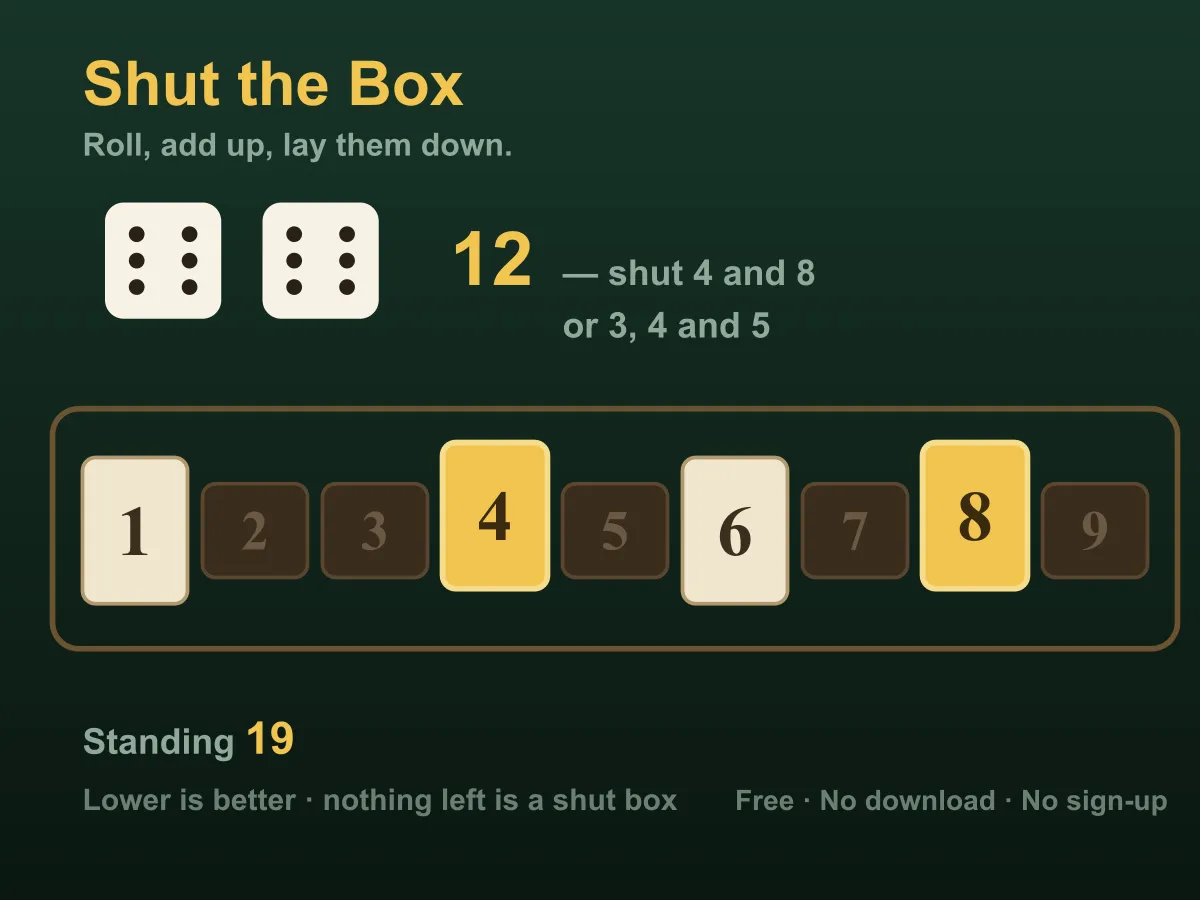



Shut the Box is a free online version of the old pub dice game, for one player. Nine tiles numbered one to nine stand in a wooden box. You roll two dice and shut any tiles that add up to what you rolled — a nine can come down as 9, as 4 and 5, as 1 and 3 and 5, or any other way the numbers allow, and choosing between them is the whole game. Keep going until a roll fits nothing that is left, and your score is the total of the tiles still standing. Low is good. Nothing at all is a shut box, and it is rarer than people expect: playing every move perfectly, it happens about one time in ten. There is one more rule, and it is the only decision you make before seeing a number. Once 7, 8 and 9 are all down, every tile left is six or under, so you may roll a single die instead of two — and a single die cannot overshoot the way a pair can. It is not always right, which is why the game asks rather than doing it for you. The obvious strategy is to shut the biggest tile you can, and it is a decent one, but it is not the best; so is keeping as many future rolls answerable as possible, and that is measurably worse than either, because a tidy row of small tiles will happily survive while the 7, 8 and 9 that are costing you the game sit there untouched. The hint button will always show you the genuinely best move: the whole game is small enough to solve outright, so it is not a guess.
How to play Shut the Box
- Press Play. Nine tiles numbered one to nine are standing in the box, and your score starts at 45 — the total of all of them.
- Roll the dice. Any set of standing tiles that adds up to the total may be shut.
- Tap the tiles you want. Only the ones that can be part of an answer light up, and the list narrows as you choose, so you cannot build a selection you are unable to finish.
- Press Shut them when your selection matches the roll exactly. Those tiles lie down and stop counting against you.
- Roll again. Keep going for as long as something on the board adds up to what you roll.
- Once 7, 8 and 9 are all down, a second button appears: roll one die instead of two. One die cannot overshoot, but it also cannot reach the bigger totals, so it is a real choice.
- The game ends the moment a roll fits nothing that is left standing.
- Your score is the sum of the tiles still up. Lower is better, and zero — every tile down — is a shut box.
- The Hint button shows the genuinely best move rather than a decent one. The whole game is small enough to solve exactly, so it is not guessing.
- Replay this box deals the same dice again, so you can take a different route through a roll you think you misplayed.
Tips
- Get the big tiles down early. The 7, 8 and 9 are 24 of the 45 points on the board, and once the small tiles are gone you will not roll high enough to reach them.
- Shutting the biggest single tile you can is a decent rule and not the best one. Measured over two thousand boxes it averages 11.7 against the solved 11.0, which is most of the way there but not all of it.
- Keeping as many future rolls answerable as possible is the trap. It averages 14.7, worse than being greedy, because a tidy row of ones and twos survives roll after roll while the expensive tiles stay standing.
- Most rolls do not need thinking about. Measured over fourteen thousand decisions, taking the biggest tile you can is already the best move 92% of the time — but on the other 8% it costs nearly two points of final score, and up to six. The skill is noticing which roll you are looking at, which is what the Hint button is for.
- The odds line under the dice is exact, not a mood. When it says this roll finds something 39 times in 100, that is a straight count of the ways the dice can land — over the 36 outcomes of two dice, or the six faces of one, whichever is the better bet for the tiles you have left.
- The single die is not automatic. Once every tile is six or under, taking one die usually helps, but with the higher of those tiles still up it can leave you unable to reach them at all.
- A score of 3 or less is not a near miss you could have avoided — it is what the last roll usually does. Measured over five thousand boxes played perfectly, 19% end that close and 10% shut outright.
- Use Replay this box after a bad finish. The same dice come back, so you can find out whether the box was losable or whether you lost it.
FAQ
Is Shut the Box free to play?
Yes. It runs free in your browser with no download, no install and no account.
How is Shut the Box scored?
Your score is the total of the tiles still standing when a roll fits nothing, so lower is better. Leaving nothing standing at all is a shut box and the best possible result.
How often can you actually shut the box?
About one game in ten, playing every move perfectly. This version solves the game exactly rather than sampling it, and the average score from a perfect start is 11.0.
When can I roll one die instead of two?
Once tiles 7, 8 and 9 are all down, so that everything left is six or under. A single die cannot overshoot, but it also cannot reach a total of more than six, so it is a genuine decision rather than a free win.
Can I shut more than one tile at a time?
Yes, and that is the whole game. A roll of nine can come down as the 9, as 4 and 5, as 1 and 3 and 5, or any other set that adds up, and which one you take decides what you can answer next.
Should I always shut the highest tile I can?
It is a good rule and not the best one. Over two thousand boxes it averages 11.7 against 11.0 for perfect play — close, but the gap is real, and it comes from the moves where splitting a total leaves the row better placed.
Is the hint actually the best move?
Yes. Nine tiles is only 512 possible boxes, so the game is solved backwards from the end, and the hint shows the move with the lowest expected final score rather than a rule of thumb.
Does Replay this box deal the same dice?
It does. Each roll of a box draws from its own stream, so taking the single die — which draws one number instead of two — does not shift the rolls that follow, and a replay really is the same box.