
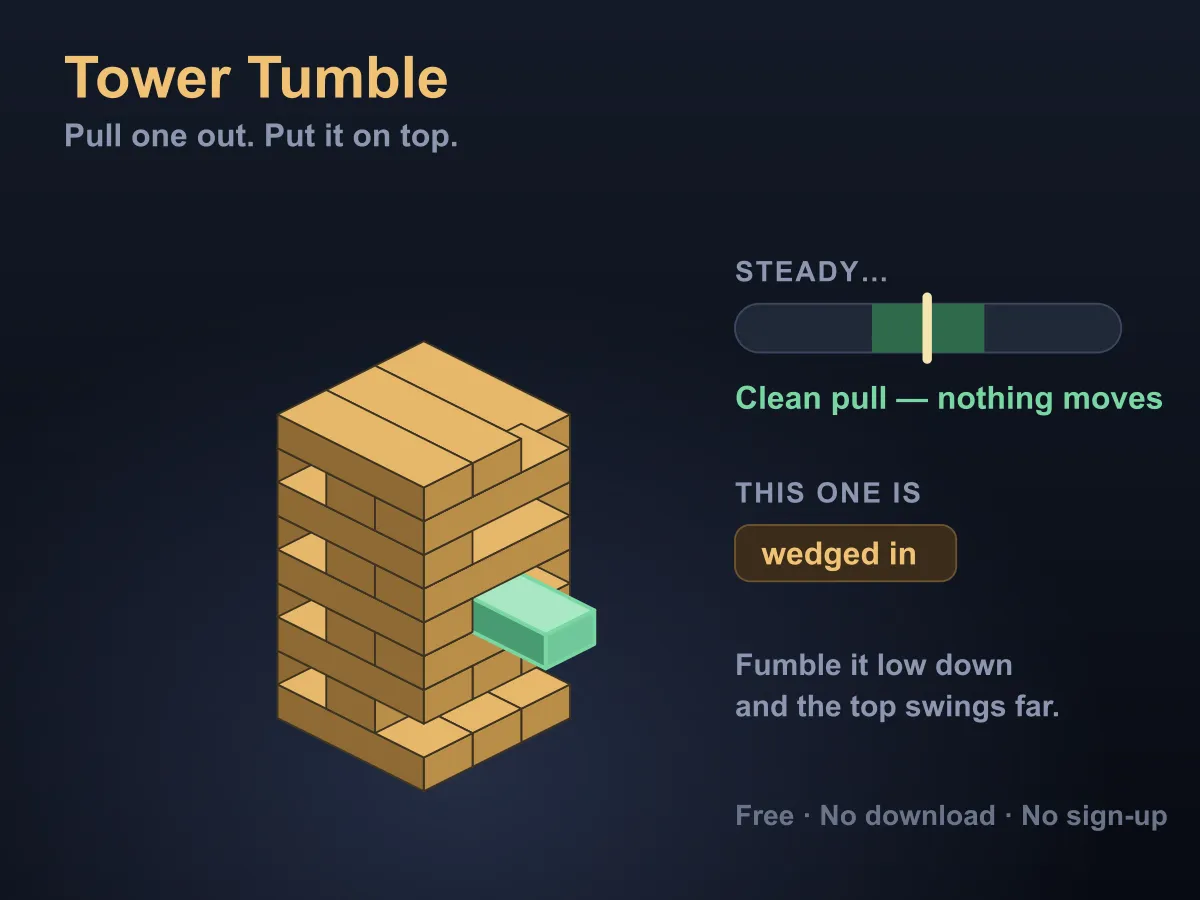








Tower Tumble is a free online block-pull tower game for one player against a computer opponent. Eighteen levels of three blocks each are stacked with every level turned a quarter from the one below, and you take turns drawing a block out and laying it on top. The tower is not guesswork: it stands exactly as long as the weight above every join sits over the blocks still holding it up, which is arithmetic the game does honestly on every move, so nothing collapses for reasons you cannot see. What can go wrong is your hand. Choose a block and a needle sweeps across a bar with a pale band in the middle. Stop it inside the band and the block comes out clean. Stop it outside and you tip the tower, and here is the part that decides games: the tower pivots on the join you disturbed, so the level just above it barely moves while the top moves a long way. A fumble near the top costs almost nothing and the same fumble at the bottom is close to fatal. Every block shows how tight it is before you touch it — the paler its top, the looser it sits — because a block carrying half the tower gives you a much narrower band than one near the top carrying nothing, and each block has its own grain on top of that. Take the outside blocks of a level before the middle and that level will give you two; take the middle first and it is finished. The tower gets taller as you play, and the game ends when somebody knocks it over — or, rarely and best of all, when there is nothing left that can safely be taken.
How to play Tower Tumble
- Press Play. Fifty-four blocks are stacked into eighteen levels of three, each level turned a quarter from the one below it.
- On your turn, click a lit block. The lit ones are the ones the rules allow: never from the top completed level, and never the last block of a level.
- Each block shows how tight it is: the paler its top face, the looser it is. Point at one and the line under the tower names it — loose, firm, tight or wedged in — from the weight resting on it and the block's own grain.
- Once a block is picked, a needle sweeps back and forth across a bar with a pale band in the middle. Click Pull it out, or press the space bar, to stop it.
- Stop inside the band and the block comes out clean, leaving the tower exactly as it was. The tighter the block, the narrower the band.
- Stop outside it and you tip the tower. The tower pivots on the join you disturbed: the level above it hardly moves, the top moves a long way.
- The block you took is laid on the top level, out of true by however clumsy the pull was. When the top level fills up, a new one starts turned the other way.
- The chip at the top says Plumb, Leaning or Going over. That is the real state of the weakest join, not a mood — when it says Going over, one more mistake ends it.
- Your opponent, the Architect, then takes a turn the same way. It picks by looking two moves ahead, and its hand is about as steady as a good player's.
- Whoever knocks the tower over loses. If it ever gets to the point where nothing can safely be taken, the tower stands and you have both built something.
Tips
- Take the outside blocks of a level before the middle one. A level down to its middle block alone still sits under the centre of the tower and holds; a level down to an outside block does not, so a level whose middle has gone is finished at two.
- Work high when you are unsure. The same fumble costs almost nothing near the top and is close to fatal near the bottom, because the tower pivots on the join you disturb.
- Read the tops before you commit. A wedged-in block can have less than half the band of a loose one, and the pale ones are visible from across the tower without picking anything up.
- Every block you move makes the level it came from tighter. The same weight is now carried by two blocks instead of three, so a level you have already visited is worse value the second time.
- Watch the lean chip rather than the tower. A tower that looks fine from the front can be a long way out in the other direction, and the chip is measuring the join that is actually closest to going.
- A clean pull leaves the tower exactly as true as it was. There is no slow decay to fight — every bit of lean in the tower was put there by somebody missing the band.
- When the tower is Going over, take the loosest block you can find, wherever it is. Getting through the turn matters more than where the block came from.
- Replay this tower after a loss. The blocks are built with the same small imperfections, so you can take the same route with a steadier hand and see how far it really had left.
FAQ
Is Tower Tumble free to play?
Yes. It runs free in your browser with no download, no install and no account.
How does the tower decide to fall?
It is solved rather than simulated. At every join, the game works out where the weight above sits and how wide the blocks underneath are; the tower stands while the first is inside the second. That means it never falls for a reason you cannot see, and the same seed always plays the same way.
What is the bar with the sweeping needle?
Your hand. Stopping the needle inside the pale band draws the block out cleanly and the tower does not move at all. Stopping outside it tips the tower, by more the further out you were and the more weight the block was carrying.
Why is the band narrower on some blocks?
Because they are tighter. The band shrinks with how much of the tower is resting on the block, and each block also has its own grain — some sit loose in the stack and some are wedged, and the label tells you which.
Does it matter where in the tower I pull from?
Enormously. A fumble makes the tower pivot on the join you disturbed, so everything above leans and the top leans furthest. Missing the band near the top is almost free; missing it on the bottom level usually ends the game.
Which block should I take first from a level?
An outside one. A level can give up two blocks if it keeps its middle, because a middle block alone still sits under the centre of the tower. Take the middle first and what is left is two outside blocks, either of which would leave the tower balanced on an edge.
How good is the Architect?
It looks two moves ahead — it simulates each legal pull going plausibly badly and keeps the one that leaves the most safe pulls afterwards — and its hand is a little steadier than average. Measured over sixty towers, the two of you knock it over about as often as each other.
Is this the wooden block game I am thinking of?
It is the same idea, but it is not that game and does not use its name. The tower here is eighteen levels of three, the pull is a timing bar rather than a fingertip, and the stability model is this game's own.