
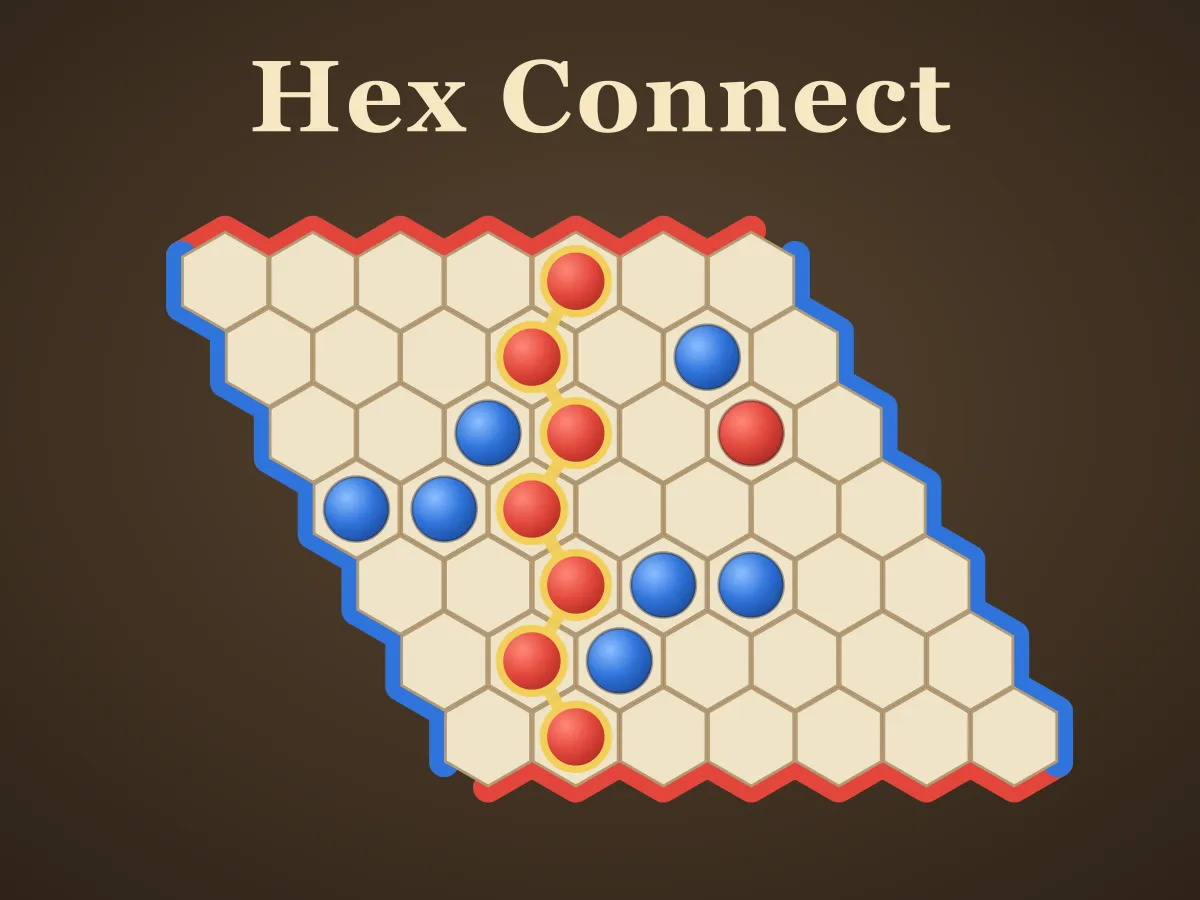






Hex Connect is the classic Hex board game against the computer. Take turns placing stones on a rhombus of hexagons: you join the two red edges, the computer the two blue ones, and stones never move or get captured. A game of Hex can never end in a draw, so somebody always gets through. Climb seven levels from a 5×5 pocket board to the full 11×11 against four computer strengths, with the swap rule keeping the first move fair. Free in your browser, no download, and it works on phones.
How to play Hex Connect
- You play Red and must join the two red edges of the board; the computer plays Blue and must join the two blue edges. On a desktop the red edges are the top and bottom. On a phone held upright the board lies on its side, so they are the left and right — the coloured borders always show which.
- On your turn tap or click an empty hexagon to place a stone, or move the cursor with the arrow keys and press Enter. Stones stay where they are put: nothing moves and nothing is captured.
- With the swap rule on, the player who answers the first stone may swap instead of placing: that stone becomes theirs, reflected across the board, and the opener moves again. When the computer opens, a Swap button appears for you; when you open, the computer may swap a stone that is too strong.
- The first player to link their two edges with an unbroken chain of touching stones wins, and the winning chain lights up. Win with few stones on the board for two or three stars; using Undo or a Hint counts the win as one star. Each win opens the next level.
Tips
- Learn the bridge: two of your stones with two empty hexagons between them, both touching both stones. If the computer takes one of those two cells, take the other at once, and the pair can never be cut.
- A stone on the second row from your edge is already as good as connected to it while the two cells between it and the edge stay empty — answer an intrusion there the same way as a bridge.
- Block from a distance. A stone placed right against the computer's chain is easy to walk around; a stone a few cells ahead of it, in the way it wants to go, stops it far more often.
- There is no separate defence in Hex: a chain that blocks the computer's path is usually also most of your own. Prefer moves that do both.
- The centre is the strongest opening, which is exactly why the computer swaps it. Under the swap rule open a little nearer an edge, with a stone you would be happy to play either side of.
FAQ
Is Hex Connect free to play?
Yes. Hex Connect is completely free to play online with no download, no account and no in-game purchases.
Does Hex Connect work on mobile?
Yes. Tap a hexagon to place a stone. On a phone held upright the board turns on its side so the hexagons stay large enough to tap; your red edges are then the left and right ones, and the coloured borders always show which.
Can a game of Hex end in a draw?
No. Whatever order the stones go down in, a completely filled Hex board always contains exactly one winning chain, so one player always gets through — usually long before the board is full. That is the property that makes Hex such a clean game.
What is the swap rule in Hex, and should I keep it on?
Hex gives the first player a big edge. Between two equal computer players on the 7×7 board, the player who moved first won 65 of 80 games without the swap rule. With it, the answering player may take the first stone as their own instead of playing, so the opener has to choose a stone that is neither too strong nor too weak — and the first player then won 46 of 80. Keep it on for a fair game, or turn it off and move first for an easier one.
Who invented Hex?
The Danish mathematician and poet Piet Hein introduced the game in 1942, and the mathematician John Nash came up with it independently at Princeton in the late 1940s. Nash also showed that the first player must have a winning strategy, though nobody knows what it is on the full 11×11 board — the reason the swap rule exists.
How strong is the computer?
There are four strengths, Pebble, Brook, Ridge and Summit. Each one plays out random games from the position before it moves — from 120 per move for Pebble to 12,000 for Summit — and keeps the moves that won most often. Measured over 40 games a level with the Brook computer playing your side, it won nearly every game on the first two levels, seven in ten on level 3, a quarter on level 5, one in eight on level 6 and fewer than one in ten against Summit.
Does the computer cheat?
No. It sees only the stones on the board, the same as you, and its strength is a fixed number of played-out games per move, not a time limit, so it plays the same on a slow phone as on a fast computer.