






Home / Simulation / Power Wash
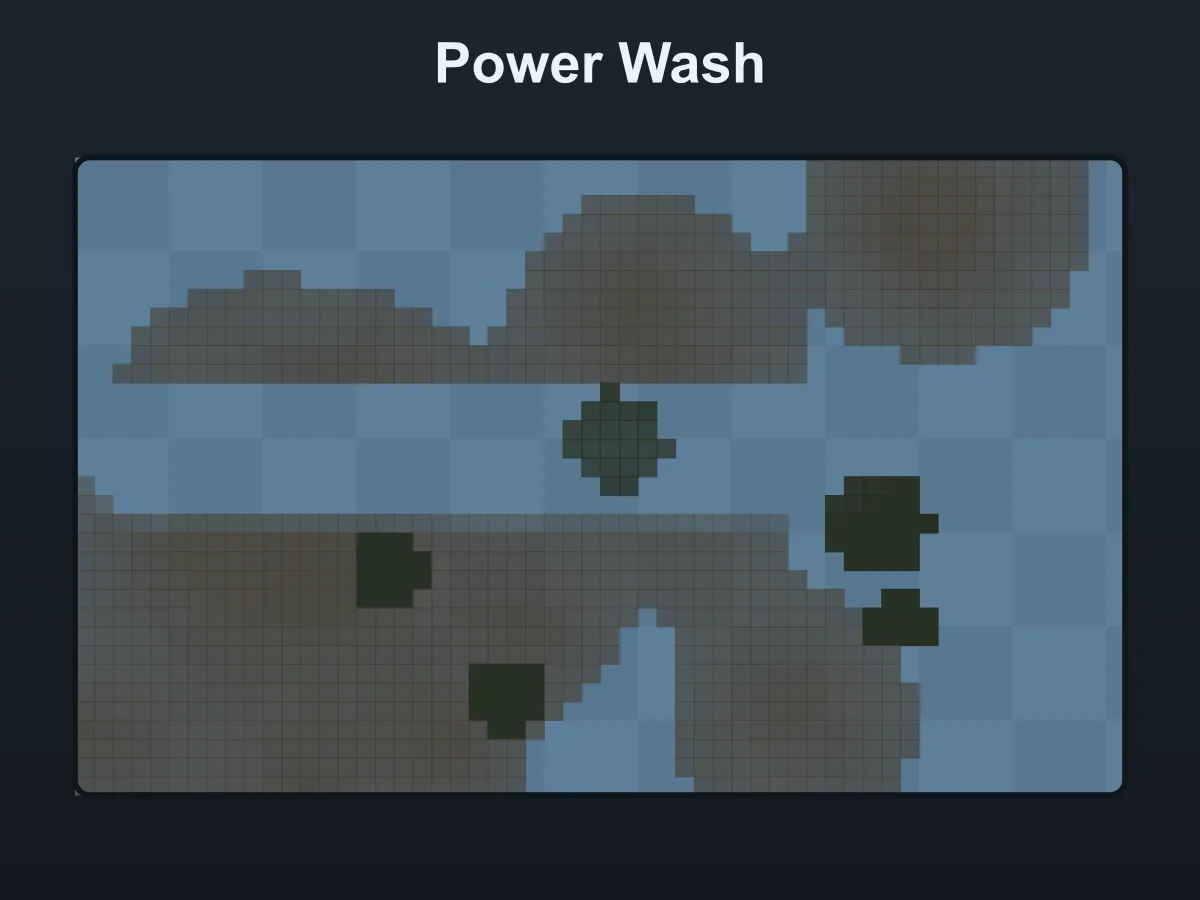
Power Wash is a free online cleaning game. Hold the pointer on a grimy surface and the spray takes the dirt off under it, spreading out from where you aim and fading at the edge of the cone. A meter fills as the surface comes clean and shows you exactly where the target sits, so you always know how much is left. Two nozzles, and choosing between them is the game: the fan is wide and gentle and clears open dirt several times faster, while the jet covers almost nothing and is the only thing that shifts the dark baked-on patches. Neither is better — a patch of caked grime will eat your whole clock on the fan, and jetting an open wall wastes it just as thoroughly. Six jobs from a back patio to a whole yard, each with more surface, more dirt and more baked patches than the last, and a clock that leaves less and less room for a wasted pass. The target is never 100%, because hunting the last few specks is not washing. No download, no account.
How to play Power Wash
- Press and hold on the surface to spray, and drag to move the nozzle. On a phone, hold a finger down and move it.
- The spray takes grime off wherever the cone lands, hardest at the middle and weakest at the edge.
- It is time that cleans, not movement — holding still on one spot works, and waving the pointer about does not make it faster.
- The bar at the top shows how much of the surface is clean, with a white line marking the target you have to reach.
- Fan is the default: wide, gentle, and much faster on ordinary dirt because it covers far more at once.
- Jet is narrow and fierce. It is the only nozzle that shifts the dark patches in any sensible amount of time.
- You can see which patches are baked on before you spray them — they are noticeably darker than the rest of the grime.
- Switch nozzles with the two buttons, or with the 1 and 2 keys.
- The job is done when the meter reaches the target. It is never 100%, so you never have to hunt the last few specks.
- If the clock runs out first the job fails, and Try Again gives you the same surface back.
- New Job generates a different layout of dirt on the same scene, with the same time.
Tips
- Sweep in overlapping rows rather than scrubbing back and forth. The cone is wide, and covering new surface is worth more than deepening a spot that is nearly done.
- Do the whole surface with the fan first, then go back for the dark patches with the jet. Switching for every patch as you meet it wastes more time than the patches cost.
- Look for the dark grime before you start. Knowing where the jet work is means you can plan the fan pass around it instead of discovering it late.
- Do not hold the fan on a baked patch hoping. It does move, just about ten times slower than the jet does — that is time you will want at the end.
- The cone is weakest at its edge, so aim the middle of the fan at the middle of a band of dirt rather than trying to catch two bands at once.
- Watch the white target line, not the percentage. You are finished when the bar reaches it, and the last stretch before it is the only part that matters.
- Corners and edges are easy to leave behind on a wide sweep. Do one pass round the border early, while there is time to spare.
- On the later jobs the spare time is thin by design — the margin shrinks every level — so a single wasted minute of jetting open dirt is the difference.
FAQ
Is Power Wash free to play?
Yes. It runs in the browser with no download, no sign-up and nothing to buy. All six jobs are included and unlock as you clear them.
What is the difference between the two nozzles?
The fan covers a wide area at low pressure and the jet covers a tiny area at high pressure. On ordinary dirt the fan clears far more surface per second simply because it touches more of it; on baked-on grime the jet is several times faster per patch. Neither is the better nozzle — that is the whole decision.
How do I know which dirt is baked on?
It is drawn noticeably darker than ordinary grime, and it is visible before you spray it. You are meant to plan around it rather than discover it by wasting a fan pass.
Does waving the pointer around clean faster?
No. Grime comes off with time, not with movement, so holding still on one spot works exactly as well as wiggling. That is deliberate: a game that rewarded waggling would be a wrist exercise, and it would also mean holding still on a stubborn patch achieved nothing.
Why is the target not 100%?
Because chasing the last few cells at the faded edge of a spray cone is pixel-hunting, not washing. The bar marks a target between 90% and 94% depending on the job, and reaching it finishes the job immediately.
Is every job actually finishable in the time given?
Yes, and it is measured rather than assumed. A deliberately unskilled bot — it sweeps in rows with the fan and only switches to the jet for what the fan gave up on — plays every job on several layouts in the tests, and the clocks are set from what it needs. The spare time it has left shrinks from a bit over double on the first job to about a third extra on the last.
How many jobs are there?
Six: a back patio, a garden wall, a work van, a shed roof, a stone statue and a whole yard. Each adds surface, dirt and baked-on patches, and the clock grows more slowly than the work does.
Does it work on a phone?
Yes. Hold a finger on the surface and move it to spray — the page will not scroll under your finger while you do. The nozzle buttons sit under the surface so they are always in reach.