


Blackjack is a free online card game you play against the dealer in your browser, with no download, no account and play money only. The goal is a hand closer to 21 than the dealer's without going over. Number cards count their face value, J, Q and K count 10, and an ace counts 11 or 1. Two cards totalling 21 is a blackjack and pays 3:2. The rules are fixed and stated plainly: the dealer stands on every 17, including soft 17, and peeks for blackjack under an ace or a 10 before you act; you can double down on any first two cards, including after a split; a pair of the same rank can be split once, and split aces take one card each. There is no insurance and no surrender. Each of the 15 levels is a bankroll session: start with 500 chips and reach the target, from 650 at the single-deck first table up to 1,700 at a 6-deck shoe, before the climbing minimum bet outruns your stack. It is a quiet place to learn basic strategy with nothing at stake.
How to play Blackjack
- Set your bet with the +/- buttons or the Min, 2x Min and Max chips, then tap Deal. You and the dealer each get two cards; the dealer's second card stays face-down.
- Number cards count as their face value, J, Q and K count as 10, and an ace counts as 11 or 1, whichever keeps your hand closer to 21 without going over. A hand with an ace still counted as 11 is called soft: A-6 is a soft 17.
- If the dealer shows an ace or a 10-value card, they check the face-down card first. A dealer blackjack ends the hand at once and only takes your original bet, so you never lose a double or a split to it.
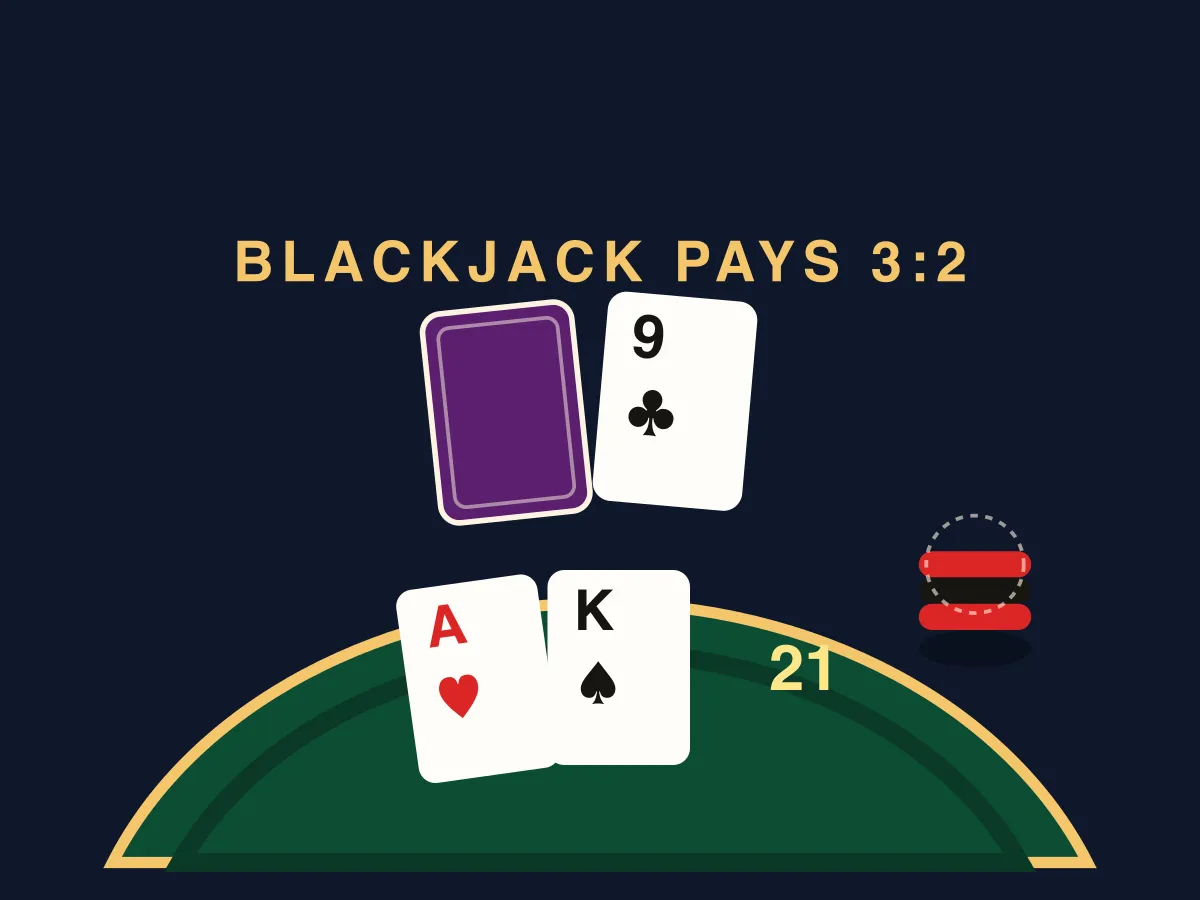
- If your first two cards total 21, that is a blackjack and pays 3:2 immediately, unless the dealer also has blackjack, which pushes and returns your bet.
- On your turn: Hit for another card, Stand to hold your total, Double to double your bet for exactly one more card, or Split a pair of the same rank into two hands, each with its own bet and a new second card. Double and Split only appear when they are legal and you have the chips to cover them.
- You can split once per hand and you can double on either split hand. Split aces get one card each and stand automatically, and an ace plus a 10 after a split counts as 21, paid 1:1, not a blackjack.
- Once you are done the dealer turns the hidden card and must hit on 16 or less and stand on 17 or more, including a soft 17. If every one of your hands has already busted, the dealer does not draw.
- You win 1:1 by finishing closer to 21 than the dealer or when the dealer busts; an equal total is a push. Going over 21 loses straight away, even if the dealer busts later.
- Every level starts you at 500 chips. Reach that level's target to clear it and unlock the next; drop below the next hand's minimum bet and the session is lost. The minimum bet rises by a quarter every six hands, so a session cannot stall forever.
Tips
- Stand on hard 17 or more and hit hard 8 or less, every time. Everything worth thinking about sits between those two.
- Hard 12 to 16 against a dealer 2 through 6: stand, because the dealer has to draw to a weak card and busts often. The one exception is 12 against a 2 or 3, which you hit.
- Hard 12 to 16 against a dealer 7 through ace: hit. It feels wrong to draw to a 16, but with no surrender here, standing on 16 against a 10 costs more over time than hitting it.
- Double 11 against every dealer card except an ace, 10 against 2 through 9, and 9 against 3 through 6. On the single and double-deck tables, doubling 11 against an ace is also right.
- Always split aces and 8s. Never split 10s or 5s: a 20 is already a winning hand, and a pair of 5s is a 10 you should double instead.
- Because you can double after splitting, split 2s, 3s and 7s against 2 through 7, 6s against 2 through 6, 4s only against 5 or 6, and 9s against 2 through 9 except a 7.
- Soft hands give you a free card, since an ace cannot bust you. Hit soft 17 or less unless it is a doubling spot, stand on soft 19 and 20, and with soft 18 stand against 2, 7 or 8, double against 3 to 6, and hit against 9, 10 or an ace.
- Double soft 13 and 14 against 5 or 6, soft 15 and 16 against 4 to 6, and soft 17 against 3 to 6. If you cannot cover the double, take the hit instead.
- Keep most bets near the table minimum early. The minimum climbs every six hands, so the chips you keep in the first dozen hands are what let you ride out a cold run later.
FAQ
How do you play blackjack?
You and the dealer each get two cards, with one of the dealer's face-down. You then hit for more cards or stand, trying to finish closer to 21 than the dealer without going over. Face cards count 10 and an ace counts 11 or 1. Once you stand, the dealer draws to 17 or more, and whoever is closer to 21 wins. A two-card 21 is a blackjack and pays 3:2.
What does the dealer have to do — hit or stand on 17?
The dealer plays by a fixed rule with no choices: hit on 16 or less and stand on any 17 or more, including a soft 17 such as A-6. Standing on soft 17 is the more player-friendly version of the rule. The dealer also checks for blackjack under an ace or a 10-value card before you act.
What does blackjack pay here?
A natural blackjack, an ace and a 10-value card as your first two cards, pays 3:2, so a 20-chip bet wins 30. Every other winning hand pays 1:1. If the dealer also has blackjack, it is a push and your bet comes back. A 21 made after splitting aces counts as an ordinary 21 and pays 1:1.
What is basic strategy in blackjack?
Basic strategy is the mathematically best hit, stand, double or split decision for every pairing of your hand and the dealer's up-card. It does not need memory or counting, just the chart. Its core: stand on 17 or more, stand on 12 to 16 against a dealer 2 to 6 except 12 against a 2 or 3, hit those hands against 7 or higher, and double 10 or 11 against weaker up-cards.
When should you double down in blackjack?
Double when one more card is likely to give you a strong total and the dealer is likely to struggle. Here that means 11 against anything but an ace, 10 against 2 through 9, 9 against 3 through 6, and soft hands such as A-7 against 3 through 6. You can double on any first two cards, including a split hand, as long as you have the chips to match your bet.
When should you split pairs in blackjack?
Always split aces and 8s, and never split 10s or 5s. Split 9s against 2 through 9 except 7, 7s against 2 through 7, 6s against 2 through 6, 2s and 3s against 2 through 7, and 4s only against 5 or 6. The two cards must share a rank, so a K and a Q cannot be split. You can split once per hand, and split aces get one card each.
How many decks does this blackjack game use?
It depends on the level. Levels 1 and 2 deal from a single deck, levels 3 and 4 from two decks, levels 5 to 7 from a four-deck shoe and levels 8 to 15 from a six-deck shoe, which is what most casino tables use. The level name in the header always shows the current deck count.
Is card counting possible in this game?
Yes, in principle. Cards are dealt from a shuffled shoe without being put back, and the shoe is only rebuilt when fewer than 20 cards remain, so what has already been dealt does change what is left. The effect is strongest on the one and two-deck tables. It makes a fair, risk-free place to practise a running count, since nothing here is real money.
Can I practise blackjack for free without money?
Yes. Every chip is play money. Each level starts you at 500 chips and they reset every session, so a busted bankroll costs nothing and you can replay the level straight away. There is nothing to buy, no prizes and nothing to cash out. It is practice for the decisions, not a gambling product, and it does not encourage real-money play.
Is there insurance or surrender?
No. This table offers hit, stand, double and split only. Insurance is rarely a good bet without counting, and the dealer's check for blackjack already means you can never lose a double or split to a dealer natural. Without surrender, the right play on hard 15 or 16 against a dealer 10 is to hit.
How many levels are there and how do I clear one?
There are 15 levels. Each starts at 500 chips and asks you to reach a higher target, 650 at level 1, 1,000 at level 8 and 1,700 at level 15, while the minimum bet starts between 20 and 50 and climbs by a quarter every six hands. Fall below the next minimum and the level is lost. Cleared levels stay unlocked to replay.
Does blackjack work on mobile, and are there other card games here?
Yes. Betting and every action is one tap, so it plays the same on phones, tablets and desktop. If you like tracking which cards are left, Higher or Lower deals one deck without replacement and shows the odds on every call, and Texas Hold'em Poker is heads-up play-money poker against one computer opponent.