
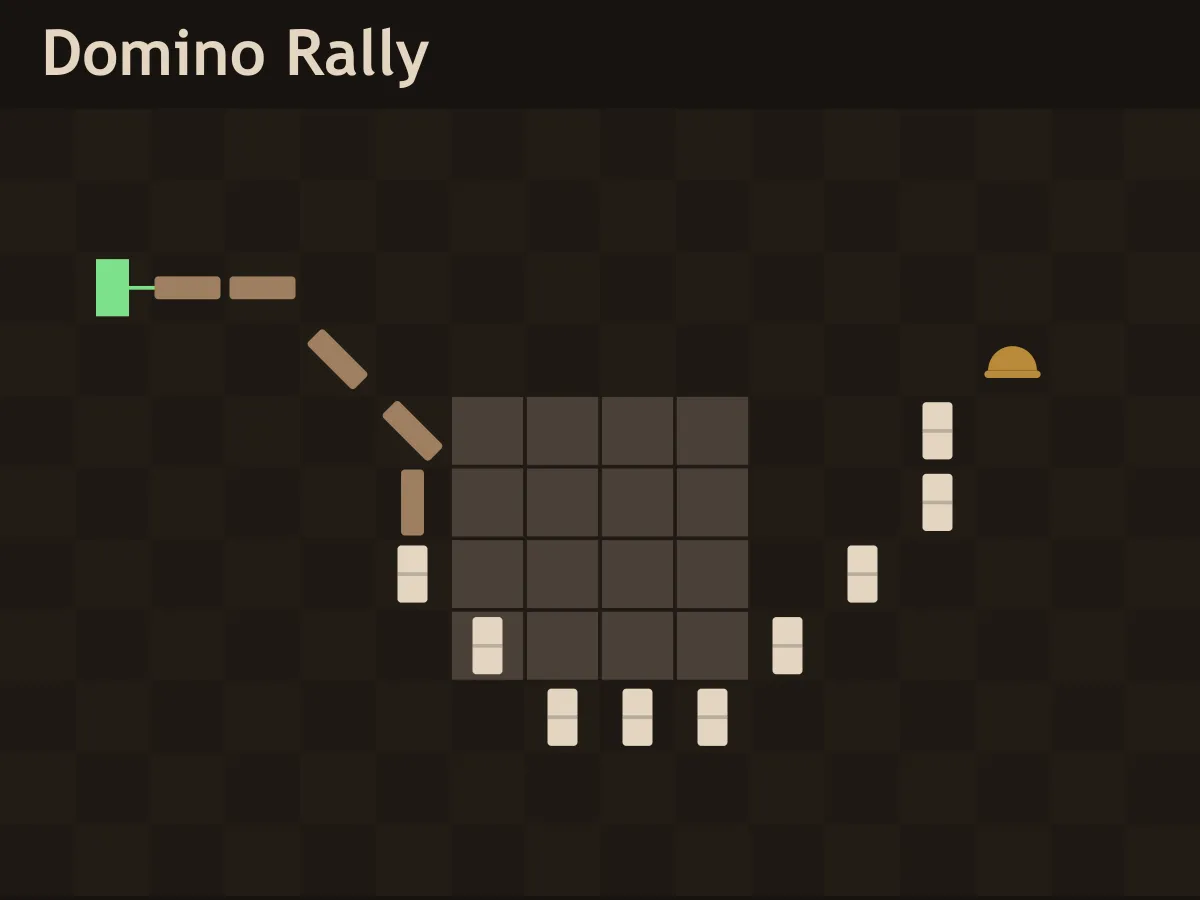







Domino Rally is a free online puzzle game about consequences: every decision is made before anything moves. You lay a run of dominoes across the floor, around the blocks, from the starting tile to the bells, out of a fixed supply — and then you press Go and the only thing left to do is watch. One rule turns that from a drawing exercise into a puzzle: a falling domino knocks over the three cells in front of it, straight on and the two diagonals, and each one it knocks falls along the line it was hit from. So a run turns corners by stepping diagonally, splits into two runs that both keep going, and never touches anything behind the wave. Laying a neat orthogonal path is the beginner’s move — it works, and it costs about a third more dominoes than the diagonal doing the same job, which is exactly why the supplies are tight. There are eight hand-written levels, each one a specific idea: a corner, a fan into two bells, a gate to thread, a staircase of gaps. They are hand-written because generated ones were tried and thrown away — a random scatter of blocks is either trivially open or accidentally sealed, and a sealed level is unsolvable with nothing on screen to say so. A solver checks every level in the test suite: each one is finishable, and the supply is set six or seven dominoes above the cheapest solution. That check earned its keep immediately, finding a level whose wall gaps needed the run to double back, which a chain that turns an eighth at a time can never do in a one-row corridor.
How to play Domino Rally
- Press Play. The green tile is where the run starts, and the line on it shows which way that first domino falls.
- Drag across the floor to lay dominoes. Tap one you have already laid to pick it back up.
- The counter at the top shows how many you have left. Each level gives you a fixed supply and no more.
- A falling domino knocks over the three cells in front of it: straight ahead and the two diagonals.
- Each domino it knocks falls along the line it was hit from, so stepping diagonally is how a run turns a corner.
- That also means a run can split: two dominoes side by side in front of one will both go over, and both halves keep travelling.
- Nothing behind the wave is ever touched, so a run cannot come back on itself.
- Ring every bell on the level to finish it. A bell rings when the wave reaches its cell — you do not need to lay a domino on it.
- Press Go when the run is built. Nothing you do after that matters, which is the point.
- Dominoes left over are worth points, but only if every bell rings, so a tight run beats a sprawling one.
- If the run stops short, stand them back up — the layout is kept — and mend the gap.
Tips
- Go diagonally wherever you can. A diagonal covers the same ground for about a third fewer dominoes than an orthogonal path, and the supplies are set assuming you found that out.
- Build from the green tile outward, not from the bell backward. The direction of the first fall decides everything downstream.
- For two bells, look for a single point where the run can fan. One split is far cheaper than two separate runs, and the supply usually only fits the split.
- Corners cost nothing extra: turning is just a diagonal step, so route around a block rather than trying to squeeze past it.
- A gap of one cell stops the whole run. When a topple ends early, the break is at the far end of the fallen dominoes — that is where to look.
- Spare dominoes pay only on a clean sweep, so there is no reward for a tidy run that misses a bell.
- Use Set up again rather than Clear. It keeps the layout, so you can fix one cell instead of rebuilding the run.
- Read the wave when it fails. The dominoes stay where they fell and point along the line they fell on, which tells you exactly where the chain went wrong.
FAQ
Is Domino Rally free to play?
Yes. It runs free in your browser with no download, no install and no account.
What exactly does a falling domino knock over?
The three cells in front of it — straight ahead and the two diagonals — and each one it knocks falls along the line it was hit from. That single rule is what lets a run turn corners and split in two.
How do I make the run turn?
Step diagonally. A diagonal neighbour is one of the three cells a domino knocks, and the new domino then falls along that diagonal, so a staircase of diagonal steps is a smooth turn.
Why do I keep running out of dominoes?
Probably because the run is orthogonal. Going straight then turning square costs roughly a third more pieces than the diagonal covering the same ground, and each level gives you about six spare over the cheapest solution.
Do I need to put a domino on the bell?
No. A bell rings when the wave reaches its cell, so the run only has to arrive next to it with the bell in front.
Can the run come back on itself?
No. A domino already down is never knocked again — without that rule two branches meeting head-on knocked each other over for ever and the wave never stopped.
Are the levels generated?
No, they are hand-written, and a solver in the test suite checks every one is finishable within its supply. Generated layouts were tried and thrown out: a random scatter of blocks is either trivially open or accidentally sealed.
What are the spare dominoes worth?
Forty or fifty points each depending on the level, and only when every bell has rung. A run that misses a bell scores nothing for what it saved.