
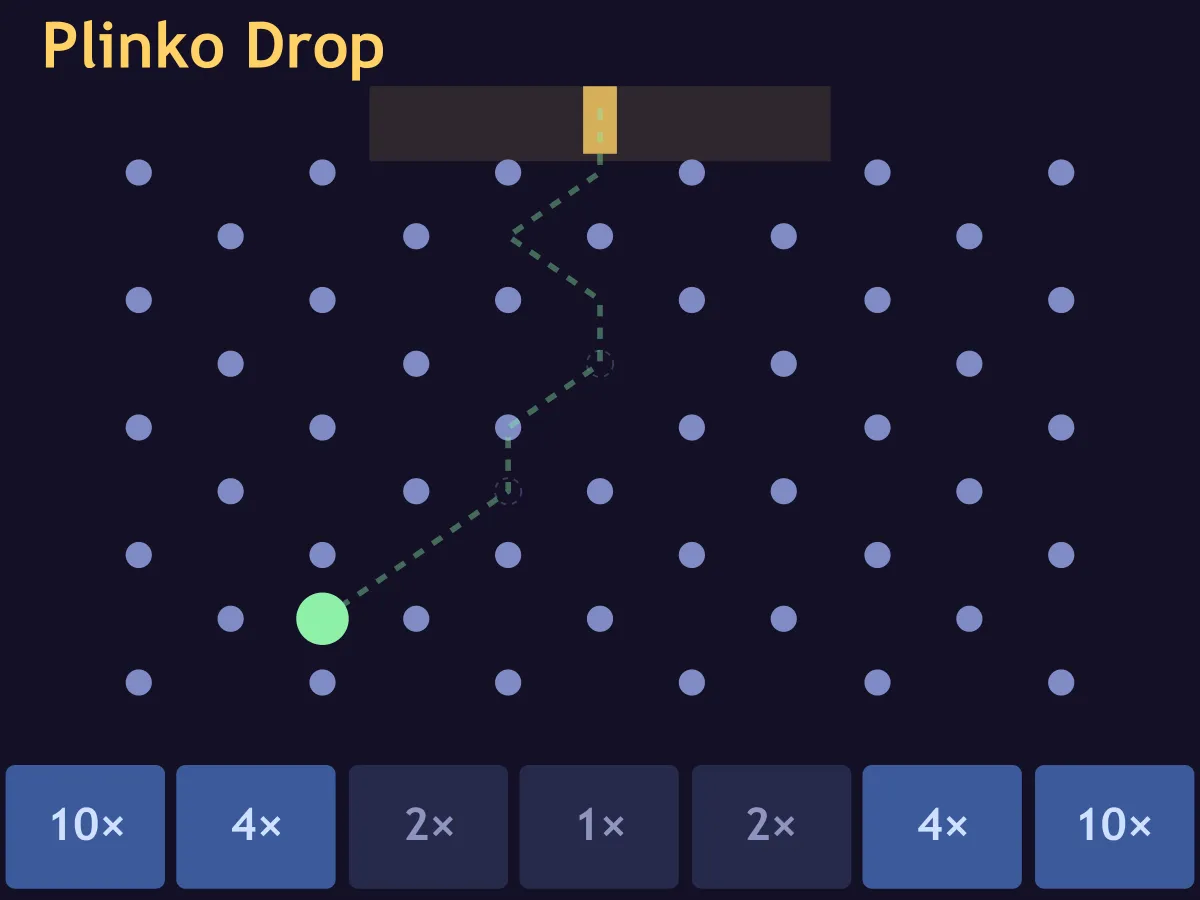







Plinko Drop is a free online peg board game with no money in it of any kind: no stake, no purchase, no payout, just points. Dropping a chip through pegs and watching it bounce is not really a game — it is a random number with an animation on it — so everything you actually decide here happens before the chip moves. You move the chute across the middle five columns, which shifts the whole spread of where the chip can end up. You pull pegs out of the board, three of them for the entire game, and a pulled peg stays out for good, so the board you play the last round on is the board your earlier rounds left. And when a chip lands you choose between banking what it won and spending one of your eight rounds dropping a second chip into the same pot. The chip itself is honest: a fixed-step simulation where every bounce comes from the seed and from the pegs the chip actually meets, one random stream per peg, so pulling one changes that bounce and nothing else. The slots are a real board’s shape — ten times at the edges, once in the middle, nothing worth zero — and from dead centre the measured spread over two hundred drops is 5, 13, 45, 68, 42, 17, 10, which is a bell with an edge about one drop in forty. That rarity is the whole point of the pulls: the edges are not somewhere you aim, they are somewhere you build a path to.
How to play Plinko Drop
- Press Play. The chip drops from a chute over the middle five columns of the board.
- Move the chute left or right with the arrows or the buttons. That shifts the whole spread of where the chip can finish.
- Click any peg to pull it out. You get three pulls for the whole game, and a pulled peg never comes back.
- Press Drop, or space, and the chip falls. Nothing you do after that touches it.
- Where it lands pays a multiplier of fifty: ten times at the outside edges, four and two further in, once in the middle.
- No slot is worth nothing, so a round always pays something. The question is how much.
- When the chip lands you have two choices: bank the pot, or spend another round dropping a second chip into the same pot.
- You have eight rounds in total, and going again costs one of them.
- Banking is always safe — nothing takes points away here, so going again is a choice about how to spend rounds rather than a gamble with what you hold.
- The game ends when the eighth round is banked. Your score is everything you banked.
Tips
- The edges are rare on purpose. From dead centre the measured spread is about one drop in forty landing in a ten-times slot, so treat them as something you build toward rather than something you aim at.
- Pull pegs directly under the chute. A pull on the far side of the board has almost no chance of being on the path your chip takes.
- Pulling a peg makes the chip fall straight through that spot instead of bouncing, so two pulls in the same column can open a clear run.
- Moving the chute one column across shifts the whole distribution — from the outer chute columns the chip reaches an edge far more often, at the cost of the middle.
- Save a pull for late. The board keeps every pull you made, so the last rounds are played on a board you have been shaping all game.
- Going again doubles down on a good board, not on a good chip. If the pegs under the chute are gone, a second drop is worth more than the first.
- With no pulls left, the chute is the only thing you have. Use the outer columns when you need a big slot and the middle when a steady one will do.
- There is nothing to lose by banking, so bank whenever the rounds left are worth more than the pot in hand.
FAQ
Is Plinko Drop free to play?
Yes. It runs free in your browser with no download, no install and no account.
Is there any real money in this game?
None. There is no stake, no purchase, no payout and no currency of any kind — the slots pay points and the score is the total you banked.
Can I steer the chip once it is falling?
No, and that is the design. Everything you decide happens before the drop: where the chute sits and which pegs you have pulled. A chip you could steer would not be a Plinko board.
How do the pulls work?
Click a peg while aiming and it comes out of the board. You get three for the whole game and they never come back, so the board the last round is played on is the board the earlier rounds left.
Does pulling a peg change the rest of the path?
Only where you pulled it. Every peg has its own random stream, so a pull changes that one bounce and everything else behaves exactly as it would have. An earlier version drew one stream per round, which made a pull indistinguishable from re-rolling the whole drop.
Why can the chip not be dropped from the very edge?
Because it was, and it broke the board. A chip started against a wall stays near it, so aiming at the wall took the ten-times slot far too often and the rest of the board was decoration. The chute covers the middle five columns.
Why are there only seven slots on a thirteen-column board?
Arithmetic. A chip moves exactly one column per bounce, so after a fixed number of bounces its column has a fixed parity — with a slot on every column, six of the thirteen took zero chips in seven hundred and eighty drops. A Galton board has its bins every other position for the same reason.
Does Replay this board give the same drops?
Yes. Every bounce is drawn from the seed, the round and the peg, so the same seed plays out identically — which also means the pegs you pull make the same difference every time.