








Home / Puzzle / World Map Puzzle
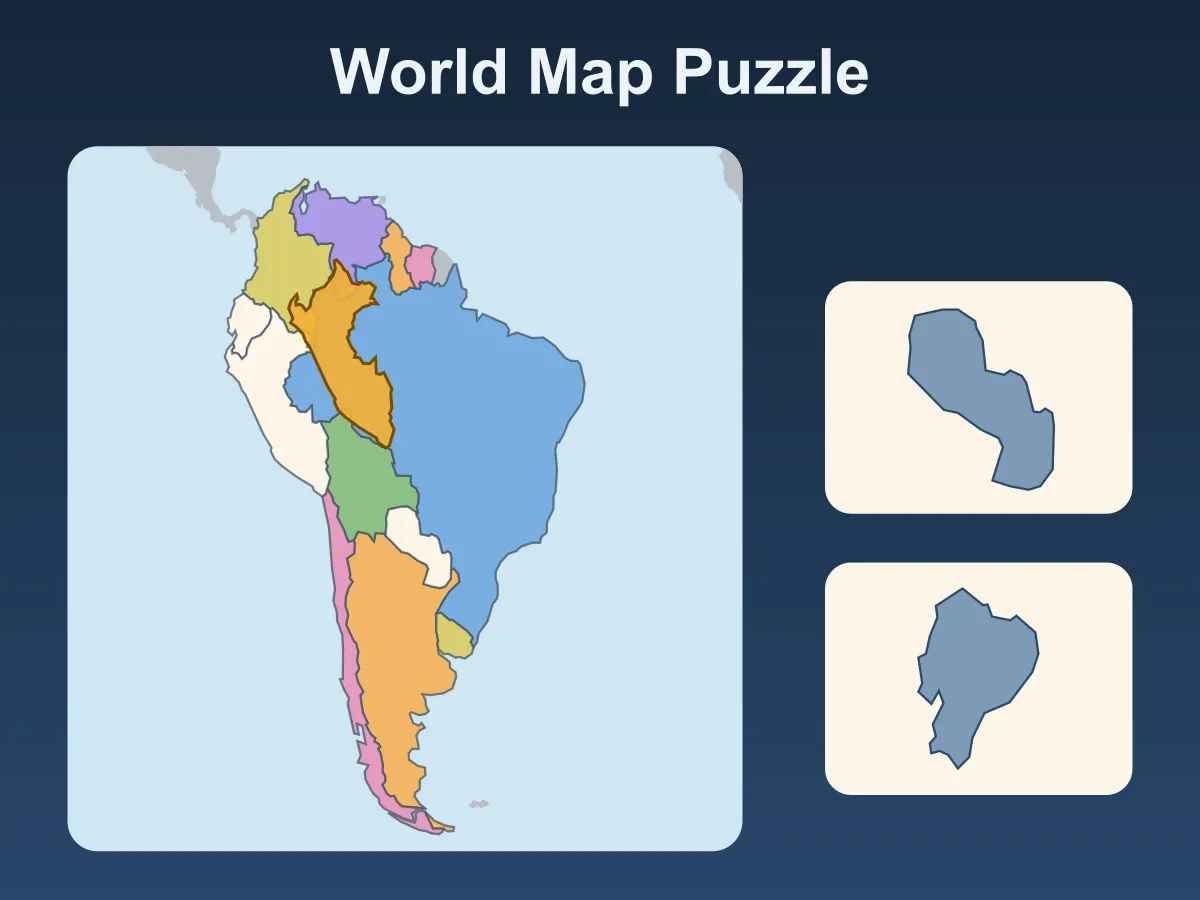
World Map Puzzle is a free online geography puzzle: the map of a region is laid out with every country an empty outline, and the countries themselves wait in a tray below it. Drag each one onto its place. Drop it close enough to where it belongs and it snaps in and takes its colour; drop it anywhere else and it slides back to the tray and counts as a miss — and if you dropped it on another country's place, the game tells you whose. Ten levels work around the globe — South America, East and South Asia, Southeast Asia and Oceania, Western Europe, North and West Africa, Central, East and Southern Africa, the Middle East and Central Asia, North and Central America, Eastern Europe and the Balkans — and the last one is the whole world, all 165 countries at once. Four pieces sit in the tray at a time, dealt in a shuffled order you can replay or reshuffle. Turn the names off and you place the silhouettes by shape and position alone. Stars reward knowing the map: two for keeping your misses down, three for doing it quickly too. You can also pick a country with a tap and then tap its place, or play with the keyboard. The borders come from Natural Earth, a public-domain world map, and follow its de facto lines; territories whose status is disputed are drawn as plain grey land and are never pieces. No download, no account.
How to play World Map Puzzle
- Each level shows one region of the world. Its countries are empty outlines on the map; everything else in view is grey land.
- The countries wait in the tray, four at a time. Drag one onto the map and let go over its place.
- If it lands close enough to where it belongs — on its own country, never a neighbour's — it snaps in and takes its colour, and the next country fills its slot in the tray.
- Let go anywhere else and it is a miss: the country goes back to the tray, and if you dropped it on another country's place the game names that country. Letting go off the map is not a miss.
- On a phone you can also tap a country in the tray to pick it and then tap its place on the map. A tap anywhere on the country counts. A dragged piece rides a little above your finger so you can see it; its centre is what lands.
- On a keyboard, keys 1 to 4 pick a tray country, the arrow keys move a ring between the empty places, and Enter drops the picked country on the ring. Escape puts it back.
- The ? button flashes where the picked country goes. You have three per level, and each counts as a miss.
- Names: Off hides the names in the tray, so you place each country by its shape alone. Tap a placed country with nothing picked to see its name.
- Two stars for finishing with few misses, three for doing it quickly as well. The result card tells you the time and misses three stars needs. Replay deals the same order again; New Order shuffles.
Tips
- Place the countries you are sure of first — the big ones and the coastlines. Every piece you place narrows down where the rest can go.
- Use the shape. A long coast, a boot, a panhandle or a country with no sea at all tells you a lot even with the names off.
- Small countries are placed by their centre, and a drop within a fingertip of it counts, as long as that is nearer their centre than any other empty place. Aim for the middle of the empty outline, not its edge.
- A long thin country — Chile, Norway, Vietnam — must be put down close to its middle, because a small miss there already lands on a neighbour, and a drop on a neighbour never counts. Tapping its place is easier: anywhere on the country will do.
- A miss on another country's place names that country. Use it: now you know one more place, and the one you are holding goes somewhere else.
- Save the hints for the countries you cannot find at all. Each costs the same as a miss, and three stars allow very few.
FAQ
Is World Map Puzzle free to play?
Yes. It runs in the browser with no download, no sign-up and nothing to buy. All ten levels are included and unlock as you finish them.
How many countries are in the puzzle?
Its 165 pieces are the United Nations member states that are big enough to draw on a world map at this scale. The smallest ones — Monaco, Singapore, Malta, the Maldives and other microstates and small island nations — are too small to show and are left out, so the whole-world level has 165 pieces rather than 193.
What are the levels?
Ten: South America; East and South Asia; Southeast Asia and Oceania; Western Europe; North and West Africa; Central, East and Southern Africa; the Middle East and Central Asia; North and Central America; Eastern Europe and the Balkans; and finally the whole world. The first nine use every country exactly once between them, and they get harder in stages: a casual player misses more often on each group of levels than on the one before.
How close do I have to drop a country?
Dragged, its centre has to land within a third of its mainland's narrower side from where it belongs — far-off islands do not count, so Alaska does not make the United States easier — and never less than about a fingertip on your screen. It also has to land on that country rather than a neighbour: Norway put down on Sweden, or Belgium on Luxembourg, is always a miss. Tapped, anywhere on the country's own outline counts. A country smaller than a fingertip can be hit within a fingertip of its centre, as long as no other empty place is nearer.
How do the stars work?
Finishing a level earns one star. Two stars need your misses (hints included) under the level's limit, and three need that and a fast time as well; the result card shows the numbers. They were set by simulated players of different skill, so that a confident player earns three and a casual one two.
Why are some areas grey?
Grey land is on the map but is not a piece. That covers every country outside the level you are playing, and a few territories whose status is disputed or that are not UN members — such as Western Sahara, Palestine, Taiwan, Kosovo, Crimea, Somaliland, Northern Cyprus, the Falklands and Greenland. They are drawn as plain land, without a name, so the puzzle takes no side on them.
Where do the borders come from?
From Natural Earth, a free public-domain world map, at its 1:110 million scale. The borders follow its de facto lines, simplified a little so the map stays light, and the map uses the Equal Earth projection, which keeps every country its true size relative to the others.
Can I play without the country names?
Yes. Press Names: Off and the tray shows only each country's silhouette, so you place it by shape and position. The choice is remembered. Tap a placed country with nothing picked and its name is shown.
Does it work on a phone?
Yes. Drag with a finger — the piece rides above your fingertip so you can see where it goes — or tap a country to pick it and tap its place. On a phone the regional levels are the best fit; on the whole-world level the map is small and the smallest countries are placed by aiming within a fingertip of their centre.
Is this the same as a geography quiz?
No. The Geography Quiz and Flags Quiz on this site ask multiple-choice questions. Here you build the map yourself, country by country, so it tests where each country is and what shape it has.