
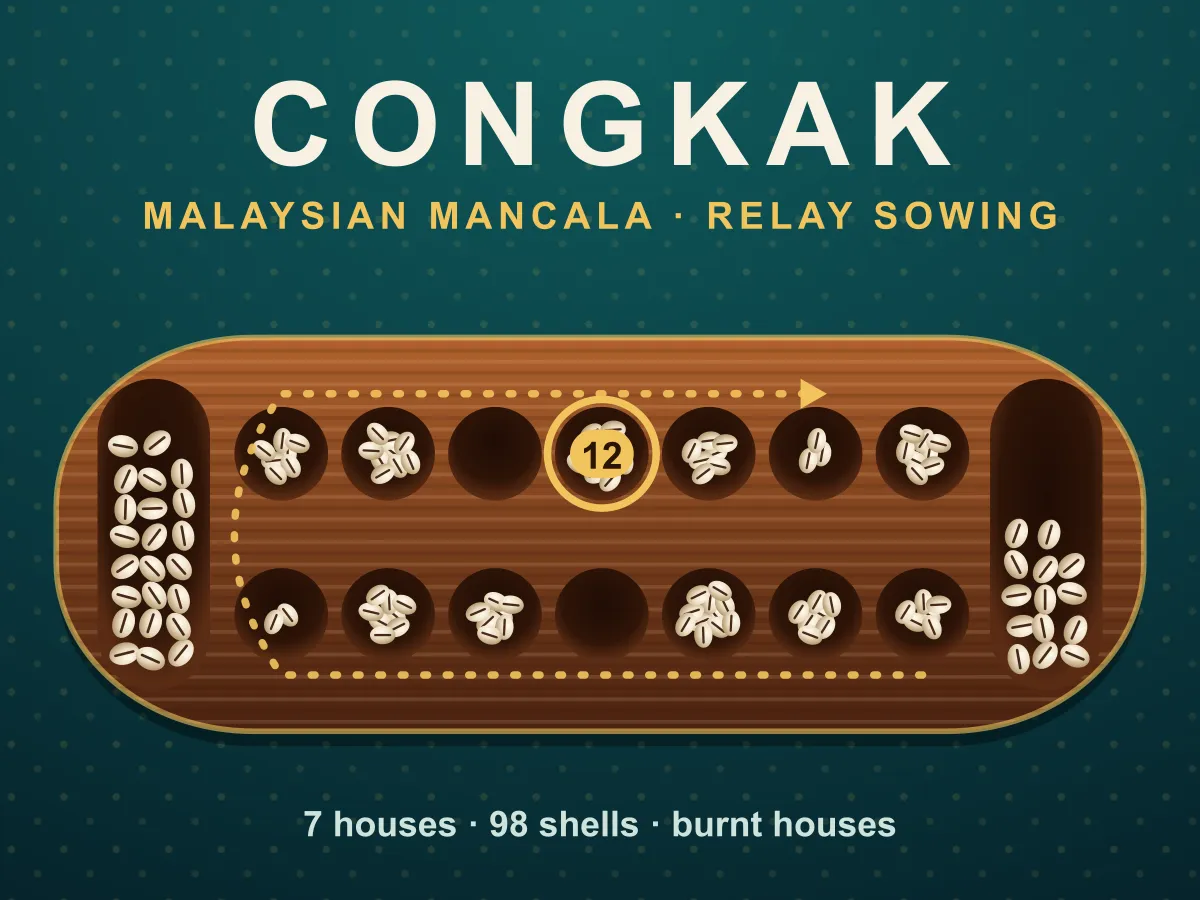
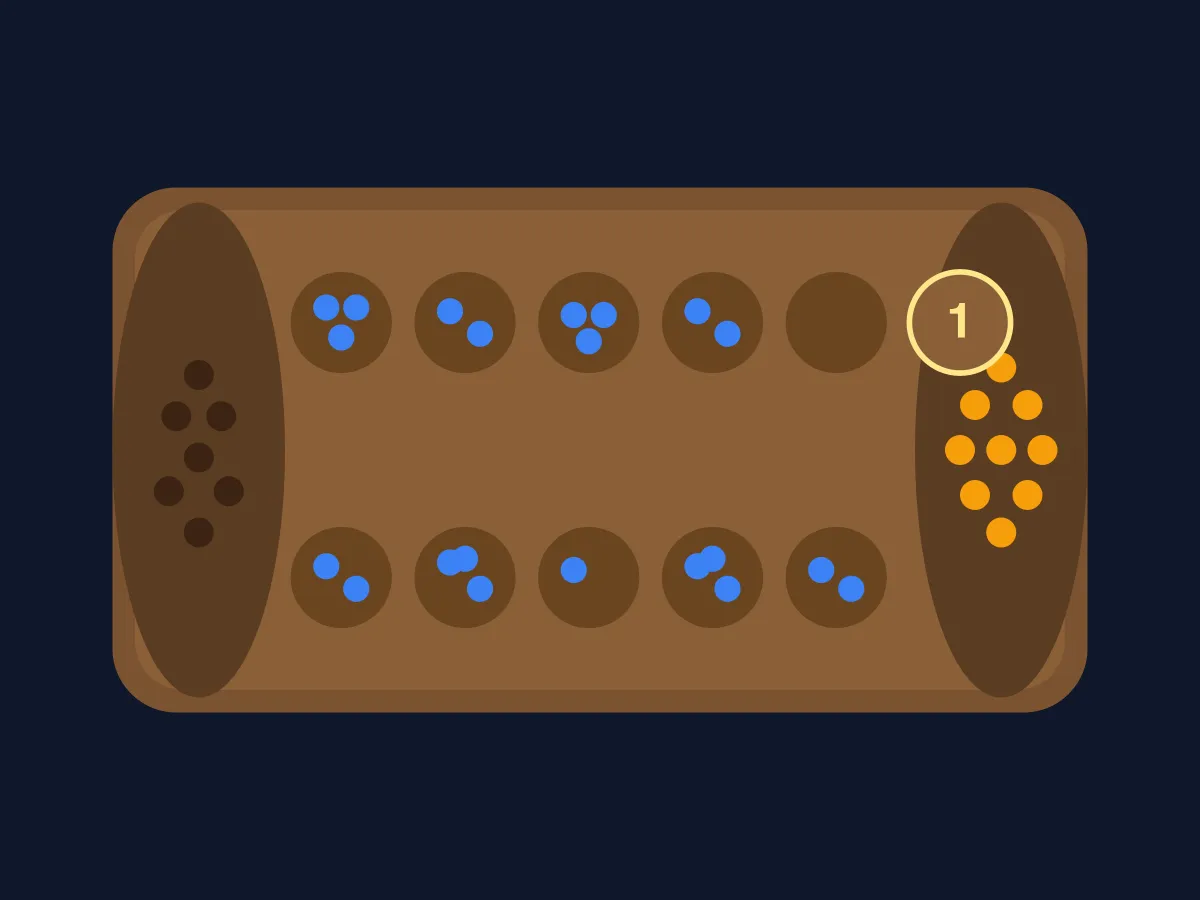


Congkak is the Malay and Indonesian mancala played on a long boat-shaped board, free to play online here with no download and no sign-up. Each side has seven houses of seven shells and a store on its left. Pick a house and sow its shells one at a time round the board, through your own store but never your opponent's. If your last shell lands in a house that already holds shells, you lift them all and keep going — a single sowing can lap the board again and again. End in your own store and you sow once more; end in an empty house of yours and you capture the house opposite. After each round the houses are refilled from the stores, and a player too short of shells to fill a house sees it burnt for the rest of the game. Five computer opponents, from a Newcomer to a Master that reads six sowings ahead, a hint button, undo, a fast-sowing switch and a one-round or three-round game.
How to play Congkak
- Your seven houses are the bottom row of the boat-shaped board, and your store is the long hollow on your left. The computer owns the top row and the store on the right. Every house starts with seven shells.
- Tap one of your houses. Its shells are lifted and sown one per place, clockwise: leftwards along your row, into your store, then along the computer's row and back round to yours. The computer's store is always skipped.
- Relay sowing: if your last shell lands in a house that already had shells in it, you pick up everything in that house and carry on sowing from there. A gold badge shows how many shells are still in your hand.
- If your last shell lands in your own store, you sow again from any of your houses. If it lands in an empty house on your side, you take that shell plus every shell in the house directly opposite into your store, and your turn ends. If it lands in an empty house on the computer's side, your turn simply ends.
- A round ends when the player whose turn it is has no shells left in their houses. Any shells still in a house go to that house's owner.
- For the next round each side refills its own houses seven shells at a time, starting from the house next to its store. A house that cannot be given seven is burnt: it stays empty and both players skip it from then on. The player who lost the round sows first in the next one.
- The game ends after the rounds you chose — one or three — or as soon as a player cannot fill a single house. Whoever holds more of the 98 shells wins; 49 each is a draw. Beat an opponent to unlock the next one.
Tips
- Count before you sow. A house holding exactly as many shells as it is places from your store — seven for the house at the far right, one for the house next to your store — ends in your store and earns another sowing. Play those first, nearest the store first, so the earlier sowing does not add a shell to the later one.
- Hover or tab onto a house to see where its whole sowing finishes, relays included: a white ring marks the last place, and a green ring marks the house you would capture.
- Captures come from your own empty houses. Before you sow, look at which of your houses are empty and how full the houses opposite them are — that is where the big hauls are.
- Shells left on your side count for you when the round ends, so keeping full houses late in a round is not wasted; but full houses are also exactly what your opponent captures. Empty the houses facing their empty ones first.
- In a three-round game the first round matters most. Every seven shells you are short at the end of it is a burnt house for the rest of the game, and a burnt house is one fewer place to land a capture.
- Use the Fast switch or Skip once you know what a long relay will do — the game has already decided the result, the animation only shows it.
FAQ
Is Congkak free to play?
Yes. Congkak is free to play in your browser with no download, no account and nothing to buy. Your progress through the five computer opponents is saved in your own browser.
Does Congkak work on a phone?
Yes. Tap a house to sow it. On an upright phone the board stands on end with the two stores above and below the rows, so the houses stay big enough to tap; turned sideways it shows the full boat-shaped board.
How do you win Congkak?
By holding more shells than the computer when the game ends. Shells reach your store by passing through it while you sow and by capturing: when your last shell lands in an empty house on your side, you take it and everything in the house opposite. At the end of a round any shells left in your houses are yours too. A game is one or three rounds; it ends early if a player is left with fewer than seven shells and cannot fill a single house.
What happens when the last shell lands in a house with shells in it?
You lift every shell in that house and keep sowing from the next place along. This relay sowing is what makes Congkak different from most mancala games: one turn can travel round the board several times and change almost every house before it stops in a store or an empty house.
What is a burnt house in Congkak?
At the start of each new round both players refill their own houses with seven shells each from their store, beginning at the house next to the store. If you run out before reaching the last houses, those houses are burnt: they stay empty for the rest of the game and nobody sows into them. Shells left over stay in your store.
Which Congkak rules does this game use?
The seven-house rules described in Wikipedia's article on Southeast Asian mancala (where the Congkak entry redirects): seven shells in each of fourteen houses, clockwise sowing through your own store, relay sowing, another sowing when you end in your store, a capture of the opposite house when you end in an empty house of your own, and burnt houses in later rounds. Two simplifications: traditionally both players make their very first sowing at the same moment, and here you take turns from the start; and a game is one or three rounds rather than open-ended, because evenly matched players can otherwise go on for dozens of rounds.
How is Congkak different from Mancala (Kalah) and Oware?
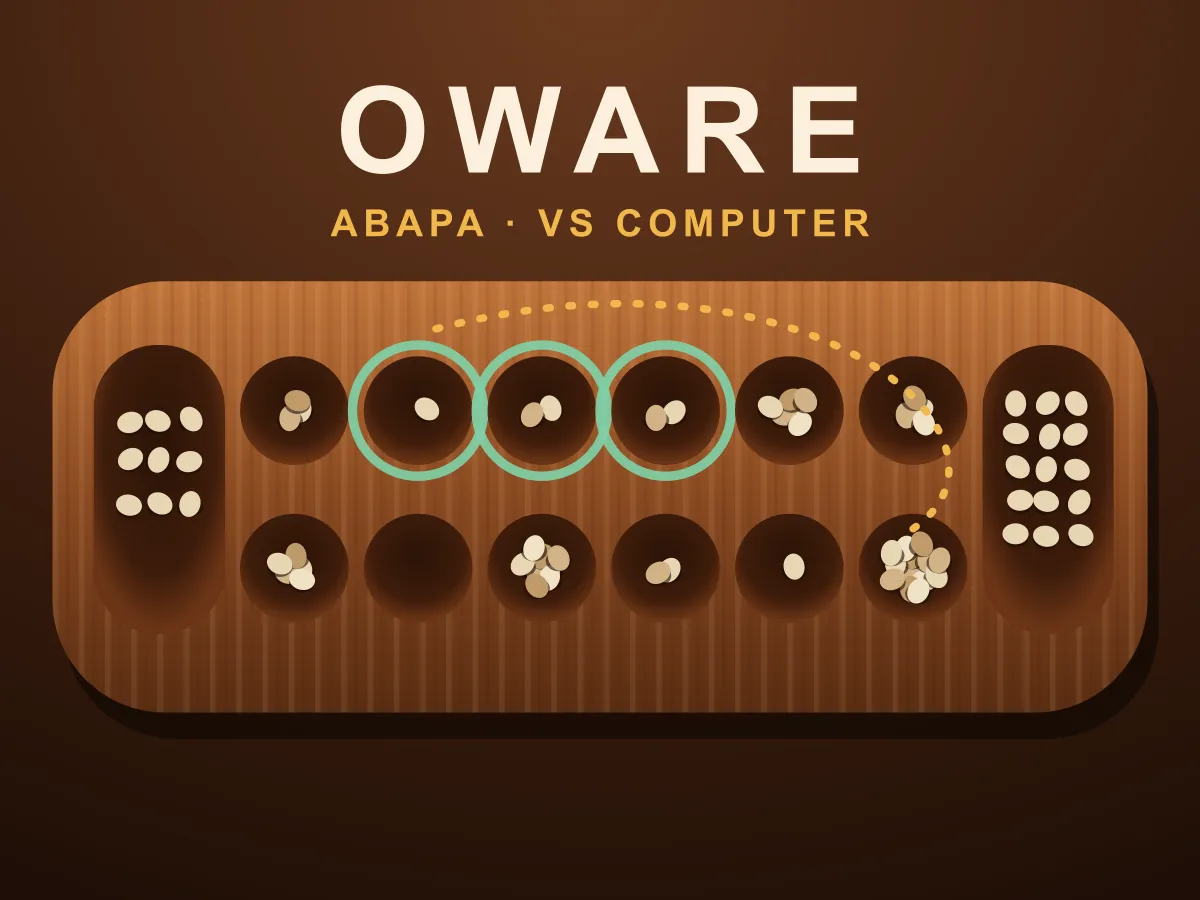
The Mancala game on this site is Kalah: six houses a side, every sowing stops where the last seed falls, and a capture takes the house opposite your empty one. Oware has no stores on the board and captures houses on the opponent's side that reach two or three. Congkak has seven houses, relay sowing that keeps going from any full house, a sow-again for ending in your store, and rounds with burnt houses — so turns are far longer and much harder to read ahead.
Is Congkak the same as Sungka?
They are the same family. Congkak (also spelled congklak or dakon in Indonesia) and Sungka from the Philippines are both two-row mancalas with seven houses a side, two stores and relay sowing, and most of their rules match. Local rules differ on details such as the opening and how burnt houses work; this game follows the Congkak rules named above.
Does it matter who sows first in Congkak?
Less than you might think, and not consistently. With the same bot playing both sides of 500 one-round games, the side that sowed first won 269 and the side that sowed second won 209, with 22 draws; with the stronger Navigator playing itself 200 times, the second sower won more — 113 to 87. So this game simply alternates who opens from one game to the next, and in later rounds the player who lost the previous round opens.
How strong are the computer opponents?
Measured over 400 one-round games each, with the seats swapped so both sides sow first equally often: the Newcomer wins 32% against a player who always grabs the most shells on offer, and each opponent then beats the one before it — the Sower 92% of the time, the Trader 74%, the Navigator 63% and the Master 56%. The Master wins 99% of its games against that greedy player. The Hint button uses the Master's own search.