
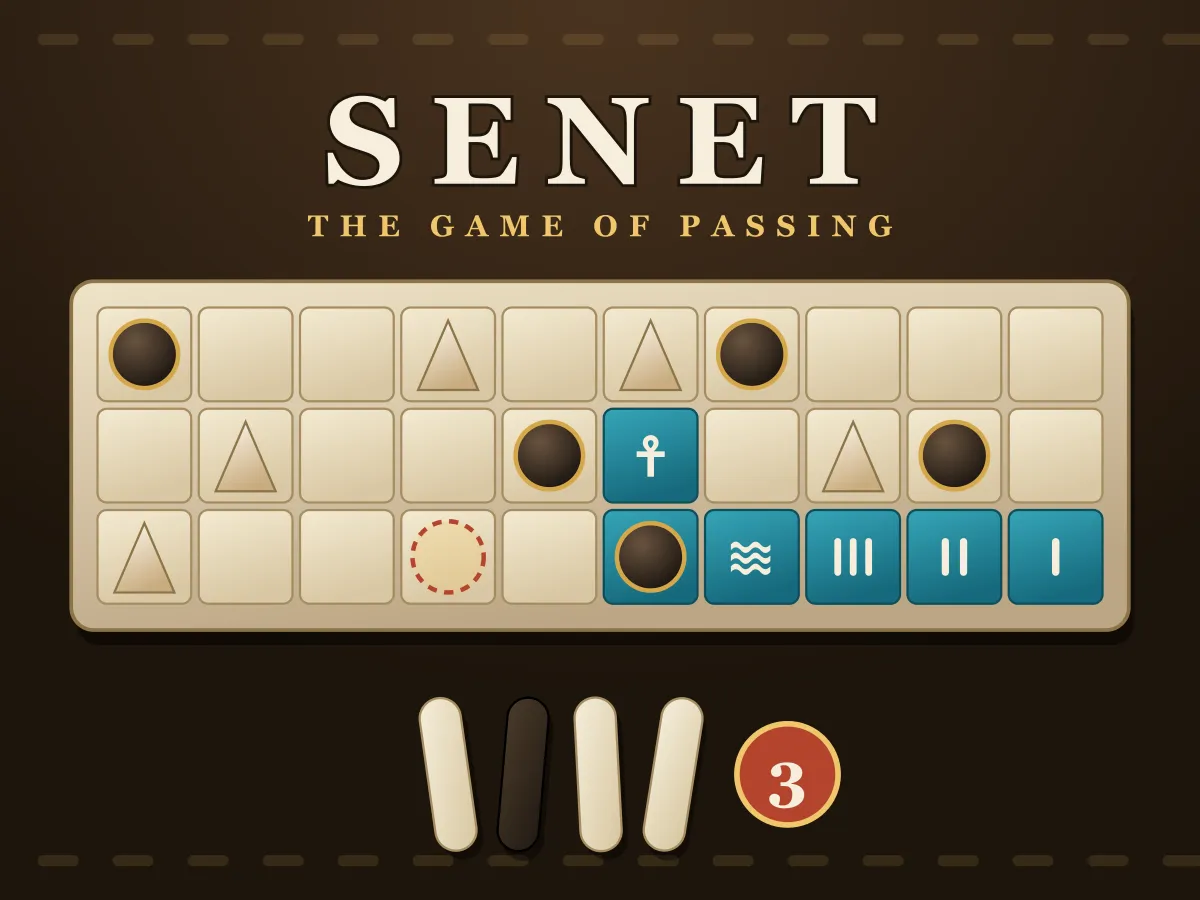



Senet is the board game of ancient Egypt, and you can play it online free here against a computer opponent, in your browser, with no download and no sign-up. Throw four flat sticks to move, run your five pieces along thirty houses laid out as an S, swap places with any lone rival piece you land on, and build walls of three that the other side cannot pass. Every piece must stop on the House of Happiness, may be washed back by the House of Water, and leaves the board only on an exact throw. The rules follow Timothy Kendall's 1978 reconstruction, the version most modern sets play, with a seven-piece variant and five opponents from Apprentice to Pharaoh. It plays the same on a phone, a tablet or a desktop.
How to play Senet
- You play the light cones and throw first. Tap the four sticks (or press Space) to throw them: the number of sticks landing light side up is your move, and all four dark counts as 5.
- Tap one of your glowing pieces to move it forward by the throw along the S-shaped track — houses 1 to 10 left to right, 11 to 20 back, 21 to 30 forward again. A dashed ring marks where it will land.
- You cannot land on your own piece. Land on a single rival piece and the two swap places; a piece standing next to one of its own side is safe, and three in a row form a wall nothing can pass.
- A throw of 1, 4 or 5 earns another throw straight away. A 2 or a 3 hands the sticks to your opponent. If no piece can move forward you must move one backward, and if nothing can move at all the throw is lost.
- Every piece must stop on House 26, the House of Happiness. A 1 from there drops it into House 27, the House of Water, which washes it back to House 15, the House of Rebirth.
- Pieces on Houses 28, 29 and 30 leave the board only on an exact 3, 2 or 1, and a piece on House 26 can leave directly on a 5. Bear all five of your pieces off before the computer does to win the level and unlock the next opponent.
Tips
- Keep your pieces in pairs. A piece with a friend beside it cannot be swapped, so moving the back piece up to join the front one is often worth more than racing ahead alone.
- Three of your pieces in a row is a wall the other side cannot move past. Building one in front of the rival's trailing pieces can freeze them for several throws.
- Plan the approach to House 26. Nothing may pass it, so a piece on House 21 to 25 needs exactly the right throw — getting several pieces there at once wastes throws.
- Count the odds: a 2 comes up six times in sixteen, a 1 or a 3 four times each, and a 4 or a 5 only once each. Leave a lone piece one or three houses ahead of a rival and it is the likeliest to be swapped.
- Think before you step off House 26 on a 1. It is the only way into the House of Water and sends the piece back to House 15, so move a different piece if you have one.
FAQ
Is Senet free to play?
Yes. Senet is completely free to play online here, with no download, no account and no in-game purchases. It runs in any modern browser.
Does this Senet game work on mobile?
Yes. On a phone held upright the board stands on end in three columns of ten with the sticks beside it, and turned on its side it lies flat. Everything is tap to play, and on a keyboard Space throws, H asks for a hint and N starts a new game.
What are the rules of Senet?
No rulebook survives from ancient Egypt, so every modern Senet game plays a reconstruction. This one follows Timothy Kendall's 1978 reconstruction, the one most sets sold today use: thirty houses walked as an S, four throwing sticks worth 1 to 5, another throw on a 1, 4 or 5, swapping places with a lone rival piece, walls of three, the House of Happiness every piece must stop on, the House of Water that sends a piece back to House 15, and exact throws to leave from Houses 28, 29 and 30. Other reconstructions, such as R. C. Bell's, differ in several details.
How do you win at Senet?
The first side to take all of its pieces off the board wins. Pieces leave only on an exact throw — 3 from House 28, 2 from House 29, 1 from House 30, or 5 straight from House 26 — so the endgame is about getting pieces onto the right houses rather than simply racing.
How strong is the computer opponent?
There are five levels: Apprentice, Scribe, Priest, Vizier and Pharaoh. Each was measured over 1,000 games against a player who simply takes any swap on offer and otherwise moves their leading piece, with every pair of games played twice with the seats swapped so both sides got the same throws. The Apprentice wins 38.6% of those games and the Pharaoh 70.9%, and each level beats the one below it head to head.
Is going first an advantage in Senet?
Yes, and it is measurable. The side that throws first also starts one house further along on every file, and when two identical computer players face each other the first side wins about 60% of the time. You always play the light pieces and throw first here, so the opponents are rated with that edge already in your favour.
What is the seven-piece variant?
Some sets and accounts of Kendall's rules give each side seven pieces instead of five, filling Houses 1 to 14 at the start. Choose "7 pieces" from the menu under the board for a longer, more crowded game where walls are easier to build and harder to get past.
How old is Senet?
Senet is one of the oldest board games known. Boards and pictures of it go back to around 3100 BC, and it was still played more than two thousand years later — Tutankhamun was buried with several Senet sets. Over that time it also took on a religious meaning, with the board read as the soul's journey through the afterlife, which is where house names like Rebirth, Happiness and Water come from.