



Home / Board / Racing Kings Chess
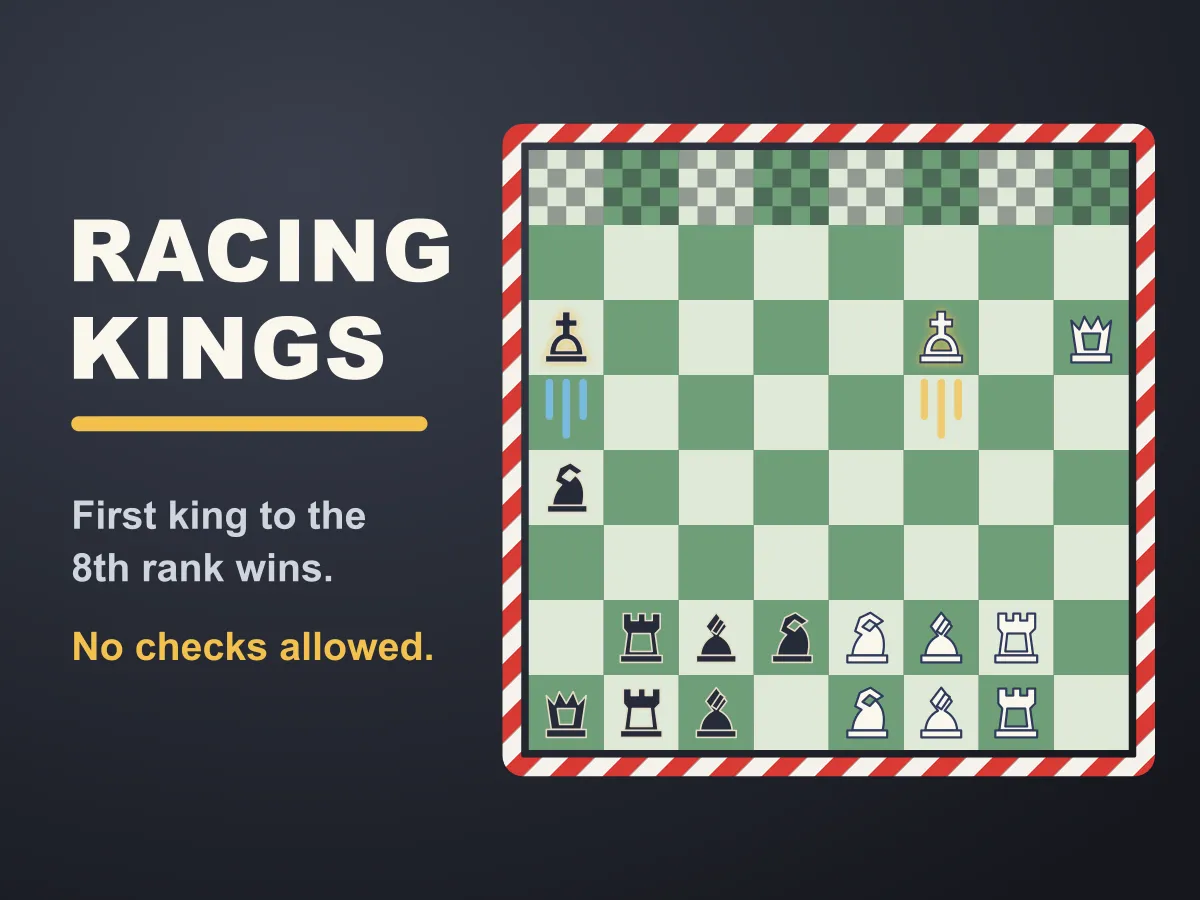
Racing Kings is the chess variant where nobody tries to checkmate. There are no pawns, both armies start side by side on the first two ranks, and the first king to reach the 8th rank wins. The twist is that no move may give check, so you cannot simply attack the other king: you block its path with your pieces, take its escorts and step past it. Because White moves first, Black gets one last move to reach the top row too and save a draw. Play it here against the computer at five measured levels, as White, Black or alternating, with hints, undo and a race meter that counts each king’s steps to the finish. Free in your browser, no download.
How to play Racing Kings Chess
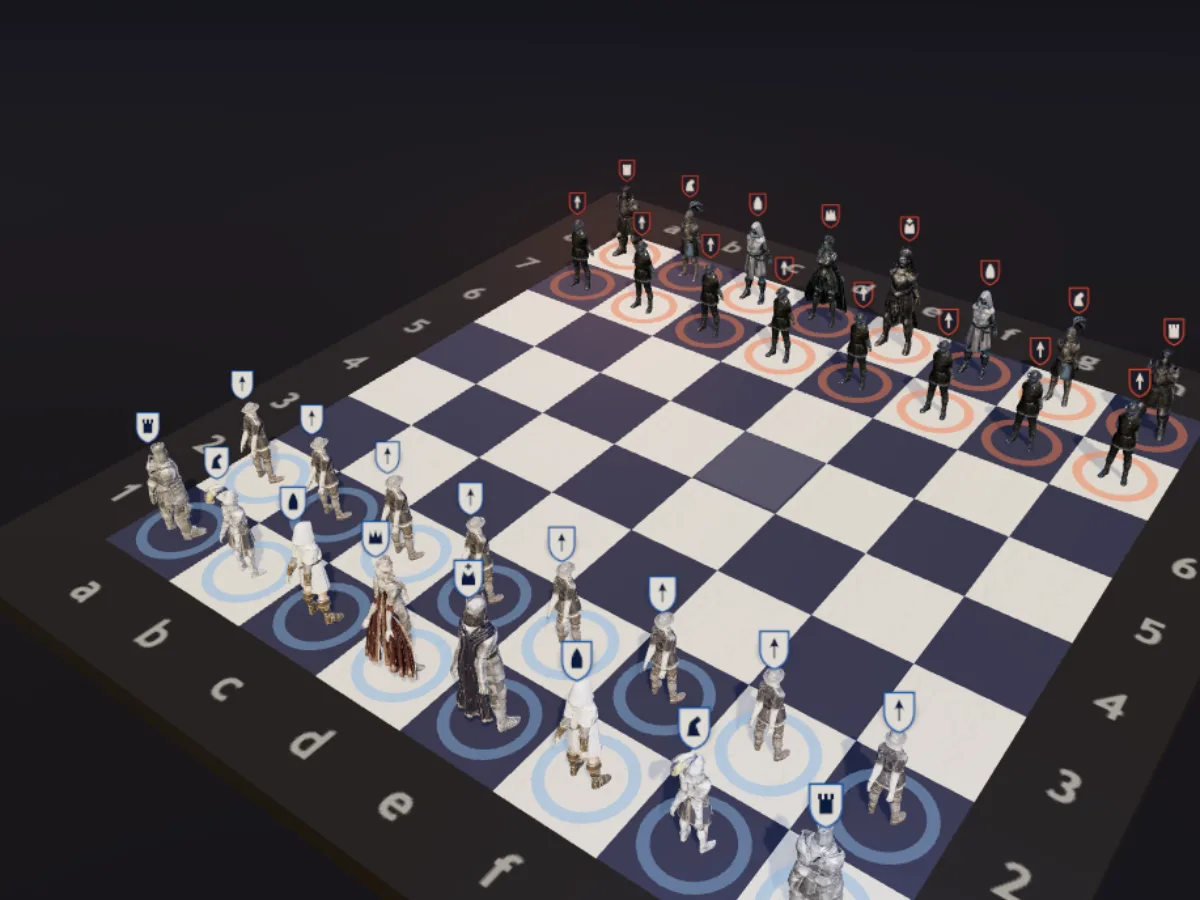
- Choose a computer level and whether you play White, Black or alternate colours, then press Start race. Every game starts from the same position: no pawns, Black’s pieces on the a- to d-files and White’s on the e- to h-files, both on ranks 1 and 2, with the kings on a2 and h2.
- Pieces move exactly as in chess — king, queen, rooks, bishops and knights — and capture as in chess. There is no castling, and with no pawns there is no promotion or en passant.
- The one big rule: no move may put either king in check. A move that would attack the other king is not allowed, and neither is a move that leaves your own king attacked. If you try one, the game tells you why it was refused.
- Race your king up the board. The first king to stand on the 8th rank — the chequered finish line along the top — wins the game.
- White moves first, so when White’s king reaches the 8th rank, Black gets one more move. If Black’s king can reach the 8th rank on that move too, the game is a draw; if it cannot, White wins.
- A game is also drawn if the side to move has no legal move (stalemate), if the same position comes up three times, or after fifty moves each with no capture.
- The race meter under the board counts how many king steps each side still needs over squares the other side does not attack. Hint suggests a move and Undo takes yours back; either one turns the game into practice, left out of your record.
Tips
- Count steps, not pieces. From the start both kings need six moves to reach the top. Every move you spend elsewhere is a move the other king gains — so a capture is only good if it saves you more than one tempo or costs the other king more.
- Your pieces are roadblocks. Since nobody may give check, the way to slow a king down is to control the squares in front of it: a rook along the 6th or 7th rank, or a queen across the board, can force a long detour.
- Remember what you cannot do. A piece that would attack the enemy king may not move there, so the other king can stroll right past your queen. Plan blocks one row ahead of the king, not on it.
- As White, a one-move lead is not enough: Black gets a reply to draw. Aim to arrive with Black’s king still two steps away, or with every square it could reach on the 8th rank covered.
- As Black, stay level. If you can always reach the 8th rank one move after White, you have a draw in hand, and White has to take risks to stop you.
- Watch the race meter. When it says Blocked, every path for that king crosses an attacked square; the side that unblocks its own king first usually wins the race.
- Do not trade your queen cheaply. It is the piece that covers the most squares in front of the other king, which is worth far more here than its value in normal chess.
FAQ
Is Racing Kings free to play?
Yes. Racing Kings is free in your browser with no download, no account and nothing to buy. Your results against each computer level are kept in your own browser.
Does Racing Kings work on a phone?
Yes. Tap a piece, then one of the highlighted squares. On a phone held upright the board fills the width with the controls underneath, and turned sideways it sits beside them. A keyboard works too: arrow keys move a cursor and Enter picks a piece and a square.
What are the rules of Racing Kings?
There are no pawns, both sides start on ranks 1 and 2, and pieces move as in chess. No move may give check or leave your own king attacked. The first king to reach the 8th rank wins, except that if White gets there first, Black has one move to reach it too, which makes the game a draw. This page follows the rules as Lichess and Wikipedia state them; it is not affiliated with Lichess.
Why can’t I give check in Racing Kings?
Because the game is a race, not a hunt. If checks were allowed, one side could chase the other king back down the board forever. Banning them means the only way to stop a king is to block the squares in front of it, which is what makes the variant tactical. Here a refused move tells you whether it would have given check or left your own king attacked.
Who has the advantage, White or Black?
White moves first, which helps, and Black’s last-move reply only partly evens it out. When two copies of our level-3 computer raced each other from 200 openings, White won 105, Black won 86 and 9 were drawn — White scored 54.75%. That is why the page offers alternating colours by default.
How strong is the computer?
There are five levels, each measured against the one below over openings played twice with colours swapped. The Learner scores 78 of 80 points against a random mover and 51 of 80 against a simple king-first racer. Each level then beats the one below by a wide margin: the Jogger 80 of 80 points, the Runner 55.5 of 60, the Sprinter 38 of 40 and the Champion 22 of 24.
Who invented Racing Kings?
Racing Kings is usually credited to the British chess-variant inventor V. R. Parton, who published it in the early 1960s. Today it is best known as one of the variants offered on Lichess.
How is Racing Kings different from normal chess?
The goal changes completely: instead of checkmating the king, you race your own king to the far side. There are no pawns, no castling and no checks at all, and games are shorter: between our computer levels the median game lasts 30 moves, and half of them end between move 23 and move 43. Piece moves are the same, so if you know how a knight or a bishop moves you can start straight away.