












Home / Reaction / Stop the Meter
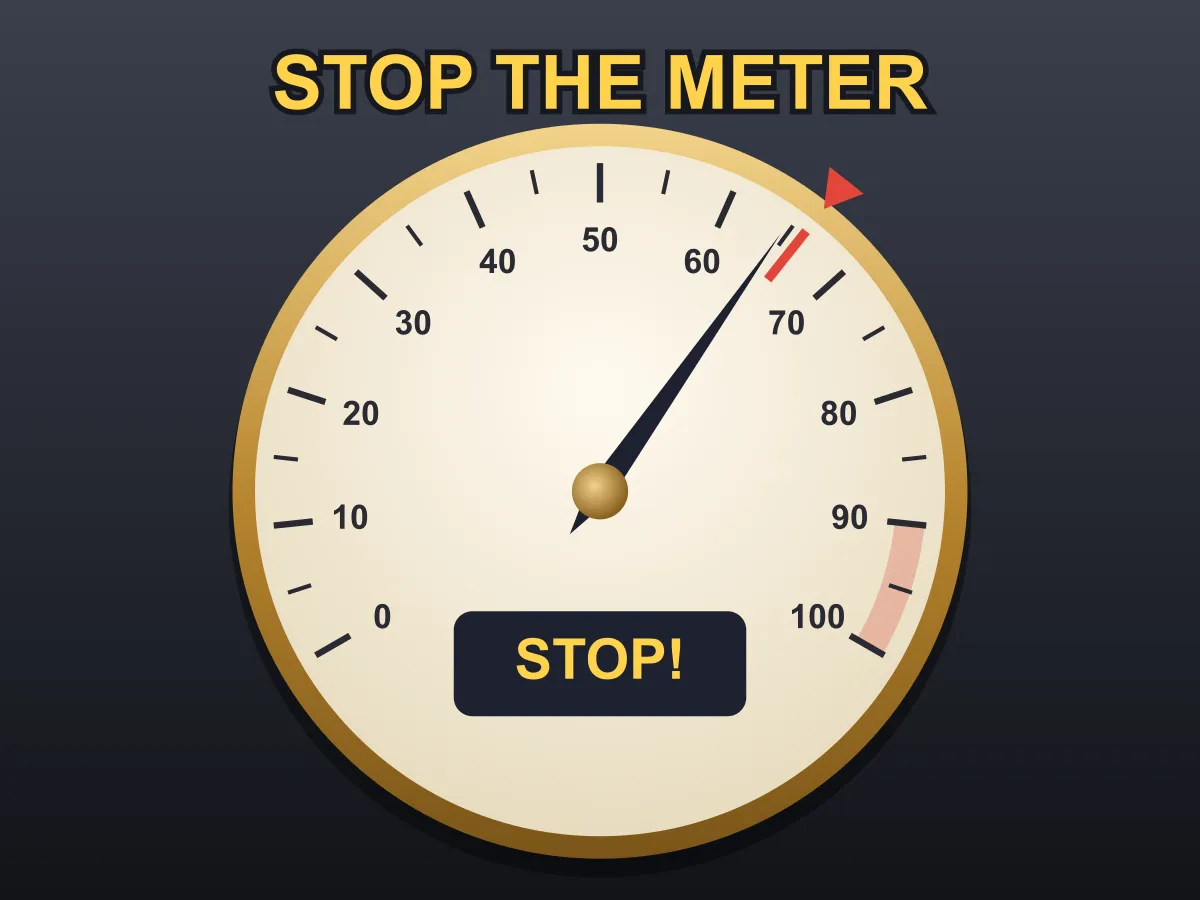
Stop the Meter is a free online timing game played on an old brass pressure gauge. Each shot puts a red mark on the dial, the needle climbs once from 0, and you tap or press Space to stop it as close to the mark as you can — let it reach 100 and the gauge bursts. There is no second pass to learn from, so every stop is judged on the way up. Twelve stages change how the needle moves: steady, revving, easing off, pulsing, ticking like a stopwatch and drifting, with covers that hide the last stretch. After each round it tells you whether you stop early or late on average. No download, no sign-up, and it plays on phones too.
How to play Stop the Meter
- Pick a stage and tap the gauge to start. Each round is eight shots, and each shot shows a red mark somewhere on a dial that reads 0 to 100.
- The needle rests at 0 for a moment, then climbs once. Tap the gauge, click, or press Space or Enter to stop it — there is only one climb per shot, so you cannot wait for it to come round again.
- The closer you stop to the mark, the more the shot pays: within half a unit is Perfect (100), within 1.5 is Great (60), within 3 is Good (30) and within 6 is Close (10). If the needle reaches 100 the gauge bursts and the shot scores nothing.
- Every stage moves the needle differently: steady, revving (speeding up), easing off (slowing down), pulsing in a steady beat, ticking 5 at a time like a stopwatch, and drifting at a changing speed. From stage 7 a grey cover can hide the dial just before the mark.
- After eight shots your score is counted. Reach the stage’s first mark to clear it and unlock the next; the second and third marks earn more stars.
- At the end of a round the game tells you how many milliseconds early or late you stopped on average, so you know which way to adjust.
- Press P to pause; switching tabs pauses too. A paused shot starts over from its rest when you go on, so nobody gets to study a frozen needle.
Tips
- Start your press before the needle reaches the mark. Your tap always lands a moment after you decide, so stopping “when it gets there” is already late.
- Read the needle on the first stretch of its climb. A revving needle that crawls at first will be flying by the top of the dial; an easing one does the opposite.
- Behind a cover, keep counting at the speed you last saw. A revving needle is still speeding up under there — stop a little earlier than feels right.
- On a ticking needle, aim for the middle of the tick that lands on the mark rather than the moment it lands. Stop one tick early or late and it is five units out.
- Pulsing needles surge and dawdle in a steady beat. Watch one surge go by and time your stop to the beat, not just to the climb.
- Use the average the game gives you at the end. If it says you stop 20 ms late, start your press that much sooner on the next round.
FAQ
Is Stop the Meter free to play?
Yes. Stop the Meter is free to play online in your browser, with no download, no account and nothing to buy. All twelve stages are here and unlock in order.
How is a stop scored?
By how far the needle stops from the mark, in dial units. Within half a unit is Perfect for 100 points, within 1.5 is Great for 60, within 3 is Good for 30 and within 6 is Close for 10. Anything further is a Miss, and a needle that reaches 100 bursts — both score nothing. A round is eight shots, so 800 is a perfect round.
What happens if I do not stop the needle?
It bursts. The needle climbs only once per shot, and when it reaches 100 the gauge bursts and the shot scores nothing. A press while the needle is still resting at 0 does nothing, so there is no false start to worry about.
What are the different needles?
Steady needles climb at one speed. Revving needles start slow and speed up; easing needles start fast and slow down. Pulsing needles surge and dawdle in a steady beat, ticking needles jump 5 at a time like a stopwatch, and drifting needles change speed with no pattern. Some shots also hide the dial around the mark under a grey cover.
How are the star scores set?
They are measured, not guessed. Three simulated players — a casual, a regular and a sharp one — watch the needle, judge when it will reach the mark from its speed, and press with a realistic timing error and a lean of their own. They play every stage 41 times. One star is the score four in five casual players reach, two stars is the regular player’s middle score and three stars the sharp player’s.
How is Stop the Meter different from Precision Stop?
In Precision Stop a marker slides back and forth along a bar, so you can watch it pass the zone a few times before you commit. In Stop the Meter the needle climbs a round dial once per shot and moves differently from stage to stage, so each stop is a single judgement of a needle you have only just met.
Is the timing the same whatever my screen’s frame rate?
Yes. The needle’s position is worked out from the exact moment of your press, not from the last frame drawn, so a 60 Hz phone and a 144 Hz monitor score the same press the same way.
Does Stop the Meter work on a phone or tablet?
Yes. Tap anywhere on the gauge to stop the needle — the press counts the instant your finger lands. The square gauge fits a phone held either way up.