







Illusion Path is a free online optical illusion puzzle about impossible geometry. You guide a small figure through isometric structures built out of blocks, and the trick is in the drawing: an isometric view flattens height into depth, so a platform standing a whole level higher can land on exactly the same line as the one under your feet. A walkway between the two looks perfectly flat and is not. Every level hangs on that. You cannot move the figure freely — tap any platform currently connected to yours and he walks there, and tap a handle to turn the arm it belongs to. Each arm carries exactly two walkways, one that gets you onto an island of blocks and one that gets you off it, so turning it early only strands you: you have to be standing on the island before the arm is any use. Eight structures, each one move longer than the last, and every one is walked through by the test suite along the shortest route a search can find. No download, no account, no timer.
How to play Illusion Path
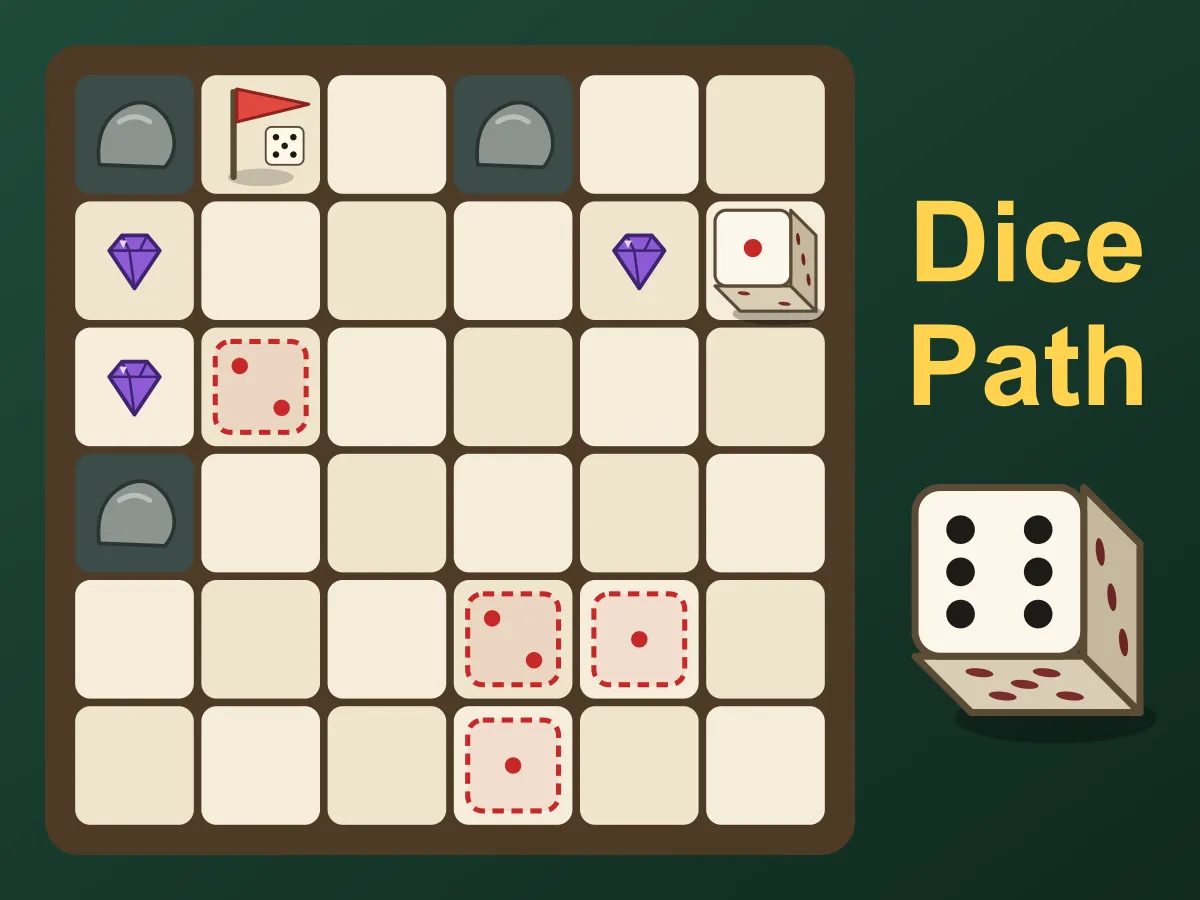
- Tap any platform outlined with a dashed diamond and the figure walks to it. Those are the platforms currently connected to the one he is on.
- A walk is one move however far it goes, so a long connected run costs the same as a single step.
- Tap a round handle to turn the arm it belongs to. That is also one move.
- An arm shows one walkway at a time and holds one or two others in reserve. Every walkway it is not showing is drawn as a dashed line, so you can see what turning will do before you do it.
- Some arms have a third position that shows nothing at all, so turning once leaves the structure looking unchanged. That position is real and it costs a move.
- The tinted walkways are the ones that move. The plain ones never change.
- An arm gets you onto a pair of blocks with one of its walkways and off them with the other, so turning it before you are standing there just cuts you off.
- Tapping a platform you cannot reach costs nothing — it flashes and the move counter does not budge.
- Reach the platform marked with a green diamond to finish the structure.
- Three stars means finishing in par, shown next to the move counter. Par is the shortest route that exists, not an estimate.
- Press R to restart, or the number keys to turn the matching handle without hunting for it.
- The ? button walks the shortest route for you. It finishes the level for one star instead of three.
Tips
- Trust the drawing, not your sense of height. If two platforms sit on the same line on screen, a walkway between them will work, no matter how far apart they look in depth.
- Read the dashed lines first. They tell you every walkway the structure could have, which turns a level from guesswork into a route you can plan before your first move.
- Work out where each arm can put you, then ask which of those places has an arm of its own. Almost every level is that question repeated.
- If turning an arm would leave you with nothing lit, you turned it too early. Walk first.
- A pair of blocks joined by a plain walkway is an island, and it is always where you need to be standing when you turn the nearby handle.
- Count the islands before you start. Two moves each plus a final walk is the floor, and any arm with an empty position adds one more turn on top — par in the header is the exact minimum, so if your route is longer there is a shorter one.
- Nothing in the structure is hidden and nothing is timed. If a level looks impossible, it is — that is the point — and the route runs through the part that looks impossible.
- Restarting costs nothing at all. The structure resets exactly as it was, so trying a route to see where it dead-ends is free.
FAQ
Is Illusion Path free to play?
Yes. It runs in the browser with no download, no sign-up and nothing to buy. All eight structures are included and unlock as you clear them.
How do you play it?
You do not steer the figure. Tap a platform that is connected to his and he walks there; tap a handle to turn the walkway it carries. The puzzle is the order you do those two things in, because an arm that gets you onto a set of blocks is the same arm that gets you off them.
Why do the walkways look flat when the platforms are at different heights?
Because an isometric view has one screen axis doing two jobs. Moving further back and moving further up push a block in opposite directions by the same amount, so they cancel: a platform two steps back and one level up lands on exactly the same line as the one you are standing on. The flat-looking walkway is real and walkable — that is the whole game rather than a rendering quirk.
Is it a timing or reflex game?
No. Nothing moves on its own, there is no timer and no way to lose. Every level is a fixed structure with a shortest route, and you can restart or wander as much as you like without penalty beyond the star rating.
What are the dashed lines?
They are the walkways an arm would show at its other angles. Showing them is deliberate: without them you would have to turn things at random to discover what they do, which makes a level a poking exercise instead of something you can read and solve.
How is par worked out?
By searching every reachable combination of position and arm angles and taking the shortest route to the exit. So par is the genuine minimum rather than a guess, and the test suite re-derives it for all eight levels and then walks that route through the same code your taps run through.
How many levels are there?
Eight, and each one is exactly one move longer than the last: two, three, four, five, six, seven, eight, nine. The length comes from how many islands of blocks a structure has, plus the occasional arm that needs two turns to come round.
What does the ? button do?
It walks the shortest route for you, one move at a time, using the same search that sets par. It is there so no structure is a dead end, and using it caps that level at one star.
Does it work on a phone?
Yes. Every action is a single tap on a platform or a handle, with nothing to drag and nothing to time, and each structure scales itself to the frame so the blocks stay finger-sized in portrait.