
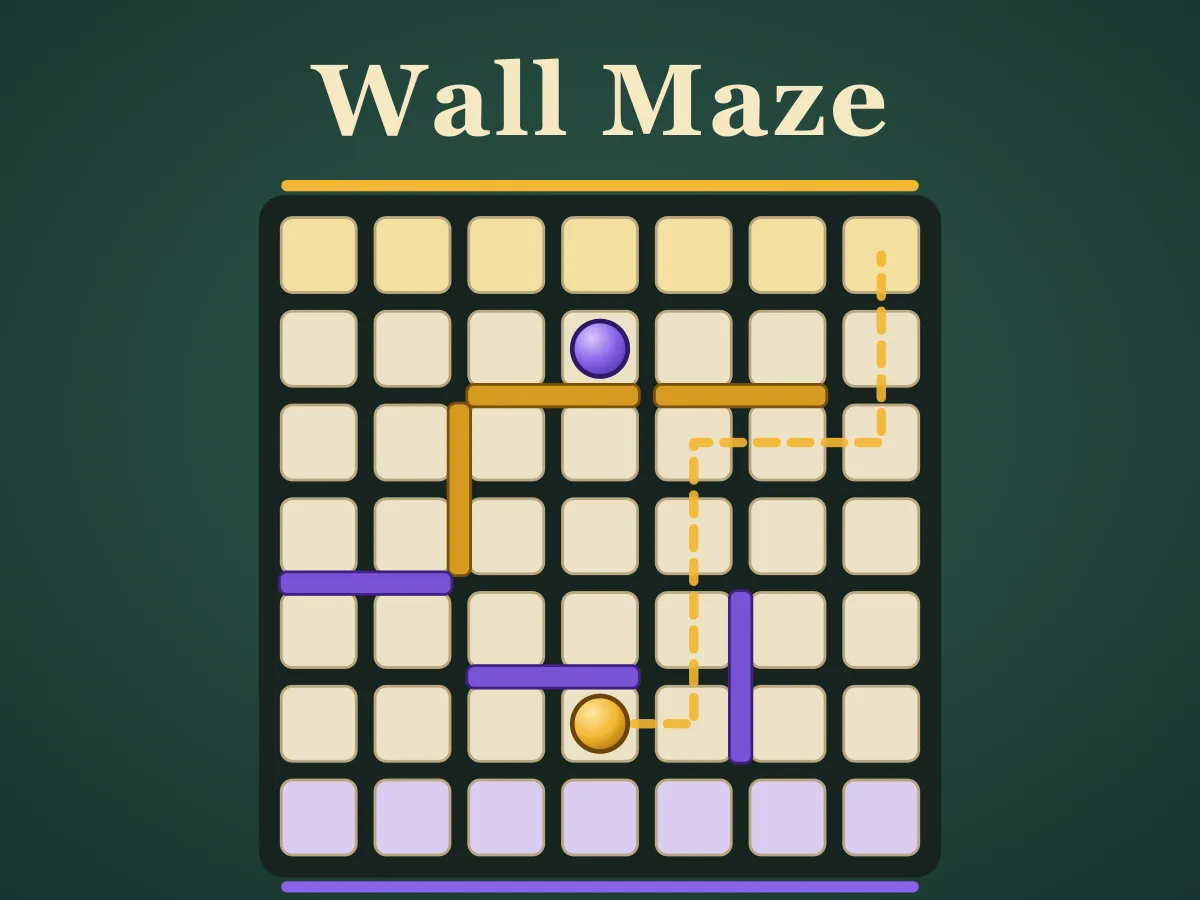




Wall Maze is a two-player race-and-block board game against the computer. Each turn you either step your pawn one square toward the far edge or place a wall in the grooves between squares to make the computer walk further. Walls can bend, slow and funnel a route, but never cut a pawn off completely. Climb seven levels from a 5×5 garden to the 9×9 Keep against four computer strengths. Free in your browser, no download, and it works on phones.
How to play Wall Maze
- Your gold pawn starts in the middle of the bottom row and must reach the top row; the computer’s violet pawn starts at the top and races to the bottom. The coloured bars show whose edge is whose.
- On your turn do one thing: step your pawn one square up, down, left or right (the gold dots show where it can go), or place one of your walls. A wall is two squares long and sits in the groove between squares; nothing can step through it.
- To place a wall, press Place wall, then point at a groove: with a mouse the wall follows the pointer and one click puts it down, on a phone the first tap shows it and a second tap (or the Place button) puts it down. Rotate turns it between lying and standing. Walls cannot overlap or cross, and a wall that would shut either pawn off from its edge is refused.
- When the two pawns meet face to face, you may jump straight over the other pawn; if a wall or the board edge is behind it, step diagonally to either side of it instead.
- The first pawn to reach its far edge wins. Win with the computer still far from home for two or three stars — the target is shown beside the board — and each win opens the next level. Using Undo or a Hint counts the win as one star.
Tips
- Count steps before you move: the step counts beside the board show how many squares each pawn still has to walk. If you are ahead and the computer has few walls left, just run.
- A wall that adds only one step to the computer’s route is no better than a step of your own, and it costs a wall. Look for walls that add two or more, usually right in front of its pawn.
- Keep a few walls for the end. Once the computer has used all of its walls nobody but you can lengthen your route, and a late wall in front of a pawn that is nearly home can decide the race.
- Two walls in an L or a long line force a detour of several squares; a lone wall in open space is easy to walk round.
- Watch the face-to-face jump: standing right in front of the computer’s pawn can hand it a free extra square.
FAQ
Is Wall Maze free to play?
Yes. Wall Maze is completely free to play online with no download, no account and no in-game purchases.
Does Wall Maze work on mobile?
Yes. Tap a gold dot to step. For a wall, press Place wall and tap the groove where you want it: the first tap shows the wall, and a second tap on the same spot or the Place button puts it down, so a slip of the finger never costs you a wall.
Can a wall trap a pawn completely?
No. Every pawn must always keep at least one way through to its goal edge. Walls can make that way as long and winding as you like, but a wall that would close it off is not allowed, for you or for the computer — the game refuses it and says why.
How does jumping over the other pawn work?
When the two pawns stand face to face with no wall between them, the player to move may jump straight over the other pawn. If a wall or the edge of the board is right behind it, you may instead step diagonally to the square on either side of it, as long as no wall is in the way.
Does it matter who moves first?
A little, and more on the small board. Between two copies of the strongest computer, the player who moved first won 33 of 60 games on the 9×9 board and 39 of 60 on the 5×5 board. You can choose who moves first at the top of the game; moving first is the easier setting.
How strong is the computer?
There are four strengths. Sprout judges only its own next move and Scout also your reply, and both pick loosely between moves that look about as good; Ranger also looks at your reply but always plays its best, and Warden looks four turns ahead, two of yours and two of its own. On the last level, the Keep, Warden also starts with 12 walls to your 10. Measured over 80 games a level with the Ranger computer playing your side, it won 79 on the first level, 74 on the second, about 60 on levels 3 and 4, 44 on level 5, 27 on level 6 and 13 on the Keep.
How are the stars worked out?
By how far the computer still had to go when your pawn arrived. Each level’s targets were measured by letting a stronger computer play your side for 80 games: two stars is a lead seven in ten of its wins reached, three stars one only its best third reached. Any win earns one star, and a win with Undo or a Hint is one star.