
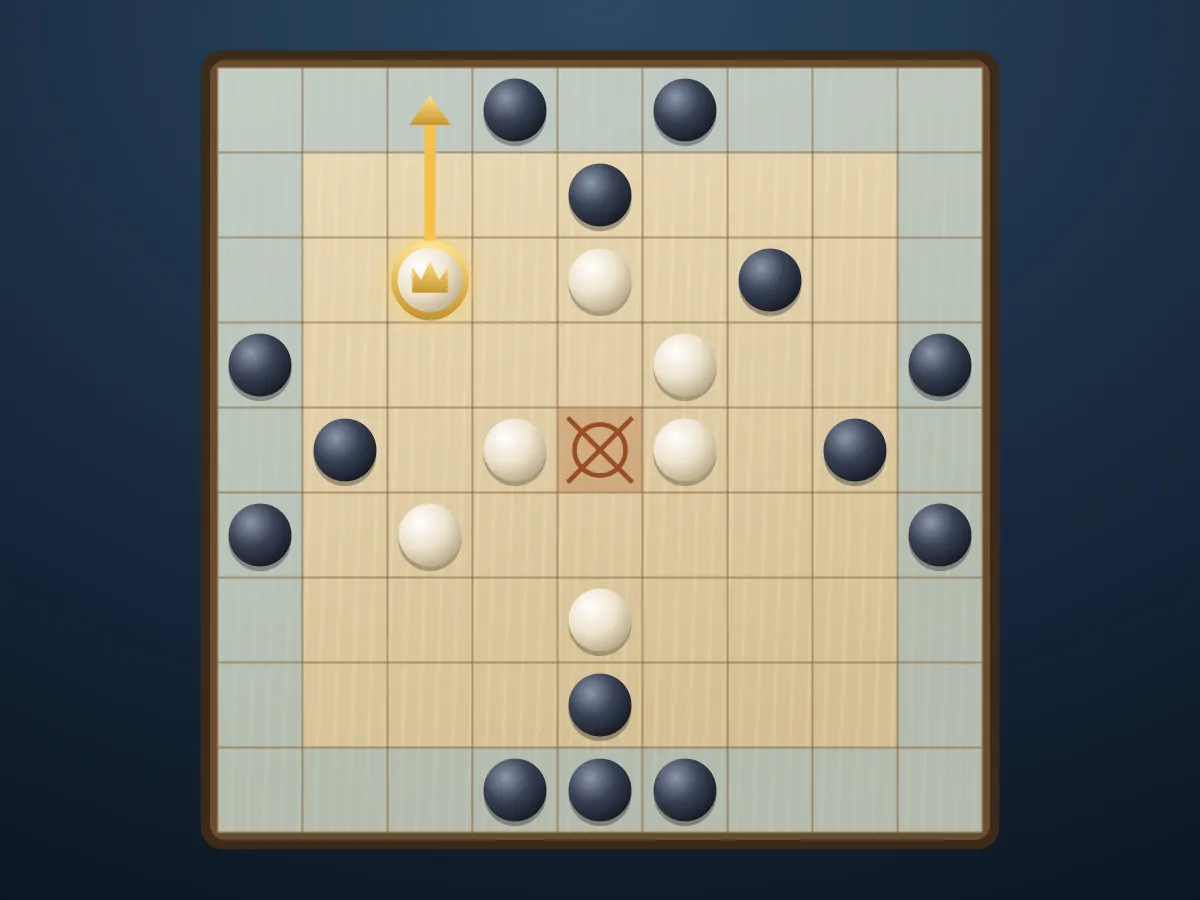
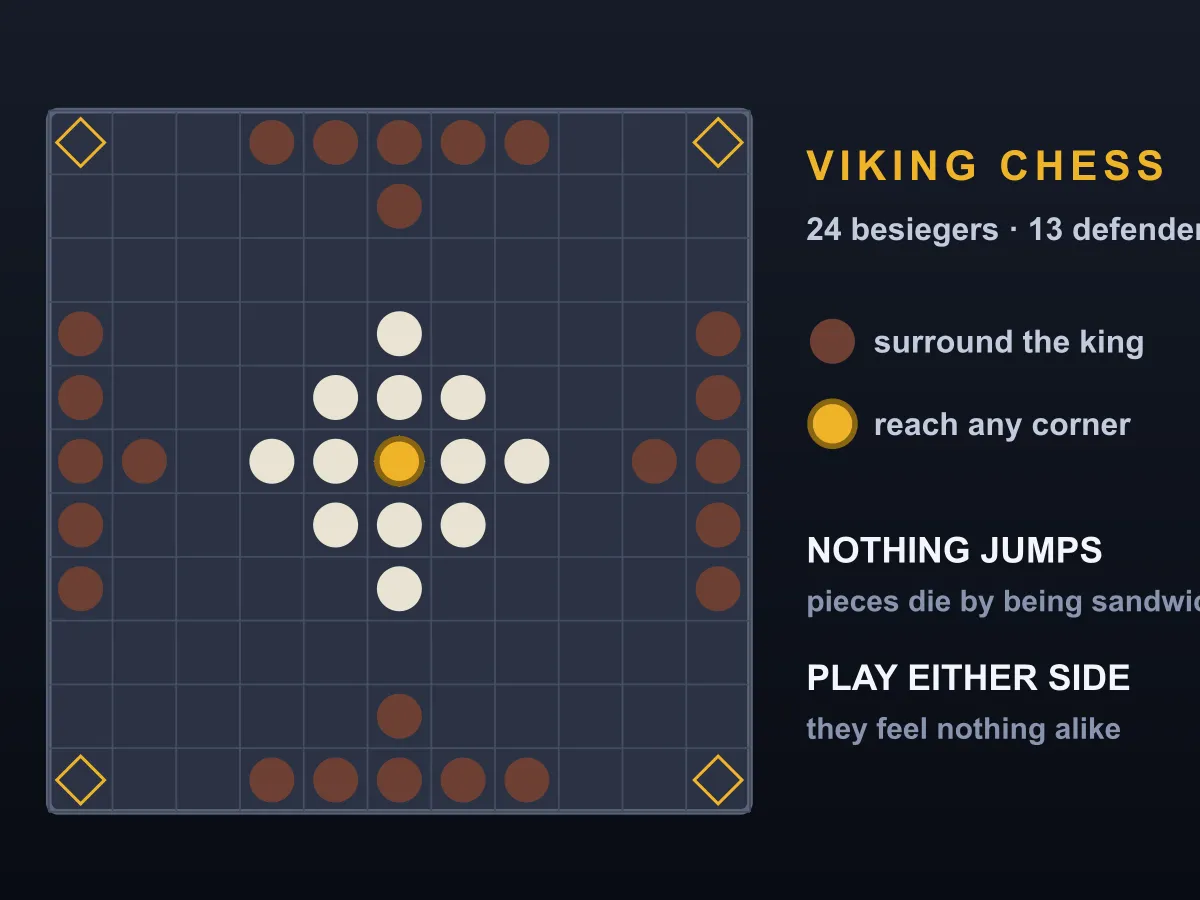
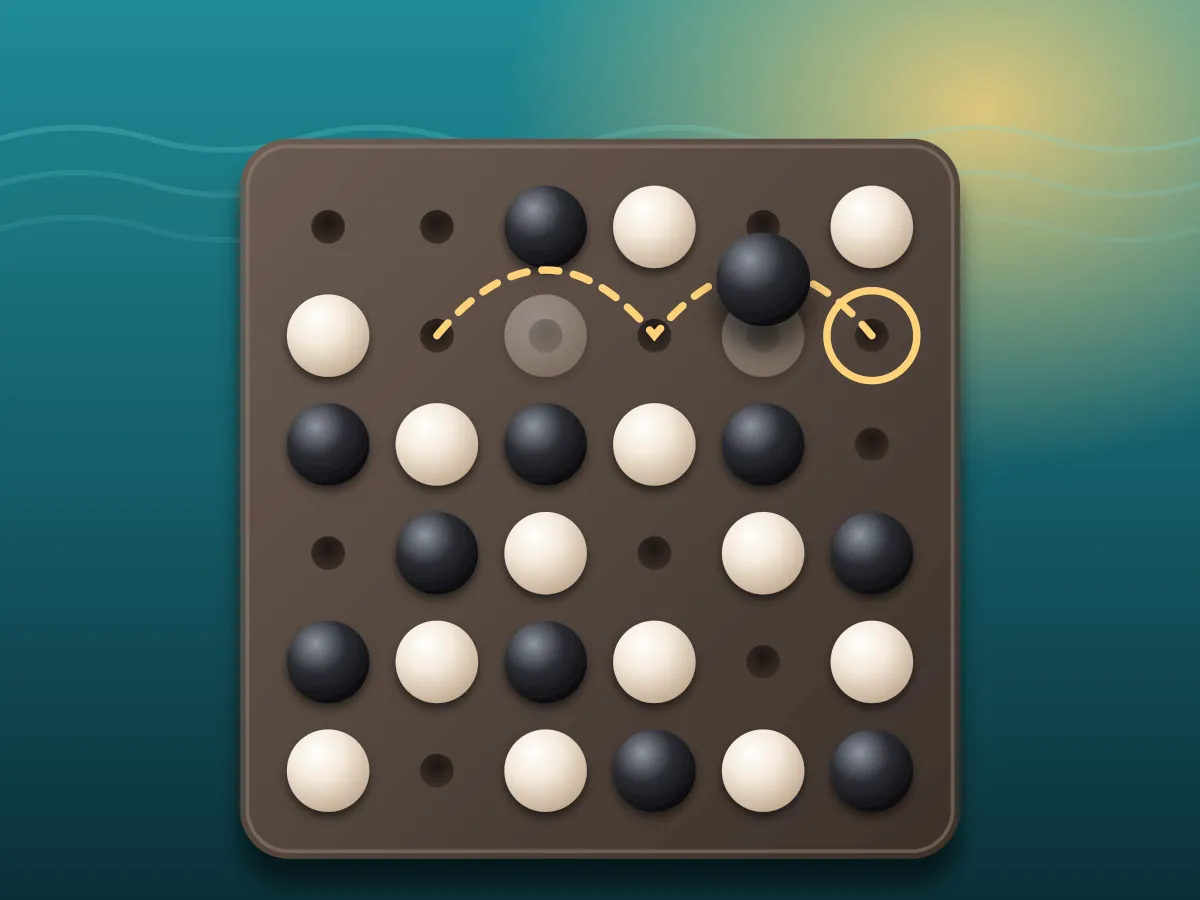


Tablut is the 9×9 game of the tafl family, the Norse "king's table" games, free to play online here against the computer with no download and no sign-up. Carl Linnaeus wrote it down in 1732 on his journey through Lapland, where he watched the Sámi play it. Sixteen attackers start in four groups on the edges; eight defenders guard their king on the central throne. Every piece slides like a rook and captures by trapping an enemy between two of its own. The defenders win the moment the king reaches any square on the edge of the board; the attackers win by catching him — two attackers either side of him are enough once he leaves the throne. Play either side against five opponents from Novice to Master, each measured against the one below. Hnefatafl, its bigger 11×11 cousin with corner escape, has its own page here.
How to play Tablut
- Choose a side. The attackers have 16 dark pieces in four T-shaped groups on the edges; the defenders have 8 light pieces in a cross around their king, who starts on the throne in the centre. The attackers always move first.
- On your turn move one piece like a rook: any distance up, down, left or right over empty squares. Nothing jumps and nothing moves diagonally. Tap a piece to see where it can go, then tap a glowing square — or drag it there.
- Any piece may cross the empty throne, but only the king may stop on it.
- Capture an enemy soldier by trapping it between two of your pieces in a straight line, on your own move. The empty throne counts as an enemy to both sides, and the king helps his defenders capture. A piece that moves between two enemies by itself is safe.
- The defenders win as soon as the king reaches any square on the edge of the board.
- The attackers win by capturing the king: away from the throne, two attackers on opposite sides of him are enough; on the throne he must be surrounded on all four sides, and beside it on the three sides the throne does not cover.
- A side with no legal move loses. The third repetition of the same position, or 50 moves each with no capture, is a draw. Win a game on either side to unlock the next opponent.
Tips
- As the defenders, count the king's clear lines to the edge. One clear line forces the attackers to block; two at once is usually a win, because one move can only block one of them — unless the attackers can capture the king instead.
- As the attackers, don't chase the king — guard the rim. Pieces placed a row or two in from the edge cut his lines off before he reaches them.
- The king is fragile off the throne: two attackers either side of him end the game, so before stepping out, check both squares beside where he lands.
- Use the empty throne as an anvil. Once the king has left, a soldier standing next to the throne can be captured by a single enemy on its far side.
- Trade when you are the attackers. Sixteen against eight means every one-for-one exchange leaves the king with fewer guards and fewer pieces to shelter behind.
- Stuck? Hint shows the move the Master would play, and Undo takes back your move and the computer's reply.
FAQ
Is Tablut free to play online?
Yes. Tablut here is free in any modern browser, with no download, no account and nothing to buy. Your unlocked levels, your chosen side and a game in progress are saved in your browser.
What is the difference between Tablut and Hnefatafl?
Both are tafl games, but Tablut is played on a 9×9 board with 16 attackers against 8 defenders and a king, and the king escapes to any square on the edge. The Hnefatafl on this site uses the Copenhagen rules: an 11×11 board, 24 attackers against 12 defenders, and the king must reach one of the four corners. Tablut's king is also easier to catch — two attackers do it once he leaves the throne, where the Hnefatafl king must be surrounded on all four sides (or three, with the throne on the fourth).
How does the king escape in Tablut?
The defenders win the moment the king lands on any of the 32 edge squares, not just the corners. Because every piece slides like a rook, a king with a clear line to the edge can get there in one move, so the attackers have to keep every line from him blocked.
How is the king captured in Tablut?
Away from the throne he is captured like any other piece: an attacker moves next to him with another attacker directly on his far side. On the throne all four squares around him must hold attackers, and on a square beside the throne the other three sides must, with the empty throne closing the fourth.
Can I move a piece between two enemy pieces?
Yes, it is safe. A capture only happens when the side that moves closes the trap. A piece that walks into a gap between two enemies stays on the board — though either enemy can still take it later by stepping away and back.
Which side is easier to play, attackers or defenders?
Against loose play the defenders: when the Novice played itself from 100 random openings, the defenders won 87 games and the attackers 8, with 5 draws, because a careless attacker leaves the king a clear line every few moves. The better both sides read, the closer it gets — the Master playing itself won 53 games as the defenders and 28 as the attackers, with 19 draws. You can play either side against every level.
Which Tablut rules does this version use?
Linnaeus' 1732 notes leave gaps, and modern rule sets fill them in different ways. This version uses edge escape for the king, an armed king who helps capture, a weak king (two attackers capture him off the throne), a throne any piece may cross but only the king may stop on, an empty throne that is hostile to both sides, and the attackers moving first. A side with no legal move loses; a third repetition or 50 moves each without a capture is a draw.
How good is the computer?
There are five levels — Novice, Apprentice, Player, Expert and Master — and their strength is measured, not guessed: computer-against-computer games from seeded openings, each played twice so both opponents take each side. The Novice scores 51% against a player who only grabs captures and escapes on offer. The Apprentice scores 85% against the Novice, the Player 60% against the Apprentice, the Expert 84% against the Player and the Master 78% against the Expert, over 200 games a pairing (80 for the Master). The Master reads four moves ahead.
Can a game of Tablut end in a draw?
Yes, in two ways: the same position comes round a third time with the same side to move, or 50 moves each go by without a single capture. A side that has no legal move left loses rather than draws.
Can I play Tablut on my phone?
Yes. The board fills the width of a phone held upright, and you can tap a piece and then a square or drag the piece. On a computer you can also play with the keyboard: arrow keys to move around the board, Enter to pick and place, H for a hint, U to undo and N for a new game.