


Home / Card / Baker's Dozen Solitaire
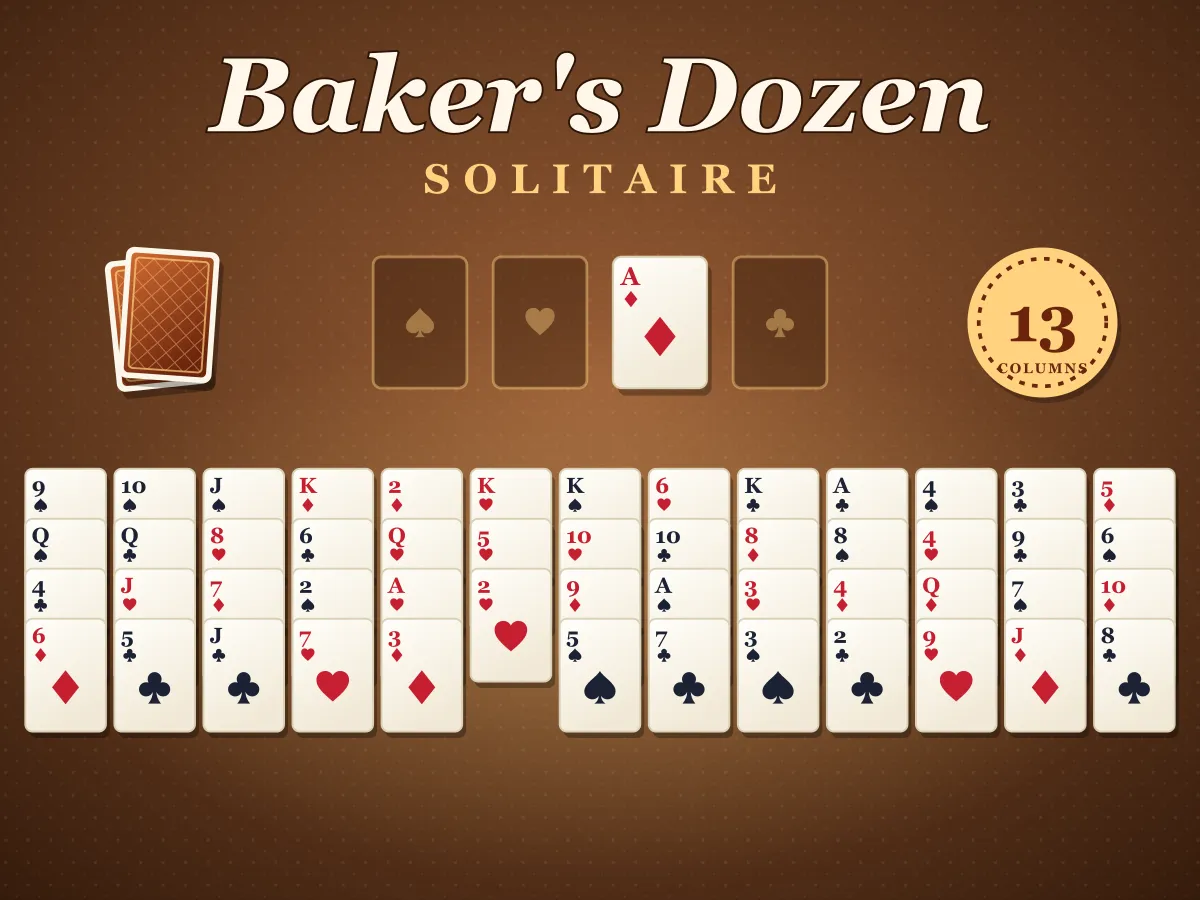
Baker's Dozen Solitaire is the classic open patience of thirteen columns — a baker's dozen — free to play online in your browser with no download and no sign-up. The whole deck is dealt face up into thirteen columns of four, and any King that lands above other cards is moved to the bottom of its column before play begins, so every card is in view and no King ever buries one. Only the top card of each column moves: build down regardless of suit — any 6 on any 7 — and send each suit up to its foundation from Ace to King. An empty column can never be filled, so every move counts. With nothing hidden it is a game of pure planning: our solver finds a win in 2,309 of the first 2,400 deals, while a simple rule-of-thumb player wins only 141. Drag or tap the cards, undo any move, ask for a hint that tells you whether the deal can still be won, replay a deal by its number, and choose random or winnable deals.
How to play Baker's Dozen Solitaire
- The game deals all 52 cards face up into thirteen columns of four cards — a baker's dozen. Any King that lands above other cards is then moved to the bottom of its column (two Kings in one column keep their order), so no King ever sits on top of another card.
- The four foundations, one per suit, start empty. Each builds up in suit from Ace to King: A, 2, 3 and so on. An Ace goes home by itself as soon as it reaches the top of a column, and so does a Two once its Ace is home.
- Only the top card of each column is in play, and cards move one at a time. Move a top card onto another column when it is exactly one rank lower — the suit does not matter, so any 6 goes on any 7. Drag a card, or tap it to send it home or onto a column one rank higher.
- A column that empties stays empty for the rest of the game: no card can ever be moved into it. Kings therefore never move except to go home — that is why the deal puts them at the bottom.
- The game also sends a card home for you when nothing could still need it in the columns — once all four cards one rank lower are home. Any other card you send home yourself, when you choose.
- You win when all 52 cards are on the foundations. If no top card can move, the deal is lost: undo, replay the deal, or start a new one.
Tips
- Every card is face up, so read the whole table before your first move. Find each Ace and Two and count the cards lying on top of them — those columns are where the game is decided.
- A card lying above a lower card of any suit has to move again before that lower card can go home. Building onto a column whose cards already run downwards buries nothing; building onto a jumbled column adds one more card to dig through later.
- Columns never refill, so do not rush to empty one. Emptying a column wins you nothing by itself — what matters is the card you uncover on the way down.
- There are usually several places a card can go, since the suit does not matter. Before you tap, look at what each target column holds underneath: put the card where it will be in nobody's way.
- Press Hint whenever you are unsure. While a winning line exists it shows its next step and says so; once a deal can no longer be won it tells you, so you know to undo rather than play on.
FAQ
Is Baker's Dozen Solitaire free to play?
Yes. Baker's Dozen Solitaire is completely free to play online in your browser, with no download, no account and no in-game purchases. It works on phones, tablets and computers.
How do you play Baker's Dozen?
All 52 cards are dealt face up into thirteen columns of four, and every King is moved to the bottom of its column. Only the top card of a column moves: build down regardless of suit onto another column, or up in suit on the four foundations from Ace to King. Empty columns are never refilled. Win by getting all 52 cards home.
Why is it called Baker's Dozen?
A baker's dozen is thirteen — bakers are traditionally said to have added a thirteenth loaf to every dozen to be sure of never selling short weight. The game is named after its thirteen columns. It was first published in 1883 in Dick's Games of Patience by William Brisbane Dick.
Why are the Kings moved to the bottom?
Because a King can never be moved onto another column — only to its foundation, after the Queen — and an empty column can never be filled. A King dealt on top of other cards would bury them for good, so the rules move every King to the bottom of its column before play starts.
Can I put a card in an empty column?
No. In Baker's Dozen an empty column stays empty for the rest of the game. That is the main difference from Spanish Patience, a close relative in which any card may fill an empty column.
Does the suit matter when building on the columns?
No. In the columns you build down regardless of suit, so any 6 goes on any 7. Only the foundations care about suit: each one builds up in a single suit from Ace to King.
How often can you win Baker's Dozen?
We measured it on the first 2,400 deals. With every card in view, a solver that searches the moves ahead finds a win in 2,309 of them, about 96 deals in every 100. A rule-of-thumb player that sends cards home, then makes the build that uncovers the lowest card, wins only 141 — about one deal in 17. The gap is planning: the order you move cards in decides the game.
What does Winnable deals mode do?
It deals only hands the solver has played all the way to a win: the 2,309 winnable deals it found among the first 2,400. Random deals, the default, draws from all 999,999 deal numbers. A winnable deal can still be lost by a wrong move — undo and the hint will get you back on track.
How does the hint work?
The hint asks the same solver. While it can find a winning line from your position, it shows that line's next step and says so; tapping the hinted card plays it. If the solver searches every position reachable from yours without finding a win, the hint tells you the deal can no longer be won, so you know to undo. If it runs out of time first, it shows a sensible move and says no winning line was found.
Why do some cards go home by themselves?
Aces always do, and so do Twos once their Ace is home. Any other card goes home by itself only once all four cards one rank lower are already home — at that point no card left in the columns could ever build on it, so keeping it out would never help. Every other card waits for you to send it.
Can I undo a move, and what is the deal number?
Yes, every move can be undone one at a time, right back to the deal, even after the game has ended. Every game has a number from 1 to 999,999 shown at the top of the table; the same number always deals the same cards, so Replay deal gives you the same game again and New deal picks a different one.
Does it save my game, and can I play with a keyboard?
An unfinished deal is saved in your browser and picks up where you left it. With a keyboard, the arrow keys move between columns, Enter plays the top card, U undoes, H asks for a hint and N starts a new deal.