



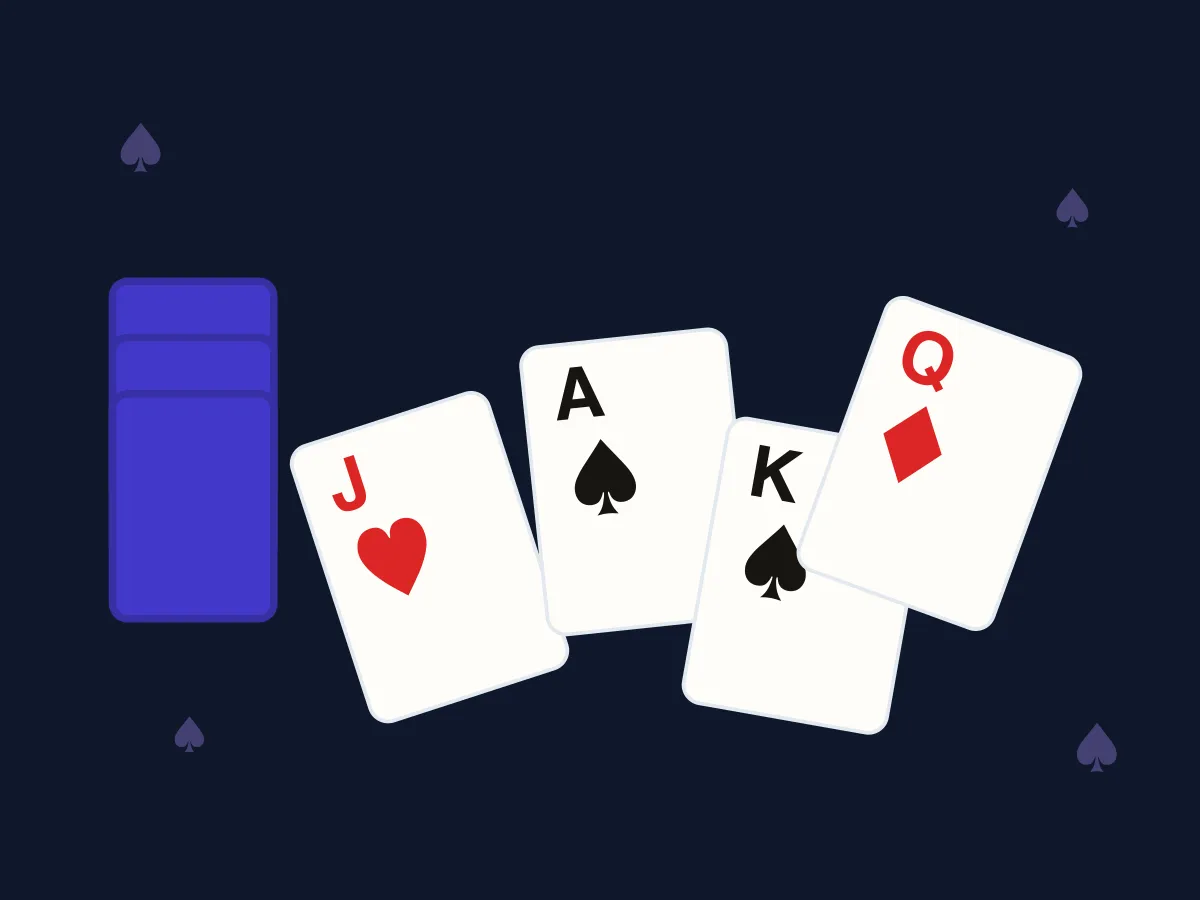


Big Two — also called Cho Dai Di, Deuces or Dai Di — is a free online card game for one player against three computer opponents. The whole deck is dealt out, thirteen cards each, and whoever holds the three of diamonds opens with a play containing it. After that you beat the play on the table with a bigger one of the same size: a single, a pair, a triple, or a five-card poker hand. Two things make it its own game rather than another shedding game. Suits decide: 5♠ beats 5♥, so the four fives are four different cards and holding 2♠ means holding the one card nobody can beat. And the five-card ladder runs straight, flush, full house, four of a kind, straight flush, so the weakest flush beats the strongest straight. Ten tables raise the opponents from beginners to a seat that plays its best move every single turn. No download, no account, no real money.
How to play Big Two
- All 52 cards are dealt, thirteen to each of the four seats. Whoever holds the three of diamonds leads, and their first play must contain it.
- Play beats play of the same size only: a single answers a single, a pair answers a pair, a five-card hand answers a five-card hand. There is no four-card play at all.
- Card order runs 3 low up through K, A, and then 2 as the highest card in the game.
- When two cards share a rank the suit decides, from diamonds lowest through clubs and hearts to spades highest. So 5♠ beats 5♥, and 2♠ is the single card nothing can beat.
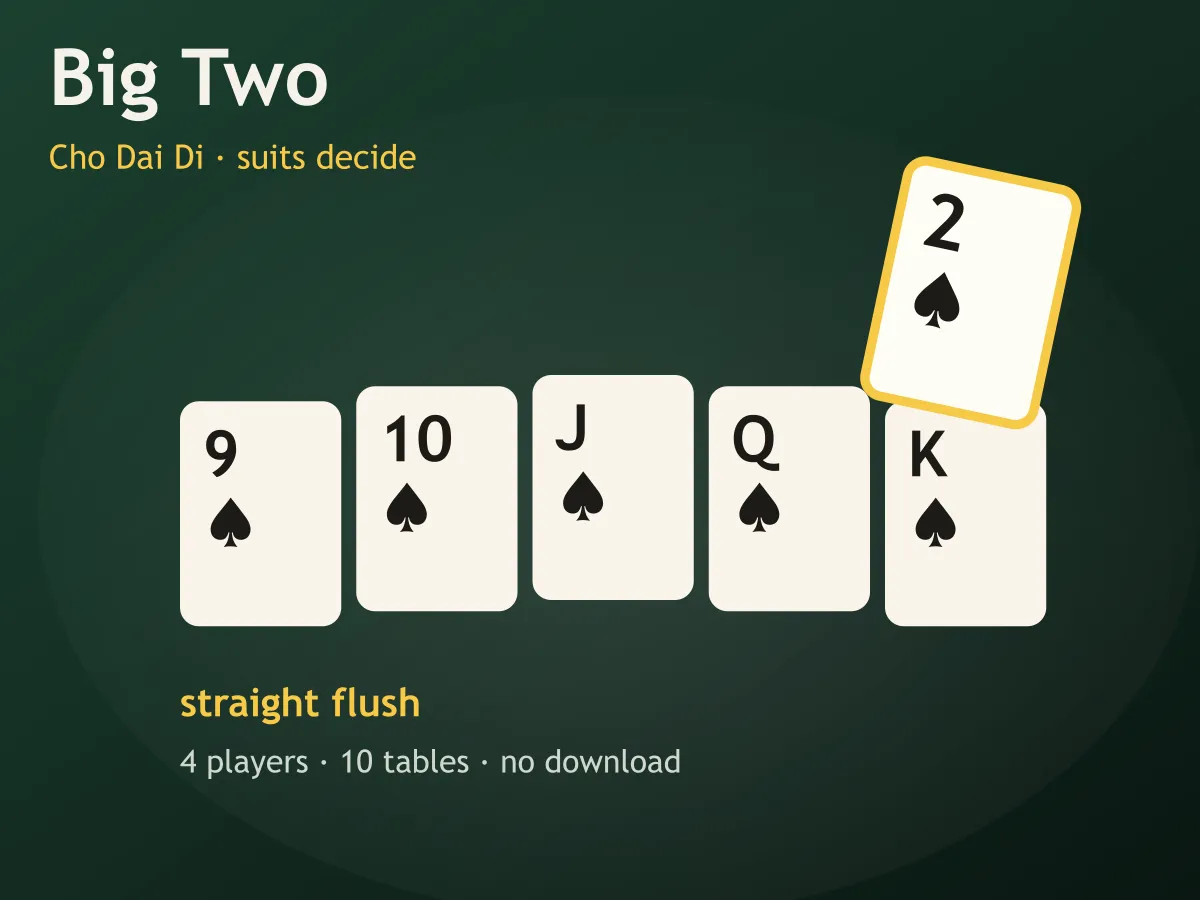
- Five-card hands rank straight, then flush, then full house, then four of a kind, then straight flush. A flush beats any straight no matter what cards the straight holds.
- Pass if you cannot or will not beat the table. When the other three all pass, the last player to put cards down clears the table and leads again for free.
- The first player to empty their hand wins the deal, and takes points from everyone else equal to the cards they are still holding.
- Getting caught with ten or more cards doubles that penalty, and never playing a card at all triples it — so shedding matters even in a deal you cannot win.
- Bank the target number of points to clear the table and unlock the next one.
Tips
- Count your twos and aces before your first play. They are your way back into the lead, and a hand with none of them has to win early or not at all.
- The three of diamonds is a gift when it sits inside a straight — leading a five-card hand on the opening play sheds five cards while everyone else is still finding their feet.
- Do not break a pair to answer a single unless you have to. The stump you leave behind is a card you will still be holding when the deal ends.
- Suit order is worth memorising, because it decides more endgames than rank does: diamonds, clubs, hearts, spades, lowest to highest.
- When somebody is down to one or two cards, stop saving anything. Taking the lead is the only thing that stops them going out.
- A flush is often better spent than kept. It beats every straight in the game, so it is the cheapest way to break up a run of five-card plays.
- Leading small is usually right. You want the table cleared while your high cards are still in your hand, not spent winning a trick nobody was contesting.
- If a deal is clearly lost, dump your longest plays anyway. Getting from ten cards down to nine halves what the deal costs you.
FAQ
Is Big Two free to play?
Yes. It runs in the browser with no download, no sign-up and nothing to buy. All ten tables are included and unlock as you clear them. There is no real money and no wagering anywhere in the game.
How is this different from the other shedding games here?
Suits. Fight the Landlord, Run Fast and Guandan all compare singles by rank alone, so their four fives are interchangeable. Here 5♠ beats 5♥, which changes every endgame — and five-card plays are poker hands with their own ladder, which none of the others have.
Which straight rules does this game use?
Straights follow the same order as everything else in the game: 3 low, through K and A, up to 2 as the highest card, and they never wrap around. So 3-4-5-6-7 is the lowest straight and J-Q-K-A-2 is the highest, while A-2-3-4-5 is not a straight here. Tables genuinely differ on this, so it is worth saying plainly: one order for the whole game is easier to hold in your head than a 2 that is highest everywhere except inside a straight.
How do two flushes compare?
By suit first, then by highest card. A spade flush beats every heart flush regardless of the cards in it.
Can I play four cards?
No. Legal plays are one, two, three or five cards. Four of a kind is played as a five-card hand with any fifth card attached, and it beats a full house.
Why did I lose so many points for one deal?
Because of how many cards you were still holding. Under ten cards you lose one point each; ten or more doubles it, and being caught having never played a card at all triples it. It is the standard table rule and it is there so that second place is worth playing for.
Do the computer players cheat?
No. They see only their own hand and the same table you do. What changes between tables is how often a seat plays the best move it can find rather than a random legal one — the top table plays its best move every turn.
Does it work on a phone?
Yes. The hand is laid out to fit thirteen cards across a portrait screen, and cards are tapped to select and deselect before you press Play.