
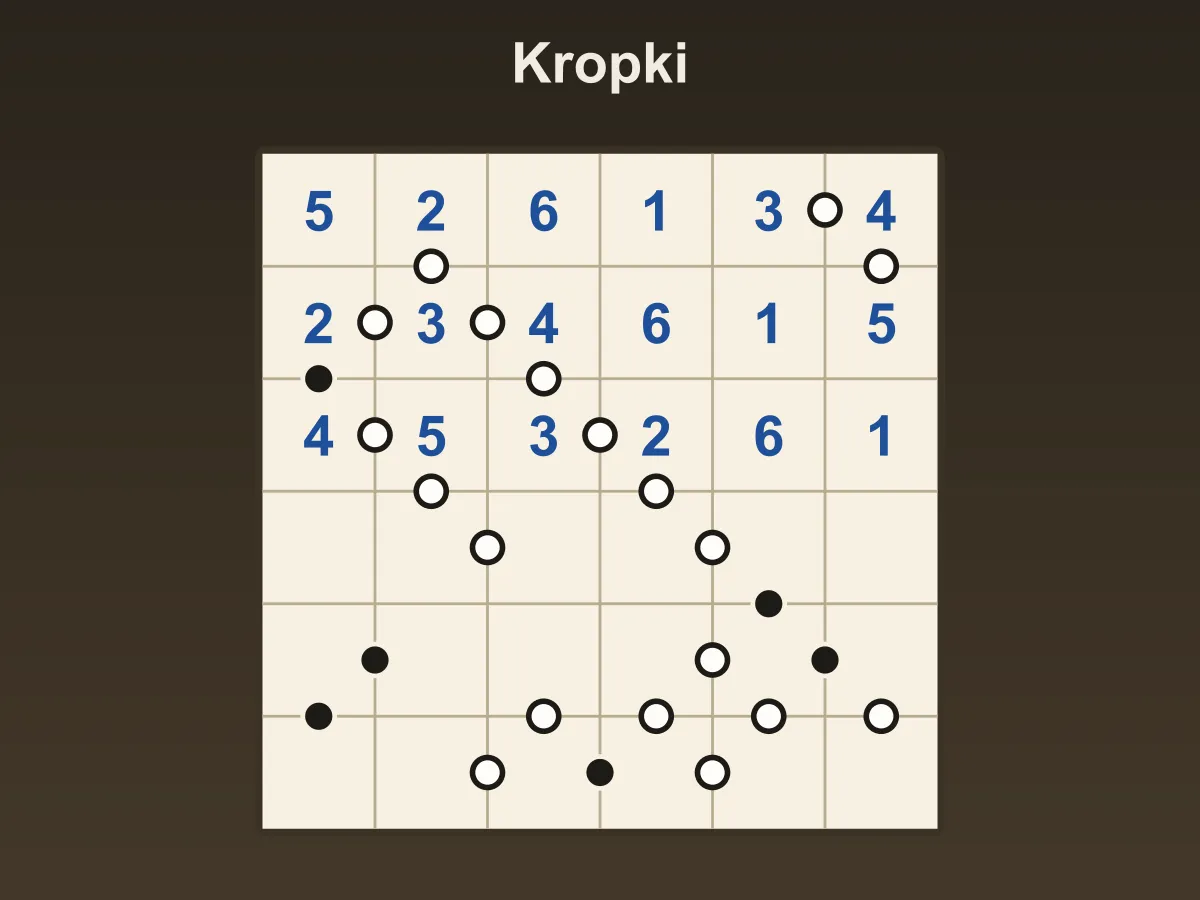


Kropki is a free online number logic puzzle played on a square grid. Fill every row and every column with the numbers 1 up to the size of the grid, each exactly once, so that every dot tells the truth. A white dot between two squares means their numbers are consecutive, like 3 and 4. A black dot means one number is double the other, like 3 and 6. And because every dot is printed, two squares with no dot between them are neither — so a missing dot is a clue as well. The only pair that is both is 1 and 2, which may carry either colour. Most grids start with no numbers at all: the dots alone lead to the one answer. Tap a square and type or tap a number to write it in, switch on Notes to pencil in what a square could still be, and any number that breaks a rule turns red, with the dot it breaks ringed. Every grid is built by the game itself, has exactly one answer, and is proved solvable without guessing before you see it. Eight levels grow from a 4×4 to a full 9×9. No download, no account.
How to play Kropki
- The grid is N squares across: 4×4 on the first level, 9×9 on the last. Fill every row and every column with the numbers 1 to N, each exactly once.
- A white dot on the line between two squares means their numbers are consecutive: 3 and 4, or 4 and 3.
- A black dot means one of the two numbers is exactly double the other: 2 and 4, 3 and 6, 4 and 8.
- Every dot is printed, so where two squares have no dot between them their numbers are neither consecutive nor double. 3 next to 5 needs no dot; 3 next to 4 would need a white one.
- The pair 1 and 2 is both consecutive and a double, so it may carry either a white or a black dot. Nothing else can.
- Tap a square to select it, then tap a number on the pad or type it. The line under the grid names the dots around the selected square.
- Tap the same number again, press 0, Backspace or Delete, or use the ⌫ key to rub a square out.
- Press Notes (or N) to pencil in small numbers instead; hold Shift while typing to pencil one in without switching. Writing a number in ink rubs it out of the notes in its row and column.
- A number twice in a line, or two numbers a dot disagrees with, turn red, and a broken dot is ringed in red. On a keyboard, arrow keys move between squares.
- The grid is solved when every square is filled and no rule is broken. Undo steps back one change, Clear wipes your numbers and notes, and New Puzzle deals a different grid on the same level.
- The ? button writes one square of the answer — a wrong number is corrected first, otherwise it fills the square the next step of logic would settle. Three per grid.
Tips
- Read the black dots first. On a 6×6 a 5 has no double and no half, so a 5 can never sit beside a black dot; on any board the only black-dot pairs are 1-2, 2-4, 3-6 and 4-8.
- The biggest odd numbers are the pickiest: on a 7×7 a 7 can only take a white dot towards a 6, and a 5 can only touch 4 or 6 through a white dot and nothing through a black one.
- Use the missing dots. A square with no dot on any side cannot hold a number next to its neighbours' — a 4 surrounded by empty lines rules out 3, 5, 2 and 8 around it.
- Two white dots in a straight row or column make a run: the three squares hold three consecutive numbers in order, so the middle one is never 1 or N. (Round a corner the two ends may match, so this only holds along one line.)
- Every number appears once in each row and column. When a number has only one square left in a line, write it in — even if the dots there allow others.
- Two squares of a line that can only be, say, 2 or 4 between them take 2 and 4 away from the rest of that line.
- Pencil in notes on the bigger boards. Writing a number rubs it out of the notes in its row and column, so the notes stay honest as you go.
- On the last three levels, try a number in your head. If following it through leaves some square with nothing it can hold, that number is wrong.
FAQ
Is Kropki free to play?
Yes. It runs in the browser with no download, no sign-up and nothing to buy. All eight levels are included and unlock as you solve them.
What are the rules of Kropki?
Fill an N×N grid with the numbers 1 to N so that each appears once in every row and every column. A white dot between two neighbouring squares means their numbers differ by one; a black dot means one is double the other. Every possible dot is shown, so two neighbours with no dot between them are neither consecutive nor a double.
Why can 1 and 2 have either a white or a black dot?
1 and 2 are consecutive, and 2 is also double 1, so both dots tell the truth about them. Printed Kropki lets the setter pick either colour for that pair, and so do these grids: each 1-2 pair gets white or black at random. Read a white dot as "differ by one" and a black dot as "one is double", and the 1-2 pair simply fits both.
How is Kropki different from Futoshiki?
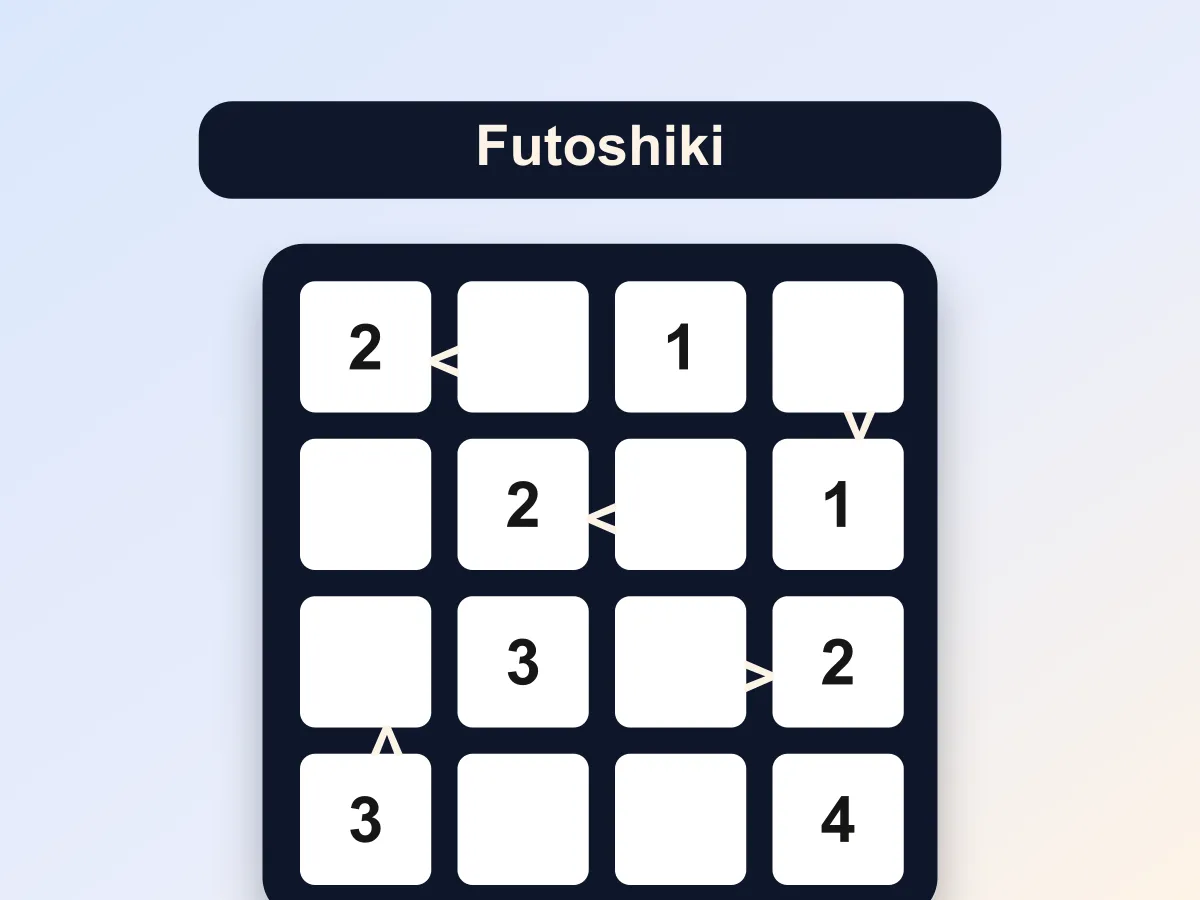
Both fill a grid with 1 to N once per row and column. Futoshiki marks some neighbours with < and > signs that say which number is bigger. Kropki's dots say how two numbers are related — consecutive or double — not which is bigger, and every relationship is marked, so a missing dot is information too. Futoshiki is also on this site if you want to compare.
Does every puzzle have exactly one answer?
Yes, and it is checked rather than assumed. Each grid is built from a real, complete answer, and numbers are removed only while a program that makes forced moves alone can still finish it; a grid it can finish that way has only one answer. The tests confirm that with an exhaustive search on every level as well.
Will I ever have to guess?
No. A grid only ships if it can be finished by deduction alone. On levels 1 to 3 every move is direct: a square with one number left, a number with one place left in its line, or a number with no partner across a dot. Levels 4 and 5 each need at least one locked set — squares of a line that share out a few numbers between them. Levels 6 to 8 each need "what if" steps: one to three on level 6, three to six on level 7, and six or more on the 9×9.
Why are there no numbers to start with?
Because the dots do the work. Every dot is printed, so each line between two squares — dot or no dot — rules numbers out, and together they usually pin a single answer. The generator removes every given number it can while the grid stays solvable by logic; most grids end up with none, and the rest keep one or two.
How many levels are there?
Eight: a 4×4, a 5×5 and two 6×6 grids, two 7×7s, an 8×8 and a full 9×9. Size grows, and so does the kind of reasoning each level needs. New Puzzle deals a fresh grid on any level you have reached.
Does it work on a phone?
Yes. Tap a square and tap a number on the pad under the grid. On a phone held upright the game uses a taller frame, so even the 9×9 keeps squares large enough to tap, and held sideways the pad moves beside the grid.