


Samba is a free online version of the Canasta card game that adds sequences, played two-handed against the computer. Three packs and six Jokers are shuffled together, you hold fifteen cards, and every turn you draw two and discard one. Meld three or more cards of a rank, with deuces and Jokers as wild cards (two at most per meld), or three or more cards of one suit in order — no wild cards in those. Seven of a rank is a canasta, worth 500 when natural and 300 when mixed; seven in sequence is a samba, worth 1500. You need two canastas before you can go out, and a samba counts as one. Take the discard pile with a natural pair of its top card and every card in it comes to your hand. Six levels run from a quick 2,500-point game to the full game to 10,000. No download, no sign-up, and it plays on a phone.
How to play Samba
- Each of you is dealt fifteen cards from three packs and six Jokers. Red threes are laid out at once and replaced from the stock. One card is turned face up to start the discard pile.
- On your turn, tap the stock to draw two cards — or take the whole discard pile: select a natural pair that matches its top card (or, once you have melded, nothing at all if the top card fits one of your open groups) and tap the pile.
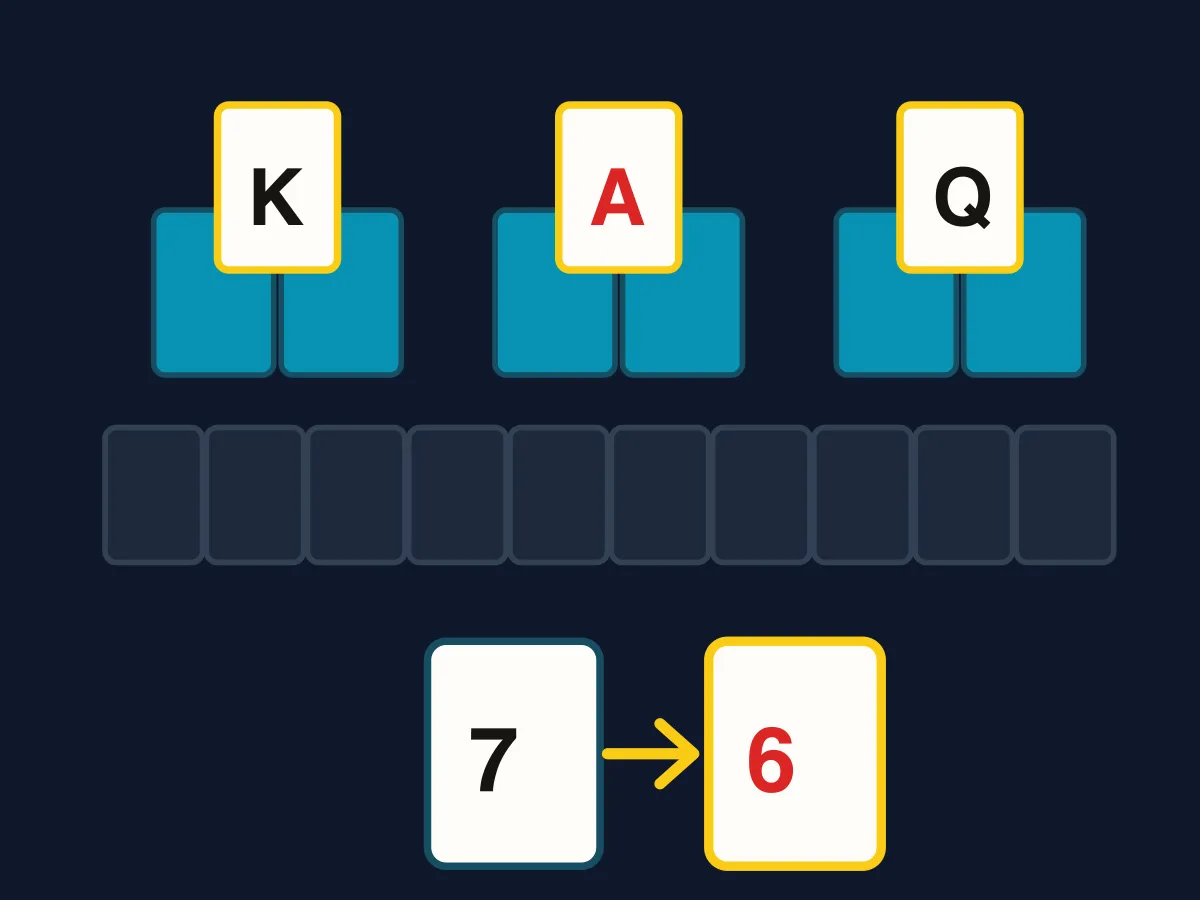
- Meld by selecting cards and pressing Meld. A group is three or more cards of one rank with at most two wild cards (deuces and Jokers). A sequence is three or more cards of one suit in order, from 4 up to the ace, with no wild cards. Your first meld of each hand must reach a minimum: 50 points at the start, 90 from 1,500, 120 from 3,000 and 150 from 7,000.
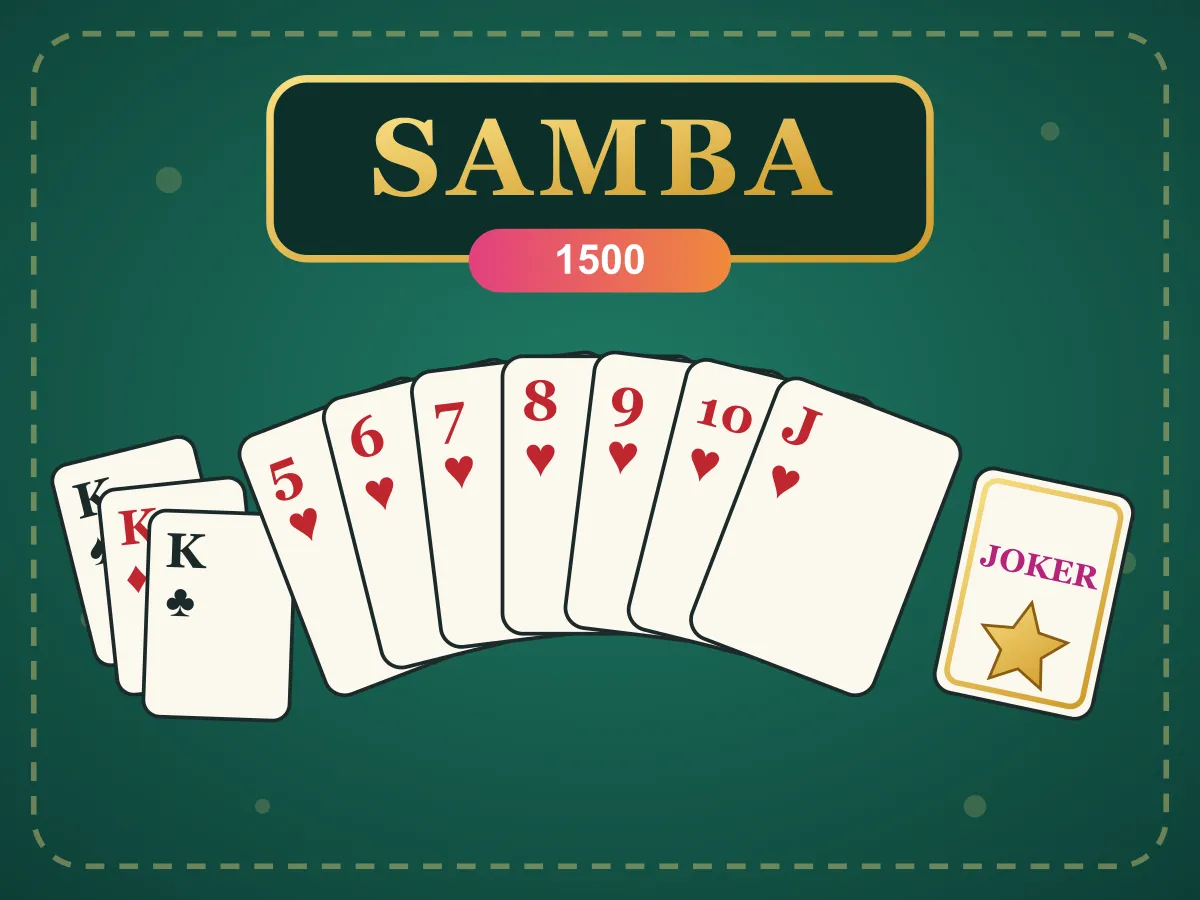
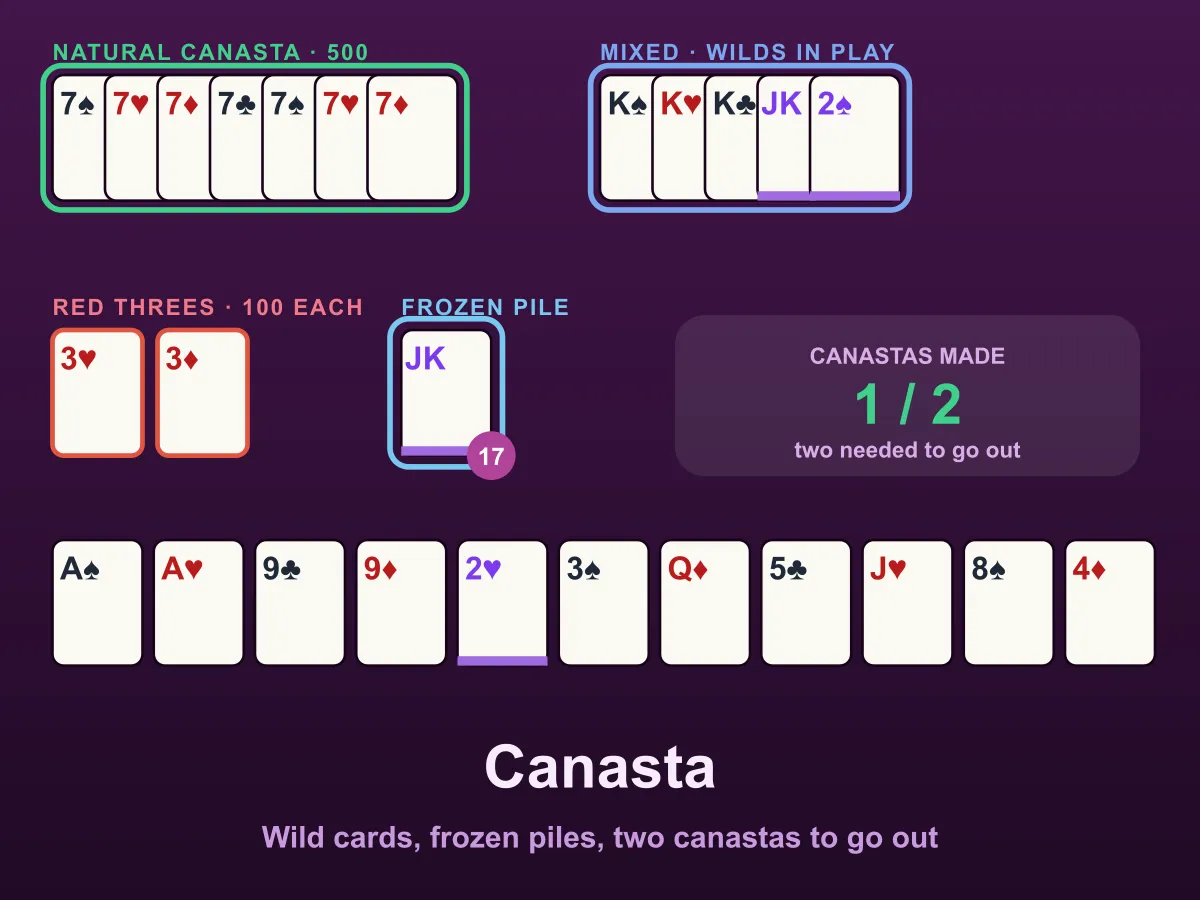
- Grow your melds to seven cards. Seven of a rank is a canasta — 500 if natural, 300 with wild cards — and seven in sequence is a samba, worth 1500. Seven is the most a meld can hold.
- End your turn by selecting one card and pressing Discard. Once you have two canastas (a samba counts), you may go out by melding or discarding your last card for a 200-point bonus. The hand is scored, and hands are dealt until someone reaches the target.
Tips
- Do not take a pile of one or two cards just because you can. Taking the pile replaces your two-card draw, so a small pile is usually a worse deal than the stock — and it uses up the pair that could have claimed a big pile later. The strongest computer here waits for five or more.
- Throw black threes when you have them. A black three on top of the pile cannot be taken with a pair, so it shuts your opponent out of the pile for a turn.
- Keep pairs in your hand. A natural pair is your claim on the discard pile; every card the computer throws is a chance to match it.
- Watch your opponent’s open groups. Discarding a rank they have on the table lets them take the whole pile without a pair once they have melded.
- Sequences are where the big points are. Hold three or four cards of one suit in a row and a samba worth 1500 is within reach — but remember no wild card can fill a gap.
- Red threes count for you only once you have two canastas. If the hand might end early, getting that second canasta is worth more than it looks.
FAQ
Is Samba free to play?
Yes. Samba is completely free to play in your browser, with no download, no account and nothing to buy. It works with a mouse, a touchscreen or the keyboard.
How is Samba different from Canasta?
Samba adds sequences. Besides groups of one rank, you may meld three or more cards of one suit in order, and a seven-card sequence is a samba worth 1500 — three times a natural canasta. It also uses three packs and six Jokers instead of two packs and four, allows at most two wild cards in a group, and the pile never freezes: you take it with a natural pair of its top card, or onto one of your own open groups once you have melded. This site’s Canasta game plays the two-pack original.
What is a samba worth?
A samba — seven cards of one suit in sequence — scores a 1500 bonus. A natural canasta (seven of a rank, no wild cards) scores 500 and a mixed canasta (seven of a rank with one or two wild cards) scores 300. On top of the bonuses, every melded card scores its value: Jokers 50, deuces and aces 20, eight to king 10, four to seven 5.
How many canastas do you need to go out in Samba?
Two. A samba counts as one of them, so a samba and a canasta, two canastas or two sambas all let you go out. Going out earns 200 points, and your opponent loses the value of every card still in their hand.
When can I take the discard pile?
When you hold a natural pair (no wild cards) of the card on top, or — once you have melded — when the top card can join one of your open groups. The top card goes into the meld and the rest of the pile comes into your hand. A wild card or a black three on top cannot be taken, and the pile is never used to start or extend a sequence. Before your first meld, the cards you meld with the pile must reach your minimum.
How many points do I need for my first meld?
It depends on your score at the start of the hand: 15 if you are below zero, 50 from 0, 90 from 1,500, 120 from 3,000 and 150 from 7,000. Several melds laid together count toward the minimum, so a group and a sequence can open between them.
Is this two-player Samba or the partnership game?
Two-player: you against one computer opponent, each with your own melds. Samba is often played by four in two partnerships, but a two-handed table keeps every meld readable on a phone screen. The rules for melds, the pile and scoring are the same.
Which rules does this version of Samba use?
Fifteen cards each, draw two and discard one, game to 10,000 on the final level. This version also settles a few points that house rules differ on: black threes are never melded; a finished canasta or samba is closed, though you may start a new group of the same rank beside it; red threes score 100 each (1000 for all six) only for a side with two canastas and count against a side without them; if the first upcard is a wild card or a three, cards are turned onto it until a plain card shows; and if both scores pass the target tied, another hand is played.
How good is the computer at Samba?
The strongest opponent, on the last two levels, wins close to nine hands in ten against a player making random legal moves, and each level measurably beats the one below it. We measured this over 600 hands per pairing, with both players taking turns to sit in each seat and to play first. The computer never sees your cards or the stock.
How long does a game of Samba take?
A hand takes a few minutes. Between two strong players, a full game to 10,000 usually lasts five to seven hands. The early levels play to 2,500 and 5,000 points for a shorter match.
Can I play Samba with the keyboard?
Yes. Arrow keys move along your hand and Space or Enter selects a card. D draws from the stock, P takes the pile, M melds, X discards, H asks for a hint, S switches between sorting by rank and by suit, and Escape clears your selection.