
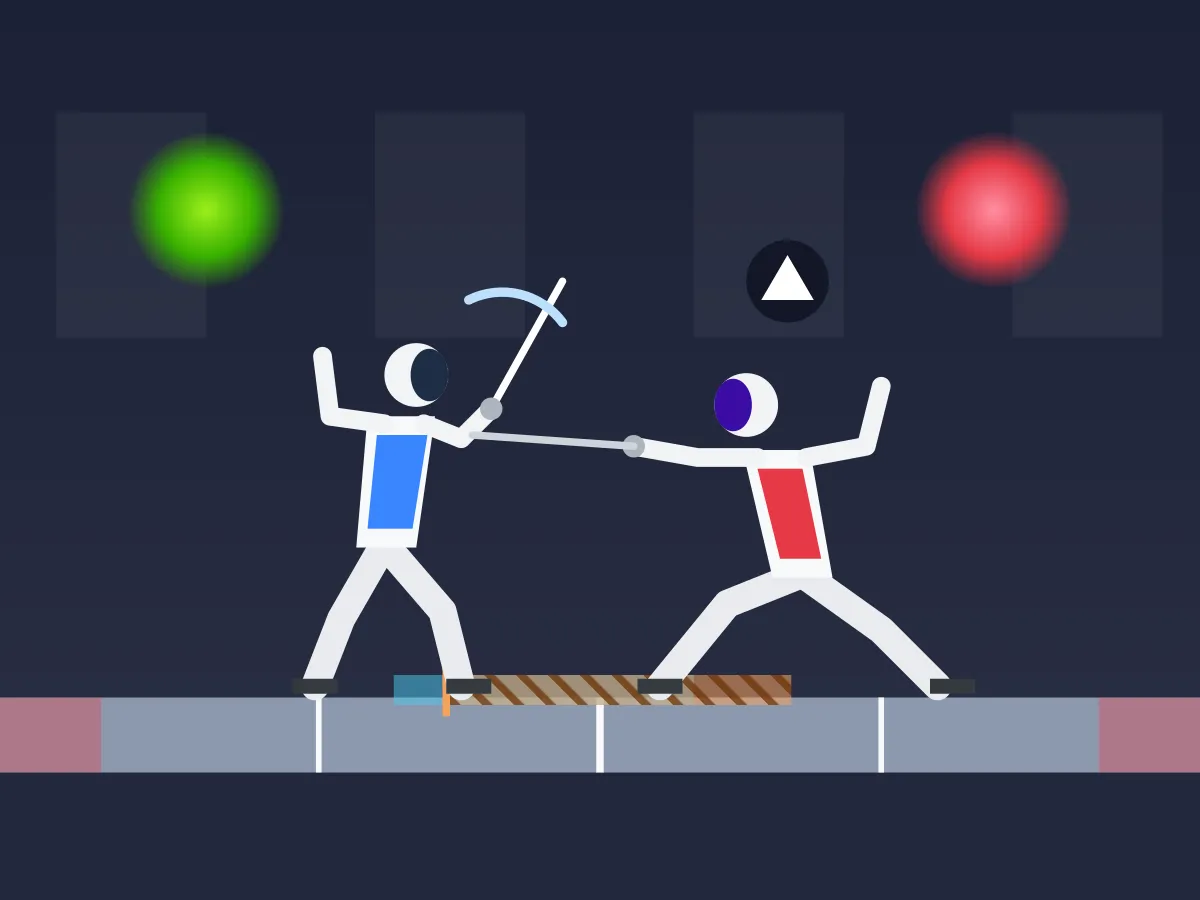





Fencing Duel is a free online fencing game about distance and timing, played side-on along a foil piste. Each fencer's lunge reaches a fixed distance, drawn as a shadow on the floor, and the whole bout turns on it: stand inside the other fencer's shadow and their lunge reaches you almost at once; stand just outside it and they have to step in first, which gives you time to step back, parry or hit them in the step. A lunge that falls short leaves its owner stuck where it ended, closer than before, and that is when you strike. Parry in the attack's line, high or low, and your riposte has right of way. When both blades land, the attack that started first scores, and an attack into a fencer who is stepping in beats their answer. Eight opponents rush, wait, feint or out-reach you. No download, no sign-up — play with a keyboard, a mouse or a phone.
How to play Fencing Duel
- Press En garde!, or any control, to start the bout. You fence on the left of the piste, your opponent on the right, both starting on the en-garde lines four metres apart.
- Watch the shadows on the floor. Each fencer's shadow shows how far their lunge reaches: yours is plain blue, theirs is striped orange. If you are standing in their striped shadow, their lunge can reach you from where they are.
- Step with A and D, or ← and →, and hold to keep stepping. A step is half a metre and cannot be stopped halfway, so the aim is to stay just outside their reach and make them come to you.
- Parry in the line of their attack. When their arm goes out, an arrow above them shows the line: ▲ is high, parry with W or ↑; ▼ is low, parry with S or ↓. A parry catches for about a quarter of a second, so time it for when the blade arrives.
- Riposte after a parry: press J or K straight away, or during the parry itself, and your riposte goes the moment their blade is caught. A riposte always has right of way.
- Lunge with J (high) or K (low). A lunge covers the whole of your reach in four tenths of a second; from further away it falls short and leaves you stuck, closer than before, while you recover. Feint with L to draw a parry.
- The first to five touches wins. When both blades land, the attack that started first scores; two attacks started together score nothing; an attack started into a fencer who is stepping in wins even against a lunge they start a moment later, though a parry still stops it. Step off the end of the piste and it is a touch against you. Level after three minutes, a priority minute follows.
Tips
- Stand just outside the striped shadow. From there they have to step in before they can reach you, and a step is something you have time to see.
- Make their lunge fall short. Step back as they step in or as their arm goes out, and the lunge stops short of you with them stuck at the end of it — lunge straight away, while they cannot parry.
- Step back a moment late rather than early. A fencer who sees you already stepping away does not lunge; one who has started lunging cannot stop.
- Never walk into their reach. A step forward cannot be parried out of, and most fencers here lunge at a step that brings you into range.
- Lunge into their step. If they step in and the step brings them inside your reach, a lunge started during the step wins the double hit even if theirs follows at once. It can still be parried, so do not start it from too far.
- Plan the riposte with the parry. Press the lunge while your parry is still up and it goes the instant their blade is caught, before they can recover.
- Do not attack a fencer who is simply standing ready outside your reach: the lunge falls short. Wait for them to move, or to miss.
- Watch your back line. The last two metres of each end are red; one more step back off the end is a touch against you, so when you are pinned there, parry instead of retreating.
FAQ
Is this fencing game free to play?
Yes. Fencing Duel runs free in your browser with no download, no install and no account, on a computer, tablet or phone.
Why does my lunge keep missing?
Because it started too far away. A lunge reaches a fixed distance, shown by your blue shadow on the floor; from further away it falls short, and a fencer who steps back as you lunge makes it fall short too. A short lunge leaves you stuck at the end of it, closer than before, so it is usually punished. Lunge when the other fencer is inside your shadow and cannot step away: when they step in towards you, or while they are stuck after a lunge of their own.
How does right of way work here?
It is foil's rule, simplified. If both blades land within a quarter of a second, the attack that started first scores. If both attacks started within a twentieth of a second of each other, nobody scores. An attack started while the other fencer is stepping in has right of way over any attack they start afterwards, even one started a moment later; a parry still takes it away. A parry in the right line takes it away from the attacker: the riposte that follows always has right of way.
How do I parry, and which line do I choose?
When the other fencer's arm goes out, an arrow above them shows the line: ▲ is a high attack, parried with W or ↑, and ▼ is a low one, parried with S or ↓. A parry in the wrong line does not stop the blade, and a parry pressed too early is over before the blade arrives. A feint shows the same arrow for a moment and then pulls back, so a parry on the first flicker can be wasted.
How do I get three stars?
By winning without conceding: three stars is a 5–0 bout against most fencers and a win conceding at most one touch against Henrik and Amara, and two stars allows two touches against (three against those two). The marks were measured with test players over 30 bouts per fencer and checked on 30 more. A player reacting in about 0.15 seconds who keeps the distance took three stars off every fencer in at least seven bouts out of ten; one reacting in about a quarter of a second won nearly every bout against the first five fencers, but did not take three stars reliably from the third fencer on apart from Henrik.
Can I win by just lunging over and over, or by walking straight in?
Not for long. A test player that lunged from wherever it stood, over and over, won at most three of 30 bouts against the first fencer, at most one against the second, and none against anyone after. One that walked straight in and lunged as soon as it was in reach beat the first two fencers, both rushers who walk onto the blade, and lost every bout against the other six.
Why not just stand close and attack?
Because close to the other fencer, their lunge arrives before you can parry it, and the one who moves second loses. In the tests, a quick player who stood in close instead of keeping its distance won at most ten of 30 bouts against every fencer from the second on, while the same player keeping its distance won at least 29.
How many opponents are there, and do they get harder?
Eight: two rushers, three counter-punchers who wait just outside your reach, two feinters and a tall fencer whose lunge reaches further than yours. The last two see you sooner, parry in the right line more often and move faster than any fencer before them. You unlock each one by beating the one before. A player reacting in about a quarter of a second wins fewer than seven bouts in ten against each of the last three, and fewer against each than the one before.
What happens when time runs out?
After three minutes of fencing the leader wins. If the score is level, a priority minute follows: the next touch wins, and if the minute ends level too, whoever was given priority by the draw at its start wins the bout.
Can I play fencing on my phone?
Yes. Seven pads sit under the piste — Back, Fwd, Feint, two parries and two lunges — and the step pads keep stepping while you hold them. It works upright or sideways.
Is it the same bout every time?
Each fencer always has the same style and skill. The timing is not the same: every rematch draws a fresh bout, so their steps, attacks and feints come at different moments and you have to read them rather than memorise a pattern.