








Home / Reaction / Paper Plane Glide
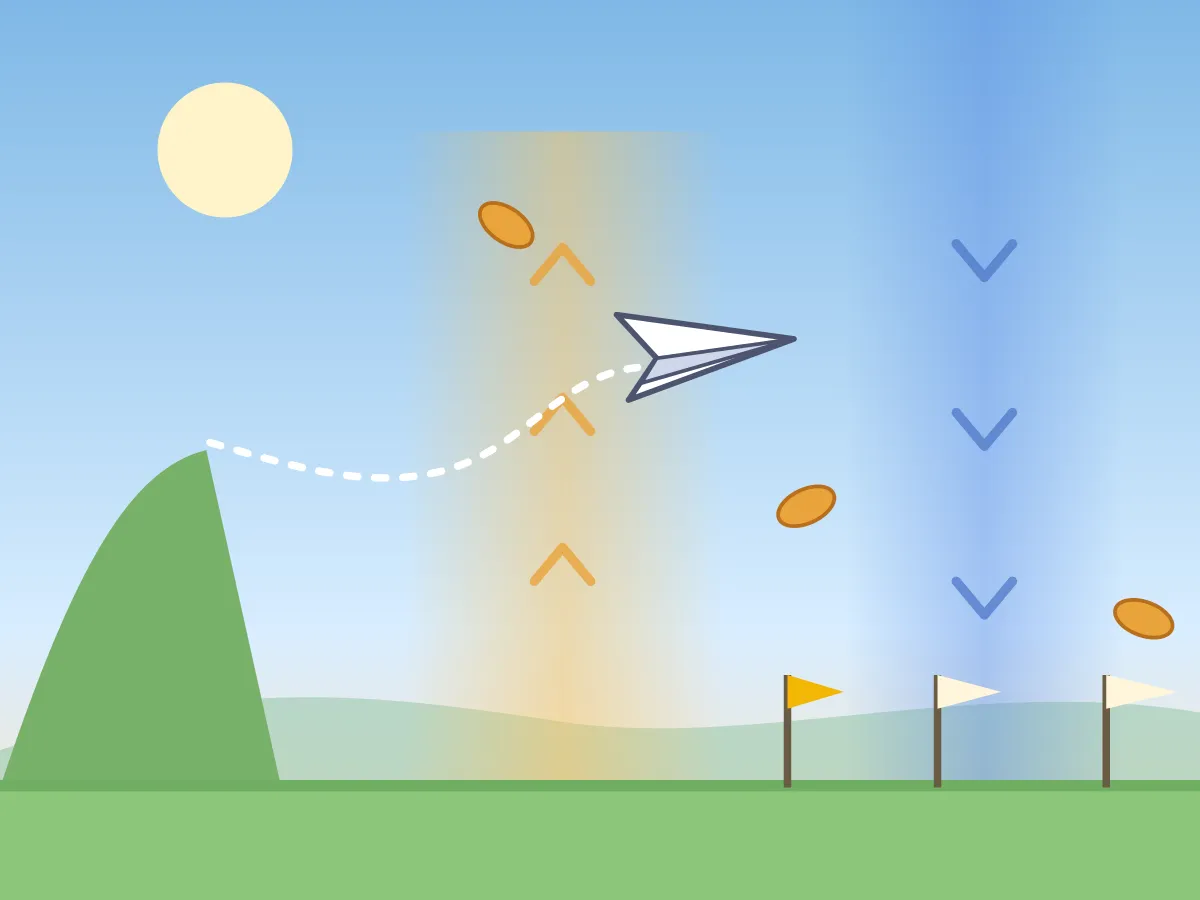
Paper Plane Glide is a free online paper plane game about the one thing a glider has to spend: height. You throw the plane from a garden, a window, a hill, a pier or a harbour tower, and after that the only control is the nose. Hold to lift it — more lift, more drag, a slower plane — and let go to let it drop and pick up speed. Hold too long and the wing stalls, the lift falls away and the plane sinks like the sheet of paper it is. The air along each course is not still: gold columns of rising air will carry a plane that flies slowly through them, and blue columns of sinking air punish one that dawdles, so the flight that goes furthest is the one that changes speed with the air — the rule real glider pilots call speed to fly. Eight courses, three distance flags each, and golden leaves laid along the best line. The flags are not set by feel: each one sits between two measured test pilots of different reaction speeds, so a throw alone never earns a star, steady flying earns one, and three stars need quick, frequent corrections. It is a calm game with no timer and no enemies, it runs in the browser with no download, and it plays with a mouse, a keyboard or a finger.
How to play Paper Plane Glide
- Press Play. The plane waits at the launch point — a hand, a window, a hilltop, a pier or a tower.
- Drag back from the sky and let go to throw: the direction of the pull sets the angle and its length the strength. Or use the up and down arrows for the angle, left and right for the strength, and space to throw.
- In flight there is one control. Hold — space, the up arrow, or press anywhere on the sky — to lift the nose. Let go and it drops.
- A raised nose gives more lift and more drag, so the plane slows and floats. A lowered nose runs faster and sinks faster.
- Holding too long stalls the wing. The HUD shows STALL; let go so the nose drops and the wing flies again.
- Gold columns are rising air, blue ones sinking air. Fly slowly through gold to be carried up, and quickly through blue to spend as little time in it as you can.
- Golden leaves float along the best line through each course. Each one caught is worth fifteen points.
- The flight ends when the plane touches the ground. Three flags mark the distances for one, two and three stars; one star opens the next course.
Tips
- The nose moves gradually, not instantly. Short presses are corrections; a long press is a pull-up, and a longer one is a stall.
- Dive to buy speed, then pull up to spend it on height. A plane that arrives at a gold column fast can climb through it instead of just floating across.
- Let the nose drop just before a blue column, not inside it. By the time you feel the sink the fastest line through it has already started.
- In rising air, fly slow. The slower you cross a column, the longer it has to lift you — right up to the edge of the stall and no further.
- A hard throw is not always the long one. A flat, strong throw keeps the speed for a pull-up; a steep one spends it on height you then have to glide back down.
- Headwind courses reward flying a little faster than feels natural — the wind takes more distance from a slow plane than a quick one.
- Watch the dotted trail. A wavy line means you are over-correcting; long, smooth arcs go further.
- The dashed purple line on the ground is your best flight on this course. Beat it first, then chase the next flag.
FAQ
Is Paper Plane Glide free to play?
Yes. It runs free in your browser with no download, no install and no account, on a computer, tablet or phone.
How do you control the paper plane?
After the throw, with the nose only. Hold to lift it and let go to let it drop. There is no steering left or right and no engine — like a real paper plane, it can only trade speed for height and back.
Why does my plane suddenly fall?
It stalled. Holding the nose up for too long raises it past the angle the wing can fly at, the lift collapses and the drag jumps. Let go, the nose drops, and the plane flies again once it has speed.
What are the gold and blue columns?
Air moving up and down. Gold is rising air that carries the plane higher if you fly slowly through it; blue is sinking air that pushes it down, so cross it quickly.
How far can a paper plane glide in the game?
In still air it covers about ten metres for every metre of height, and the rising air on each course can stretch a flight well beyond that — the longest courses run past four hundred metres.
How are the stars decided?
By distance, with three flags per course. The flags were placed from test pilots: a throw with no flying never reaches the first, a slow, steady pilot passes it, and three stars need quick, frequent corrections through the rising and sinking air.
Is the same course the same every time?
Yes. There is no randomness anywhere — the air, the leaves and the flight physics are fixed, so the same throw flown the same way lands in the same place.
Is there a timer or anything chasing me?
No. It is a calm game: one flight at a time, no clock, no enemies. The only thing against you is the ground.