
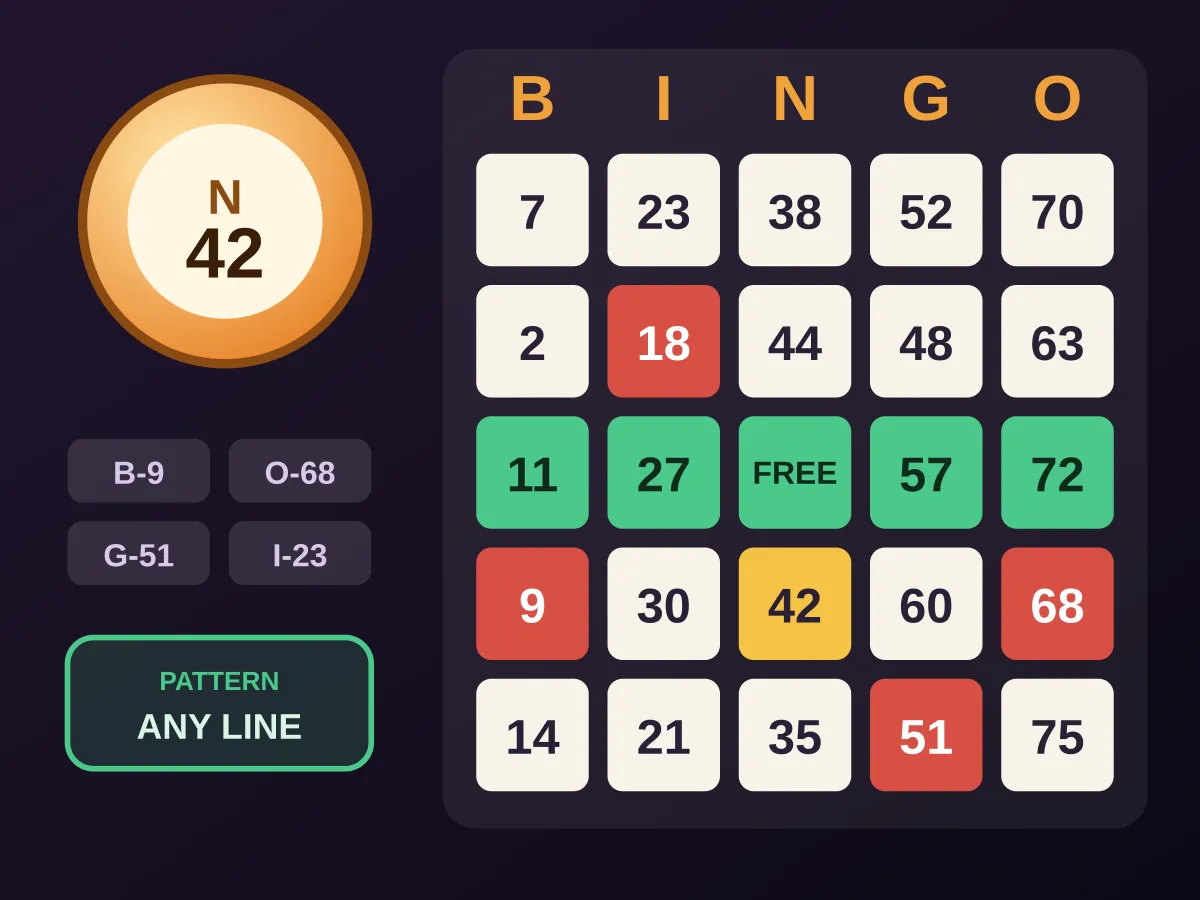

Bingo is free online 75-ball bingo for one player, with no download, no sign-up and no money involved — nothing to buy, nothing to bet and no prizes, just the game. Your card is built the way a real one is: the B column holds 1 to 15, I holds 16 to 30, N 31 to 45, G 46 to 60 and O 61 to 75, with a free square in the middle of the N column. Press Call Ball and a number rolls out in its column colour — blue B, red I, white N, green G, yellow O — and lights up on a 75-number caller board, so you can check at a glance what has already come out. Then you daub it on your card yourself. A number you have not covered does not count toward a bingo, which is the whole skill of the game, though any number already called stays open to daub until the round ends. Twelve levels work through four patterns — any line, four corners, a big X and a full blackout — inside a ball limit, and from level 4 they add rival cards that never miss a number, each with a live count of the squares it still needs. Ball limits are set from measured deals rather than guessed, so every level can be won and none is a formality. A short guide explains the rules the first time you play, and auto-daub and auto-call are there if you would rather sit back and watch the race.
How to play Bingo
- A short guide opens the first time you play and walks through the three steps below. Press "Call the first ball" to close it and start, or reopen it any time from the ? button beside New Cards.
- Press Call Ball to draw the next number. It rolls into the caller in its column colour, the last few balls sit beside it, and the 75-number caller board lights up every ball called so far. Only the cards you see are in play; each round deals a fresh set from a shuffled 75-ball draw.
- Tap that number on your card to daub it. Only called numbers can be daubed, and a number glowing amber is one that has been called but not yet covered. A number you skipped stays daubable for the rest of the round, so you can go back for it. The tag above each card counts how many squares you still need.
- The centre square is free and counts as daubed from the start, on every pattern that uses it.
- Complete the level's pattern with your own daubs to call bingo: any full row, column or diagonal on the early levels, then four corners, both diagonals as a big X, and finally a full blackout. The small card beside the caller draws the pattern, and on corner and X levels the squares that count are outlined on your card.
- From level 4 there are rival cards in play. They are checked against the balls rather than against daubs, so they never miss a number, and the rivals panel shows how many squares each one still needs. If any of them completes the pattern first, the round is lost.
- Each level has a ball limit, shown in the header and on the meter under it. Reach it without completing the pattern and the round is lost. Auto-daub covers every called number for you and is remembered between visits; auto-call draws a new ball every few seconds until you switch it off.
- Win a level to unlock the next one, up to level 12. New Cards deals a different set of cards and a different draw for the same level; the level picker lets you go back to any level you have already unlocked.
Tips
- Learn the column ranges. When B-7 is called you only need to look at the left column — checking all 25 squares every ball is what makes people miss numbers.
- Glance at the caller board, not just the last ball. If you looked away for a couple of calls, every lit number on the board is one you may still need to daub.
- On two- and three-card levels, scan every card for the same number before moving on. It is called once and it is easy to daub one card and forget the other.
- Four corners looks easy and is not. Only four specific numbers matter and none of them is the free square, so on one card it usually takes about 64 balls against roughly 43 for a line.
- A big X needs nine squares but the two diagonals share the free square, so it is really eight numbers — better odds than the picture suggests.
- Watch the rivals panel. A rival flashing "1 to go" can win on the very next ball, so that is the moment to make sure every called number on your own card is daubed before you call again.
- Do not leave auto-call running on rival levels unless auto-daub is on too. A ball arrives every few seconds whether you have daubed or not, and the rivals never fall behind.
- Turn auto-daub on for the blackout levels. Twenty-four numbers across three cards is a bookkeeping exercise rather than a game, and the rivals will not wait.
FAQ
Is this bingo game free to play?
Yes. It runs entirely in your browser with no download and no account. All twelve levels are free, there are no in-game purchases, and level progress saves on your own device.
Is there any real money or gambling involved?
No. There are no stakes, no bets, no coins to buy and no prizes of any kind. This is bingo played for the game itself, the way you would play it at home with cards and a caller, so it is fine for anyone to pick up.
How do you play bingo?
Numbers are called one at a time. Each time one matches a square on your card, you daub (cover) it. When the covered squares form the pattern for that game — a line, four corners, an X or the whole card — you have a bingo and win. Here you press Call Ball to draw each number and tap your card to daub, and the game checks the pattern for you.
What is 75-ball bingo?
75-ball bingo is the version played across North America. The balls are numbered 1 to 75, and each card is a 5x5 grid headed B-I-N-G-O with a free centre square. Games are won with a pattern rather than by lines alone, which is why one session can play any line, four corners, an X and a blackout in turn.
How is a 75-ball bingo card built?
Five columns of five, each drawing from its own range: B is 1 to 15, I is 16 to 30, N is 31 to 45, G is 46 to 60 and O is 61 to 75. No number appears twice on a card, and the centre of the N column is a free square that counts as already covered.
What patterns can I play?
Four, across the twelve levels: any line, meaning any full row, column or diagonal; the four corner squares; a big X made of both diagonals; and a blackout, also called a coverall or full house, which is every square on the card.
What is the free space in bingo?
The middle square of the card, in the N column. It has no number and counts as daubed from the first ball, so any line through the centre, and the big X, needs one number fewer. It does not help four corners at all.
Do I have to daub the numbers myself?
By default yes, and an undaubed number does not count toward your bingo — that is the skill. A number you missed stays daubable until the round ends, so you can still go back for it. If you would rather not, auto-daub covers every called number automatically and the setting is remembered.
How fast are the numbers called?
As fast as you like. Each press of Call Ball draws one number, so you set the pace. Auto-call draws one every few seconds on its own and stops when the round ends or when you switch it off.
What is the difference between 75-ball and 90-ball bingo?
75-ball bingo, the American game played here, uses a 5x5 card headed B-I-N-G-O with a free centre square and is won with a pattern such as a line, four corners or a blackout. 90-ball bingo, the British game, uses tickets of three rows and nine columns and pays out for one line, two lines and a full house. This game plays 75-ball only.
How many balls does it usually take to get a bingo?
On one 75-ball card, measured over hundreds of deals here: a single line typically lands around the 43rd ball, four corners around the 64th, a big X around the 70th, and a blackout needs nearly all 75. Playing more cards at once brings every one of those numbers down, which is why the later levels give you two or three.
How do the rival cards work?
They are ordinary bingo cards dealt from the same deal as yours, and they are checked against the balls rather than against daubs, so they never miss one. The rivals panel shows how many squares each one still needs, and if a rival completes the pattern before you do, the round ends.
Can I play bingo on my phone?
Yes. The game works in any modern mobile browser in portrait, with the caller, pattern and rival counts in a strip above your cards and every daub a single tap. On narrow screens the 75-number board is left out so the cards stay large; the recent balls beside the caller show what has just come out.