
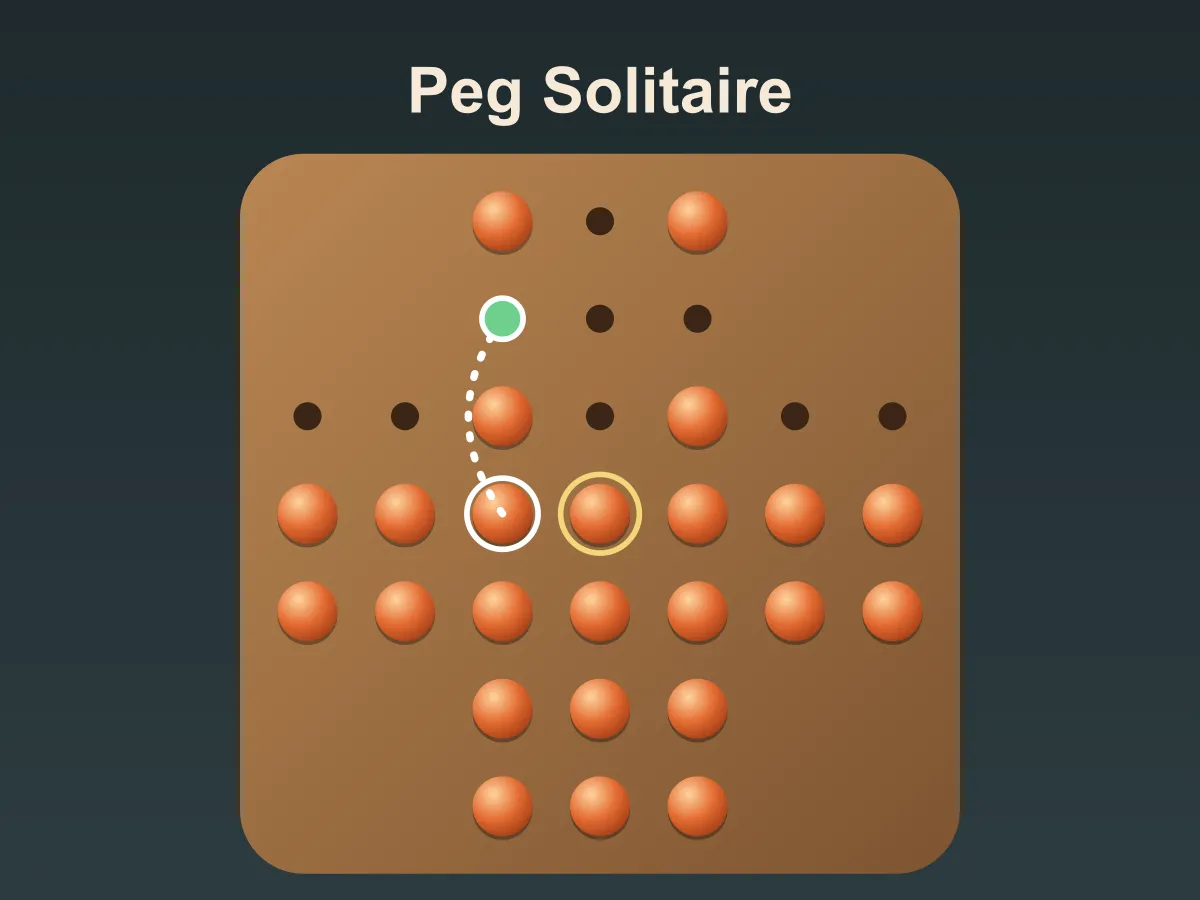



Peg Solitaire is a free online version of the classic board puzzle, also known as marble solitaire or Brainvita. The board is full of pegs with one hole empty. A peg jumps over a neighbour into an empty hole just beyond it, and the peg it jumped over comes off. Keep jumping until no jump is left: one peg is a win, and one peg in the ringed goal hole is a perfect finish. Twelve boards build up to it — small shapes on the English board such as the Cross, the Plus, the Pyramid and the Fireplace, the fifteen-hole triangle where jumps run along all three sides, a plain rectangle, then the full 33-hole English board, a harder off-centre start, and the 37-hole European board. Every board ships with a winning line the game has actually played through, so every one can be finished. Tap a peg and then a glowing hole, or drag the peg across; undo is unlimited, and three hints per board point at a jump that still leads to the ring. No download, no account.
How to play Peg Solitaire
- Every hole but one starts with a peg in it. The empty hole is where the first jump lands.
- A peg jumps over a peg next to it, straight across, into the empty hole directly beyond. The peg it jumped over is taken off the board.
- On the square boards pegs jump up, down, left or right, never diagonally. On the triangle they jump along any of its three directions.
- Tap a peg to pick it up; the holes it can jump into glow green. Tap one to jump, or drag the peg straight into it.
- After a jump the same peg stays picked up if it can jump again, so a chain of jumps is a run of taps.
- Keep going until no jump is left anywhere. One peg left passes the board. One peg left in the ringed goal hole is a perfect finish.
- Undo takes back one jump, as many times as you like. Restart puts every peg back.
- The ? button shows a jump that can still finish on the ring, backing up first if the ring is already out of reach. Three per board.
- On a keyboard, arrow keys move the highlight, Space or Enter picks up and jumps, Escape puts a peg down, U undoes and H asks for a hint.
- Stars: three for the ring with no undo and no hint, two for the ring with undos, one for a single peg anywhere or a finish with hints.
Tips
- Count first: every jump removes exactly one peg, so a board of 32 pegs needs 31 jumps to finish with one. The question is only which ones.
- Clear the far ends of the arms early. A peg at the tip of an arm has very few ways out, and once its neighbours are gone it is stranded for good.
- Keep the pegs in one group. Two pegs that end up far apart with empty holes between them can never meet again.
- Think in packages: three pegs in an L next to an empty hole can usually be cleared as a unit, and most classic solutions are built from such small clean-ups.
- Work towards the goal, not away from it. The last few jumps must bring a peg into the ring, so save pegs near it for the end.
- Long chains are good. One peg jumping three or four times in a row clears a lot of the board while leaving the rest untouched.
- On the triangle, the corners are the hard part: a corner peg can only leave along the two sides it sits on.
- Stuck with two or three pegs left? Undo a few jumps rather than one. The mistake is usually several jumps back.
FAQ
Is Peg Solitaire free to play?
Yes. It runs in the browser with no download, no sign-up and nothing to buy. All twelve boards are included and open up as you finish them.
How do you win peg solitaire?
By leaving a single peg on the board. Each jump removes one peg, so you win when every jump you made was one the board could afford. Finishing with that last peg in the ringed goal hole — the centre, on the classic English board — is the perfect finish, and the only way to three stars.
Is the English board always solvable?
From the classic start, yes: 32 pegs with the centre empty can be brought down to one peg in the centre, in 31 jumps. Every board in this game ships with a winning line the game has played through on its own rules, and the tests replay each one, so every board you are given can be finished.
Why does the European board not start from the centre?
Because from the centre it cannot be solved at all. Colour the holes in three repeating colours along the diagonals, once each way. A jump always covers one hole of each colour, so it flips every colour count between odd and even at the same time, and the pattern of which counts agree never changes. With the centre empty, the 37-hole board starts with a pattern that no single peg anywhere on it has, so no line of jumps can end with one peg. The game starts it one row down from the top instead, which can be finished.
What is the triangle version?
Fifteen holes in a triangle, often found on restaurant tables. Pegs jump along any of the three directions of its sides. The Top Hole level is that classic start, with the top hole empty; the Triangle level starts from the middle of a side and must finish back in the same hole.
Is this the same game as Peg Pop?
No. Peg Pop, also on this site, is an arcade game where you fire a ball into a board of pegs. Peg Solitaire is the old board puzzle with no ball and no luck at all: pegs jump over each other, one comes off each time, and the only question is the order.
What does the hint do?
It shows one jump from which a finish on the ring is still possible, and picks up that peg for you. If the ring can no longer be reached from where you are, it first goes back to the nearest earlier position that can still finish, and says how many jumps it undid. On the three full boards the search can take a few seconds — the board says it is looking — and a position can be too tangled to settle even then; the hint then says so and goes back to the nearest jump it can confirm. You get three hints per board, and using one costs the three-star finish.
Why is there no warning when the board is lost?
On purpose. The game can often tell exactly when a jump has made the ring unreachable, but announcing it after every jump would turn each board into trying a jump and undoing it. You find out when you run out of jumps — or by spending a hint.
How hard are the levels?
The order is measured. For each board the game estimates the chance that a player who jumps completely at random finishes on the ring: about 1 in 64 on the Cross, 1 in 1,700 on the Pyramid and 1 in 200,000 on the Fireplace. The three full boards, with 32 to 36 pegs, come last.
Does it work on a phone?
Yes. Tap a peg and then a hole, or drag the peg across. The board scales to the screen, and on a phone held sideways the controls move beside it.