
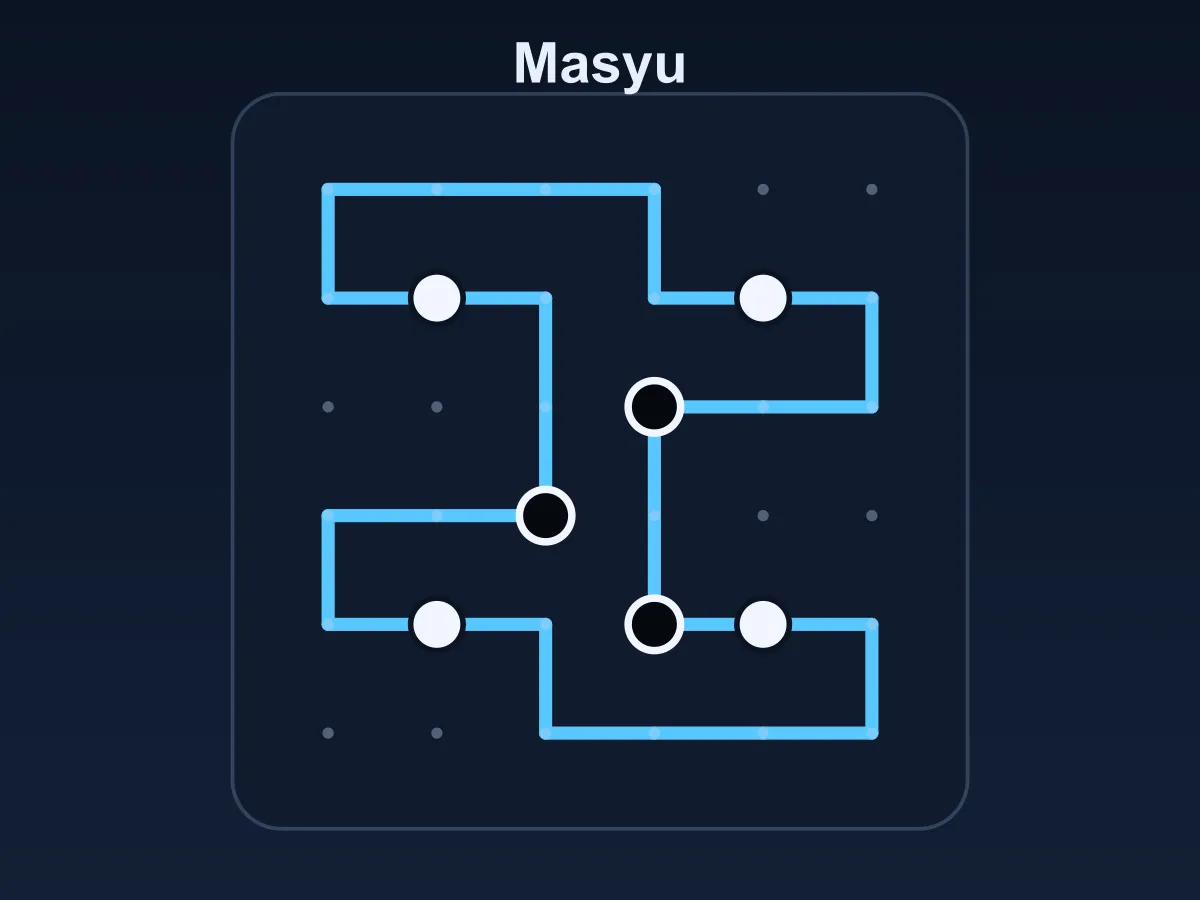




Masyu is a free online loop puzzle. You draw a single closed line that runs between cell centres, never crosses or reuses a cell, and does not have to visit every cell. Two kinds of circle tell you what the line does: at a white circle the loop passes straight through and must turn in at least one of the two cells either side, and at a black circle the loop turns and must run straight through both of the cells either side. That second half of each rule is what makes it a puzzle rather than a tracing exercise — a circle constrains its neighbours, not just itself. Drag to draw a segment, drag back over it to rub it out, or tap one segment to cycle it between drawn, ruled out and blank. Eight levels grow from a 5×5 with a short loop to an 8×8 that fills most of the board, every one generated with exactly one answer and checked by a full solver before it reaches you. No download, no account.
How to play Masyu
- Drag from one cell to the next to draw a segment of the loop. Drag back along a segment you have drawn to rub it out.
- Tap a single segment to cycle it: blank, drawn, ruled out with a small cross, blank again. The crosses are for your own notes — they never affect the answer.
- The loop is one closed line. It runs between the centres of neighbouring cells, never crosses itself, and never enters the same cell twice.
- The loop does not have to visit every cell. Plenty of cells stay empty, and that is normal.
- At a white circle the loop goes straight through — and it must turn in at least one of the two cells immediately either side.
- At a black circle the loop turns — and it must go straight through both of the cells immediately either side.
- A circle your drawing has already broken turns red, and so does any cell where three segments meet — no loop can ever do that. The Mistakes counter in the header shows how many there are.
- A cell with only one segment is a loose end, not a mistake, so it is never marked red. It still has to be tidied up: the loop only closes when every cell it uses has exactly two.
- On a keyboard, the arrow keys move the highlighted cell, Shift with an arrow draws or erases the segment in that direction, and Alt with an arrow marks one as ruled out.
- Undo steps back one change. Clear wipes the board without changing the puzzle. New Puzzle generates a different board on the same level.
- The ? button fixes one segment for you — it rubs out a wrong one first, and draws a missing one otherwise. Three per board.
Tips
- Start at the edges. A circle on the border has fewer directions available, and a white circle on an edge can only run along it.
- A black circle two cells from a wall is pinned: the loop has to turn there and run straight for two cells in each of the two directions it takes, so it cannot point at the wall.
- Two white circles side by side in a line force the loop to run straight along that whole line, because a turn at either would break the other.
- Two black circles next to each other cannot both turn into the space between them — the straight run one of them needs would pass through the other.
- Use the ruled-out crosses as hard as you use the lines. Knowing where the loop cannot go closes a cell down to one option far more often than knowing where it can.
- Count segments per cell as you go. Every cell the loop uses has exactly two, so a third one is wrong the moment you draw it — the Mistakes counter says so immediately.
- When a long stretch of loop is fixed, look at what it has stranded. A cell the loop can no longer reach on either side is a cell it never visits.
- If a board feels arbitrary, it is not: every one is verified to have a single answer before you see it, so there is always a next segment you can justify.
FAQ
Is Masyu free to play?
Yes. It runs in the browser with no download, no sign-up and nothing to buy. All eight levels are included and unlock as you clear them.
What do the white and black circles mean?
At a white circle the loop passes straight through, and it must turn in at least one of the two cells immediately either side. At a black circle the loop turns, and it must run straight through both of the cells immediately either side. Each rule has two halves — one about the circle itself and one about its neighbours — and the second half is where almost all the deduction comes from.
Does the loop have to go through every cell?
No. That is the difference between Masyu and a Hamiltonian loop puzzle. Plenty of cells stay empty; what has to be true is that the line is closed, never crosses itself, and satisfies every circle.
Does every puzzle have exactly one answer?
Yes, and it is checked rather than assumed. Each board is generated from a real loop, then every circle the loop could legally carry is placed and taken away one at a time, keeping a removal only when an exhaustive solver still finds a single answer. That is why a correct loop is never rejected and a guess is never necessary.
What are the small crosses for?
They are your own notes: a segment you have decided the loop does not use. They are ignored when the board is checked, so marking one wrong costs you nothing but your own time — and on the bigger boards they are usually what makes the next deduction visible.
Why has a cell turned red?
Either a circle whose rule your drawing has already broken, or a cell where three segments meet — no loop can do that, so it is wrong the moment it appears. A cell with a single segment is only a loose end and is never marked, because an unfinished line is not a mistake. It does still have to be tidied up before the loop counts as closed.
How many levels are there?
Eight, running from a 5×5 with a short loop up to an 8×8 whose loop covers most of the board. The loop gets longer at every step, which is the thing that actually makes the later boards harder.
Can I get a different board on the same level?
Yes. New Puzzle generates another board on the same level. Boards are seeded, so a level always opens with the same one and each New Puzzle reliably differs from the last.
Does it work on a phone?
Yes. Dragging across cells draws the loop and dragging back rubs it out, which is the whole input. The board scales to the frame so the full grid stays on screen in portrait.