
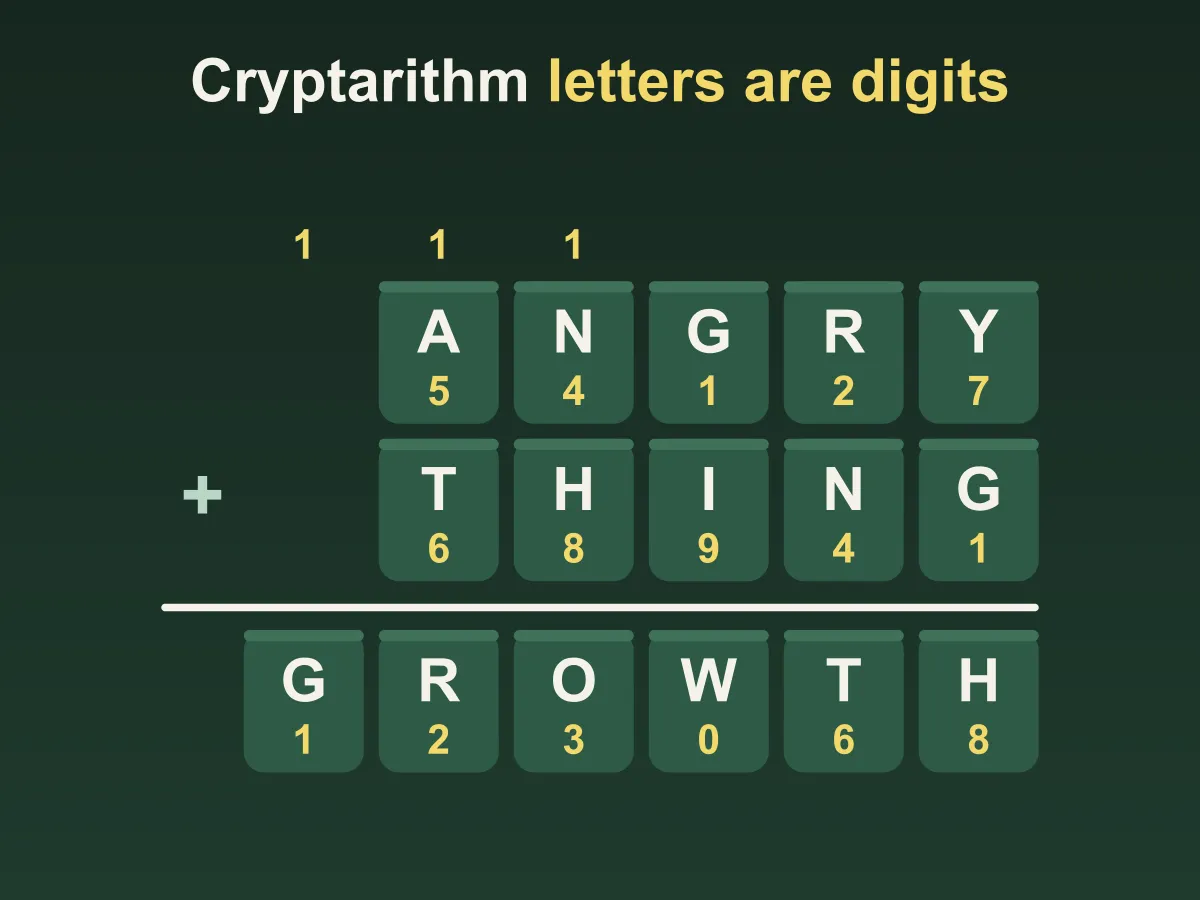


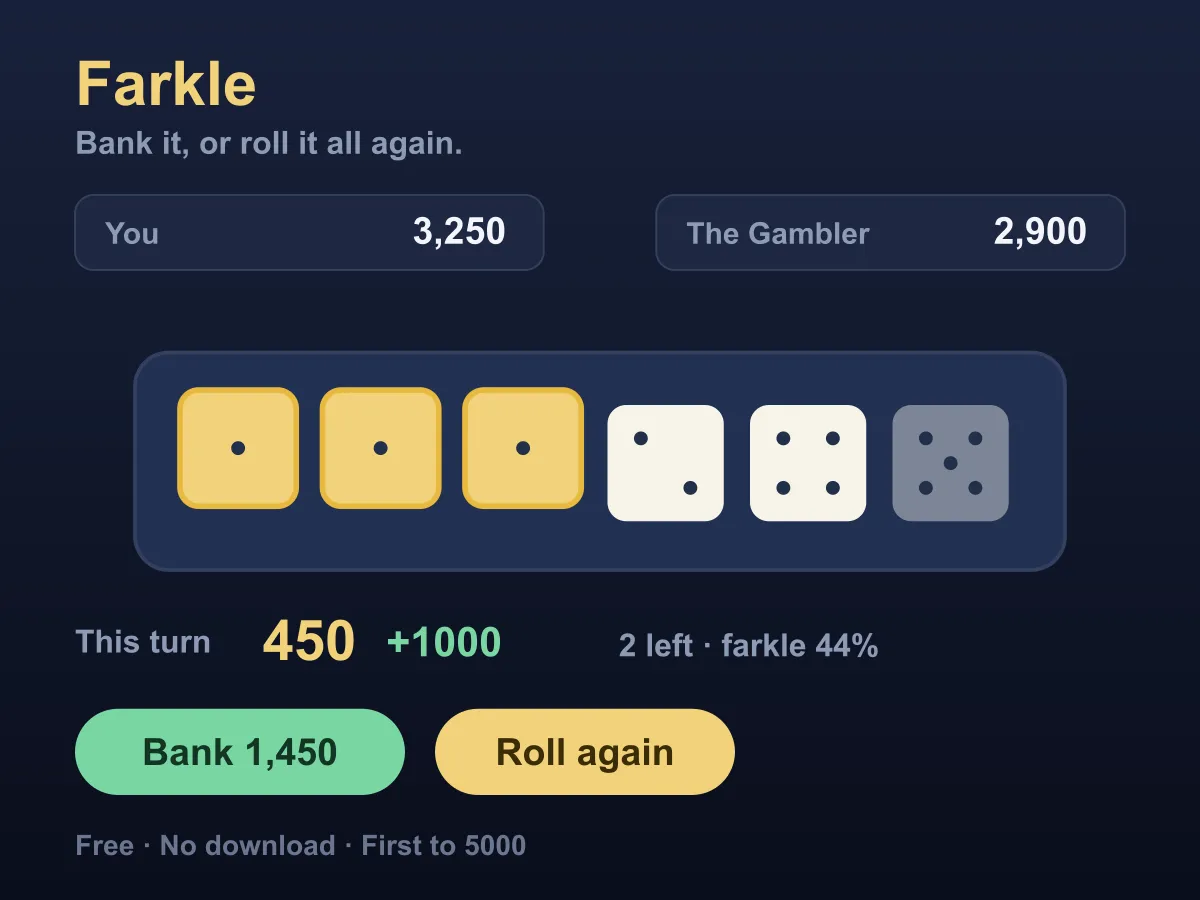


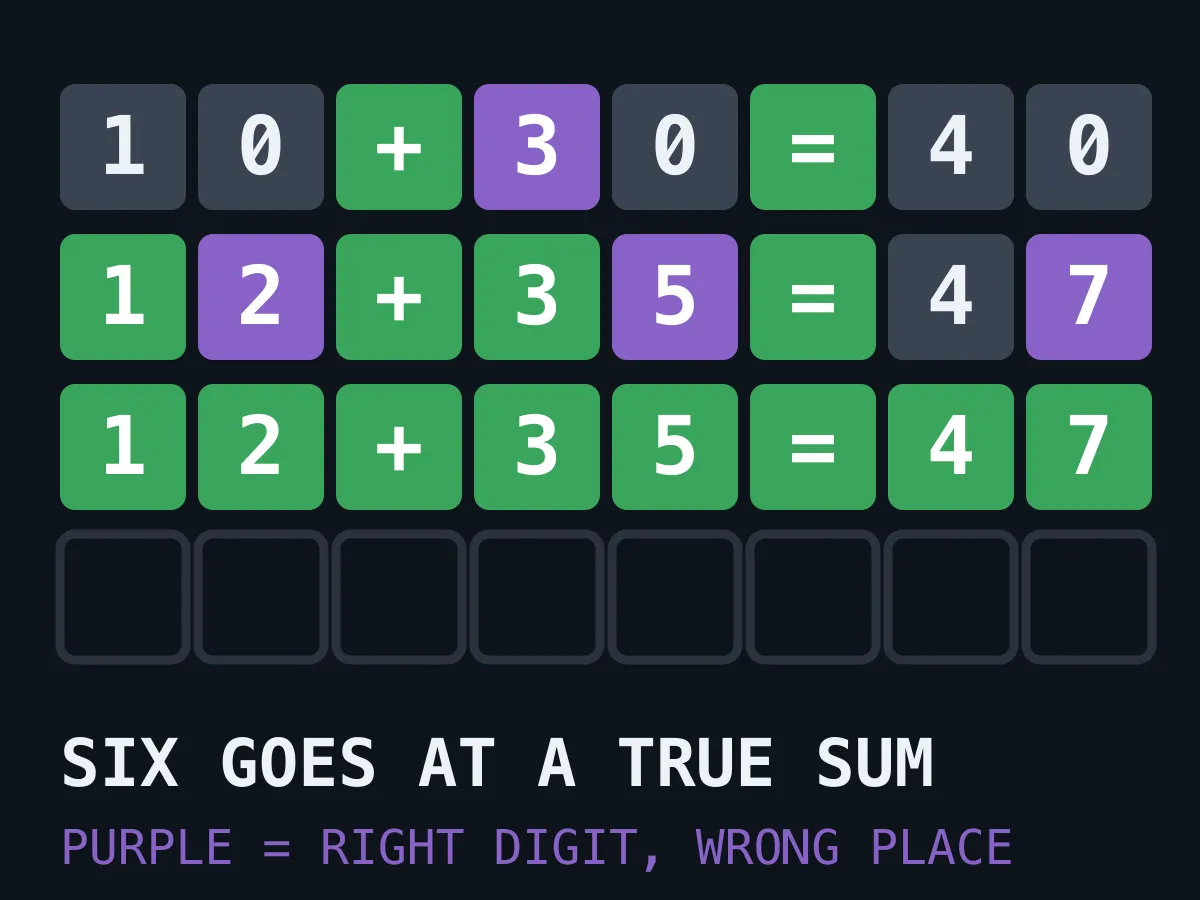



Cryptarithm is a free online math puzzle of letter arithmetic, the kind made famous by SEND + MORE = MONEY. A sum is written in words, and every letter stands for one digit: the same letter is always the same digit, two different letters are never the same digit, and no number starts with 0. Find the digits that make the sum true. Tap a letter, in the sum or in the table under it, then tap a digit; on a keyboard, type the letter and then the digit. The board does the margin working for you as you go: once every letter in a column and the carry into it are known, the carry it sends left appears above the next column and the column is marked green if it adds up or red if it does not, and two letters on one digit or a 0 at the front of a word are flagged at once. Nine levels go from short sums a few letters long, through sums that use all ten digits, subtractions and three-word additions, to coded multiplication, where each letter's digit is its place in a hidden ten-letter key word (the first letter is 0, the next 1, and so on) and the win card shows the whole word, and a final set that needs a "what if" inside a "what if". Every puzzle has exactly one answer, checked by the game's own solver, and every one can be finished by reasoning. No download, no account.
How to play Cryptarithm
- The puzzle is a sum written in letters. Each letter stands for one digit from 0 to 9. The same letter is always the same digit, and two different letters are always different digits.
- No number starts with 0, so the first letter of every word of two or more letters is 1 to 9.
- Tap a letter, in the sum or in the row of letter buttons under it, then tap a digit on the pad to give it that digit. Tapping the same digit again takes it off, and ⌫ clears the selected letter. After each digit the selection moves on to the next letter without one, unless the digit clashes with another letter.
- On a keyboard, type a letter to pick it and a digit to set it. Backspace clears, the arrow keys step through the letters, and Escape lets go.
- Work from the right. When every letter in a column and the carry coming into it are known, the carry it sends on appears above the next column, and the column turns green if it adds up or red if it does not. A digit on two letters, or a 0 at the front of a word, is marked straight away.
- Check column says which of your digits in the highlighted column are right, three times per puzzle. Tap a letter in the column you want checked first.
- Subtraction levels read top to bottom as usual, and the small −1 above a column is the 1 it lends to the column on its right. On the coded multiplication levels every letter comes from a ten-letter key word with no repeated letter, and its digit is its place in that word, counting from 0. A product usually uses only some of the ten letters, and any letter shown in gold is already given.
- The puzzle is solved when every letter has its digit. Undo steps back, Clear wipes your digits, Replay starts the same puzzle again, and New Puzzle gives a different one on the same level.
Tips
- Look at the leftmost column first. When the answer is one letter longer than the numbers being added, its first letter is the carry, and adding two numbers can only carry 1 — so that letter is 1.
- A column where a letter plus something equals the same letter tells you a lot: the something must be 0, or 9 with a carry coming in.
- Two numbers of the same length that make a longer answer both start big. In SEND + MORE = MONEY, M is 1, so S must be 8 or 9 to reach five digits.
- Keep track of the carries. Every column sends 0 or 1 to the left when two words are added, and at most 2 with three words, so each column narrows down the next.
- If a puzzle uses all ten letters, every digit is used exactly once, so a digit that can only fit one letter belongs to that letter.
- When reasoning stalls, pick a letter with two or three possible digits and try the first. If a column then cannot add up, that digit is out.
- In coded multiplication, the multiplier letter times the last letter of the top number gives the last letter of the answer. Try the small multiplication tables against it before anything else.
FAQ
Is Cryptarithm free to play?
Yes. It runs in the browser with no download, no sign-up and nothing to buy. All nine levels are included and unlock as you solve them.
What is a cryptarithm?
A sum written in letters instead of digits, where each letter stands for one digit and the job is to find which. They are also called alphametics or verbal arithmetic. The best-known one, SEND + MORE = MONEY, was published by the puzzle writer Henry Dudeney in 1924, and its one answer is 9567 + 1085 = 10652.
What are the rules?
Every letter is a digit from 0 to 9. The same letter is always the same digit, different letters are always different digits, and no number of two or more digits starts with 0. With those rules the sum has to be true.
Does every puzzle have exactly one answer?
Yes, and it is checked rather than assumed. The word puzzles were picked from thousands of real-word sums that a search proved to have a single answer, and the game's tests prove it again for every one. Each multiplication is built with a real product and letters are revealed only until one answer is left.
Will I have to guess?
No. Every puzzle can be finished by reasoning. The first two levels need nothing more than working through the columns and carries, every puzzle on the middle word levels needs at least one "what if", and the final level always needs a "what if" inside another one. The game's own solver grades every word puzzle this way. The multiplication levels make no difficulty promise: letters are revealed in gold until only one answer is left, and working a product out usually means trying a few digits for the first factor.
How is this different from a cryptogram?
A cryptogram hides a sentence behind swapped letters and you decode the words. A cryptarithm hides numbers: the words are already there, and you find the digit behind each letter so the arithmetic works. If you prefer decoding quotes, Cryptogram is also on this site.
How many levels are there?
Nine: short sums, longer word sums, sums with carries that need a "what if", sums that use all ten digits, subtraction, three-word addition, coded multiplication, coded long multiplication with its partial products, and a hardest level of ten-letter sums. Each word level has thirty puzzles, the multiplication levels build a new one every time, and New Puzzle moves to the next.
What is coded multiplication?
A real multiplication written in the letters of a ten-letter word with no repeated letter, such as BLACKSMITH, where the first letter stands for 0, the second for 1, and so on. A product rarely needs all ten, so you solve the letters it uses and the win card then shows the whole key word. A letter or two may be given in gold so that there is only one answer.
Is it good for practising math?
Yes. Every step is column addition with carrying, subtraction or times tables, done in your head against a fixed target, and the running carries and green or red columns let you check each step. It suits older children, adults and anyone who likes logic puzzles.
Does it work on a phone?
Yes. Tapping a letter and then a digit is the whole input, and on a phone held upright the frame grows taller so the sum, the letter buttons and the digit pad all fit with room to tap.