






Home / Simulation / Scam Call Center
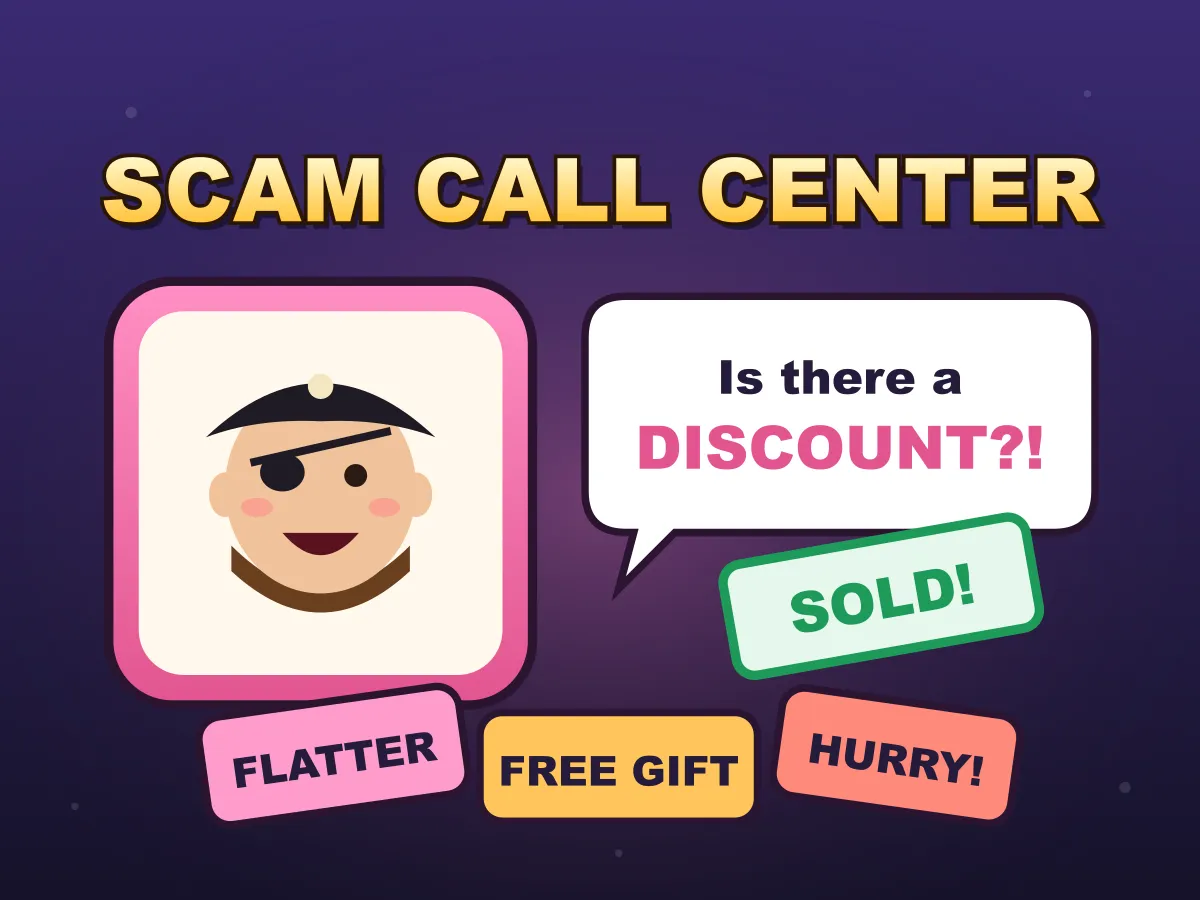
Scam Call Center is a free scam call center game you play online, in your browser, with nothing to download. It is a comedy call center simulator: you are the newest hire at Totally Legit Telemarketing Ltd., the autodialer rings one caller after another, and your job is to sell them things nobody needs — Invisible Socks, Dehydrated Water, a Moon Timeshare, a warranty for your toaster's feelings. The callers are cartoons too: a pirate captain, a vampire, an alien tourist, a gym bro, a ghost and seven more. The game is all about reading people. Every line a caller says gives away what will hook them right now. A bargain hunter asks what is free, a show-off talks about themselves, an impulse buyer is in a hurry, a gadget nerd wants specs, a big softie worries about you, a snob wants what nobody else has, and a skeptic sees through every trick and only buys from someone honest. You answer with one of ten script cards — Flatter, Free Gift, Hurry!, Tech Talk, Sob Story, VIP Club, Be Honest, Ask, Calm Down and Hang Up — before their patience runs out. The right card hooks them; the wrong one is a strike, and two strikes end the call. Some lines fit two kinds of caller, so the real choice is whether to guess or spend a little patience asking a question. Shouting callers have to be calmed down first, and scam-baiters, who sound keen but never buy, are only worth a hang-up. Each evening the boss checks your quota, your commission buys office upgrades, and if you last until Friday you get to see what happens when the Fraud Squad walks in. It works on phones, tablets and computers, by tap, click or number keys.
How to play Scam Call Center
- Press Start Monday. Each day opens with a briefing: the quota you must make, how long the shift lasts, how patient the callers are and which script cards you have. Monday gives you Flatter, Free Gift, Hurry!, Ask and Hang Up; a new kind of caller and a new card arrive on each day after that.
- Start the shift. The autodialer connects a caller: you see who they are, the absurd product you are pitching and its price, and how many hooks it takes to sell — two for cheap products, three for premium ones.
- Read the line. Every caller says something that gives away what will hook them right now — freebies for a bargain hunter, compliments for a show-off, a deadline for an impulse buyer, specs for a gadget nerd, a sad story for a big softie, exclusivity for a snob and plain honesty for a skeptic.
- Play a card by tapping it or pressing its number key (1 to 0). The right card is a hook and gives the caller 4 seconds of patience back. The wrong card is a strike: it costs 3 seconds of patience and knocks a hook off. Two strikes and the caller hangs up and complains.
- When a line could mean two things, decide: guess, or tap Ask. Asking costs 2.5 seconds of patience and the answer always shows clearly what the caller wants.
- Calm Down a caller who is shouting before you try anything else, and Hang Up on a scam-baiter — someone who sounds keen but never takes the bait — before they waste your shift.
- When the clock runs out you finish the call in progress, then the boss reviews your day. Make the quota to move on, spend your commission on office upgrades, and make every quota until Friday to finish the week.
Tips
- Learn each caller's main type. Most of what a caller wants comes from one personality, so once a pirate has asked twice about freebies, a line that could mean "bargain hunter" or "snob" is very likely the freebies again. In our tests, betting on the main type beat asking every time over the whole week.
- Ask on two-way lines early in a call. Before you know who someone is, a guess is a coin flip and a wrong one costs a strike, a hook and 3 seconds; a question costs 2.5 seconds and is never wrong. Our careful test player, who asks, earned about a tenth more than a guesser on Thursday and Friday.
- Never pitch to a shouting caller. Every card except Calm Down is a strike while they are angry — including Ask — and one more strike after that ends the call.
- A pitch that neither hooks nor annoys is the giveaway: only a scam-baiter answers a pitch with "Ooh! Again! Slower!" Hang up straight away — it costs nothing, while staying on the line for 15 seconds costs $40 and a wasted call. Our test player who hangs up on them earned about a tenth more on each day from Wednesday.
- Do not hang up on a real customer to hunt for easier ones. It costs $10 each time, and a player who pitched one card to everyone and hung up whenever it missed was fired every week by Wednesday.
- Keep calls clean. A sale with no strikes pays 25% more, so on a three-hook Moon Timeshare one careful question is worth far more than a lucky guess.
- Spend your commission every evening. In our tests a first-timer who never bought an upgrade finished only 45 of 120 weeks, against 91 for the same player buying them; which one you buy first mattered far less. For the biggest week totals, the Lucky Mug first did best for a careful player.
FAQ
Is Scam Call Center free to play online?
Yes. Scam Call Center is a free online game that runs in your browser on a phone, tablet or computer. There is nothing to download, no account and nothing to buy, and your week is saved on your device between days.
How do you play the scam call center game?
Each caller says a line, and the line shows what will hook them. You answer with a script card before their patience bar runs out. The right card is a hook — two hooks sell a cheap product, three sell a premium one — and the wrong card is a strike. Make the day's quota before the shift clock runs out, five days in a row, Monday to Friday.
How do I know which card to play?
Read what the caller wants right now. A bargain hunter asks about discounts and freebies (Free Gift). A show-off talks about themselves (Flatter). An impulse buyer is in a rush (Hurry!). A gadget nerd wants specs and diagrams (Tech Talk). A big softie worries about how you are doing (Sob Story). A snob wants what ordinary people cannot have (VIP Club). A skeptic expects a trick, and the only thing that works on them is Be Honest. Most callers stick to one type, but people are complicated: a show-off can still ask for a discount.
What does the Ask card do?
Some lines fit two kinds of caller — "How much is it? And I mean that very seriously" could be a bargain hunter or a snob. Ask puts a question to the caller for 2.5 seconds of patience, and the answer always shows clearly what they want. Guessing is quicker but a wrong guess costs a strike, a hook and 3 seconds. In our tests a careful player who asks earned about a tenth more than a guesser on Thursday and Friday, when two-way lines are most common.
What happens if I play the wrong card?
It is a strike: the caller cools off, loses a hook of interest and 3 seconds of patience, and keeps wanting the same thing. A second strike and they hang up and file a complaint, which costs $15. A caller who runs out of patience simply leaves. A sale with no strikes at all pays a 25% smooth-talker bonus.
Who are the shouting callers and the scam-baiters?
From Tuesday some callers pick up shouting. Play Calm Down first: any other card is a strike until they have calmed down. From Wednesday you also get scam-baiters — people who sound keen, ask you to spell things and never buy, because they are recording you for their channel. Hang up on them and it costs nothing; keep them on the line for 15 seconds and they post the call, which costs $40. Hanging up on a real customer costs $10, so be sure first.
What happens if I miss the quota?
The quotas are $325 on Monday, $325 on Tuesday, $450 on Wednesday, $450 on Thursday and $600 on Friday. Miss one and the boss gives you a final warning and makes you do the day again with new callers. Miss a second quota in the same week and you are fired, and you start a new week.
What are the office upgrades?
You keep 20% of every sale as commission, even on a day you miss quota, and spend it in the evening. The Turbo Dialer ($100) connects callers in 0.8 seconds instead of 2. The Comfy Headset ($150) makes callers lose patience 20% slower. The Lucky Mug ($180) makes every sale pay 15% more. The Script Binder ($200) makes Ask cost no patience. Each can be bought once per week.
How do the stars work, and how hard is it?
You earn one star for making every quota from Monday to Friday, two stars for a week total of $3,300 and three stars for $5,700. Those thresholds come from test players run through the real game: a careful player who reads every line, asks when unsure and hangs up on scam-baiters made every quota in all 120 of our test weeks, with a median week of $5,670. A first-timer who reads slowly, misreads now and then and improves a little each day got through Monday more than 9 times in 10 and finished about three weeks in four. Tapping cards at random never got past Monday.
Can I play Scam Call Center on my phone?
Yes. On a phone held upright the caller sits on top and the cards fill the bottom of the screen, big enough to tap; on its side, or on a tablet or computer, they sit side by side. On a keyboard the number keys 1 to 0 play the cards. Your week is saved at the end of each day, so you can close the page and carry on later.
Does this game teach real scams?
No. It is satire: every product is ridiculous, every caller is a cartoon, and nothing in it resembles a real scam script. If anything it works the other way round — the cards you play are the same pressure tricks real fraudsters use. In real life, a caller who rushes you, flatters you, promises a free prize or asks you to keep it secret is the one to hang up on; then call the company back on a number you looked up yourself.
Is this the Scam With Your Friends game?
No. Scam Call Center is an original single-player game made for this site and is not affiliated with Scam With Your Friends or any other scam simulator. If you like that kind of call center comedy, this is a quick version you can play in a browser on your own: five short shifts, a boss, an absurd catalogue and a reading game at its heart.