







Home / Simulation / Game Studio Tycoon
Game Studio Tycoon is a free online studio management game. Each project is four decisions: which genre to make, which theme to set it in, which platform to publish on, and how to split your team’s effort between design, tech and polish. The split is where the game lives — every genre wants a different balance, none of it is written down anywhere, and the review after a project tells you which of the three was short. Genre and theme also have a fit; a run hands you a few pairings for free and the rest are learned by shipping them, so early projects buy information and later ones cash it in. Sales pay for bigger platform licences and more staff, and both compound, so a run is really a question of when to spend. Five runs, from six projects in a garage to fourteen on publisher money, with a cash target that rises faster than the project count and less free knowledge each time. No download, no account.
How to play Game Studio Tycoon
- Pick a genre and a theme for the project, then the platform to publish it on.
- Split your effort points between Design, Tech and Polish with the plus and minus buttons. You must assign at least one.
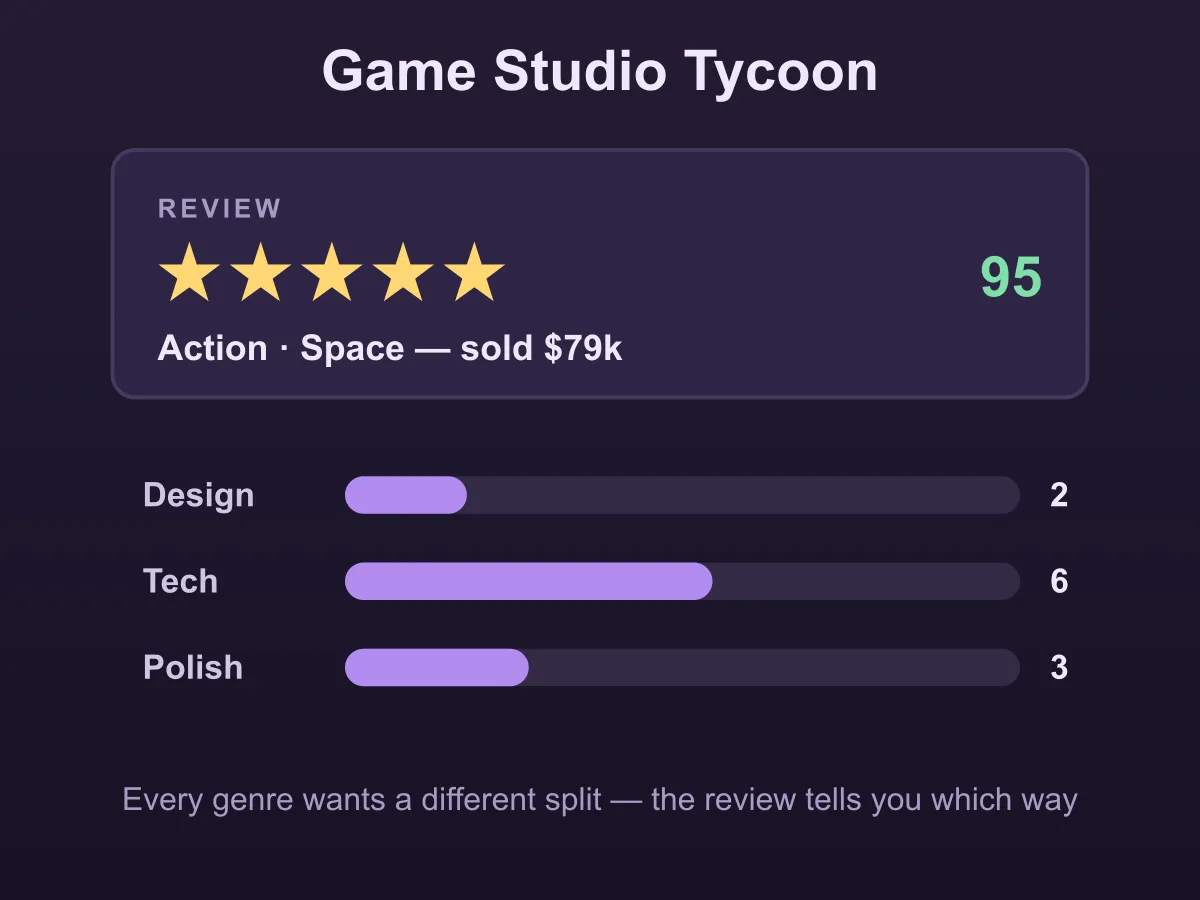
- Every genre wants a different balance. Nothing tells you what it is up front — the review after each project says which area reviewers wanted more of.
- Genre and theme also have a fit: some pairings are great, some are poor, most are fine.
- A run starts with a few pairings already known — seven on the first run, none on the last — and any other pairing you find out about by shipping it.
- Once a pairing is known, the fit is shown on the theme button from then on. That is your studio’s memory, and it is most of what you are building in the early projects.
- Press Ship it to release the project. You get a star rating, a score out of 100, and the money it made.
- Money pays for two things: a licence for a bigger platform, which reaches more people on every future project, and Hire, which adds an effort point.
- Both compound, so the question is always whether you can afford to spend now and earn it back before the run ends.
- Each project costs money to make, and a bigger studio costs more, so a badly aimed project can lose money outright.
- The bar at the top shows your cash against the target. Hit the target before the projects run out and the run is won.
- Making several projects in one genre gives a small experience bonus, so switching genre constantly has a cost.
- New Studio starts a fresh run on the same level, with a different fit table to work out.
Tips
- Spend your first couple of projects finding a good pairing, not maximising one. Information is worth more early than money is.
- Read the review line before anything else. "Reviewers wanted more tech" is the game telling you the genre’s ratio, and it will not tell you twice.
- Once you find a great pairing, stay on it. The fit bonus and the genre experience stack, and hopping around throws both away.
- Buy the first platform licence as soon as you can afford it comfortably. It multiplies every future project, so the earlier it lands the more it earns.
- Do not buy a licence with two projects left. It will not pay back, and the cash counts towards the target as it stands.
- Hiring raises what a project costs as well as what it earns, so a hire made just before a poorly aimed project makes the loss bigger.
- A poor fit is not a disaster if the split is right — but a poor fit and a wrong split together will lose money on the project.
- The later runs hand you less free knowledge, so budget more of the early projects for exploring and expect the first few to be thin.
FAQ
Is Game Studio Tycoon free to play?
Yes. It runs in the browser with no download, no sign-up and nothing to buy. All five runs are included and unlock as you clear them.
How do I know how to split the effort?
You do not, at first — that is the game. Every genre wants a different balance between design, tech and polish, and the only way to learn it is the review after each project, which names the area reviewers found short. Once you know a genre’s shape you keep it for the rest of the run.
What is the fit between a genre and a theme?
Every genre has exactly one theme it works great with and one it works poorly with; the other two are fine. Which is which changes with each run, so it has to be found rather than remembered. A run hands you a few pairings for free — seven on the first run, none on the last — and the rest are learned by shipping them. Any known pairing shows its fit on the theme button from then on.
Should I always buy the biggest platform?
Only if there is time to earn the licence back. A bigger platform multiplies every project after it, so buying early is worth far more than buying late — and buying with two projects left usually just costs you the target.
Does hiring always help?
It raises what a project can earn and what it costs to make, so it pays back on well-aimed projects and makes badly aimed ones worse. The price rises each time, so growth has to come out of rising sales rather than one lucky hit.
Do the decisions actually matter?
Yes, and it is measured rather than claimed. Two bots play every run in the tests: one that splits effort the way each genre wants, sticks to pairings it has found to be good and buys platforms when it can, and one that picks at random, splits evenly and never upgrades. Over two hundred runs apiece, the careless one never reaches a target and the careful one reaches between 92% and 100% of them, depending on the run.
How many runs are there?
Five, from six projects to fourteen. The cash target rises faster than the project count does, and each run starts you knowing fewer genre and theme pairings — so the risk goes up as much as the arithmetic.
Does it work on a phone?
Yes. On a narrow screen the pitch and the desk stack into one column instead of sitting side by side, and everything is buttons, so there is nothing to drag.