
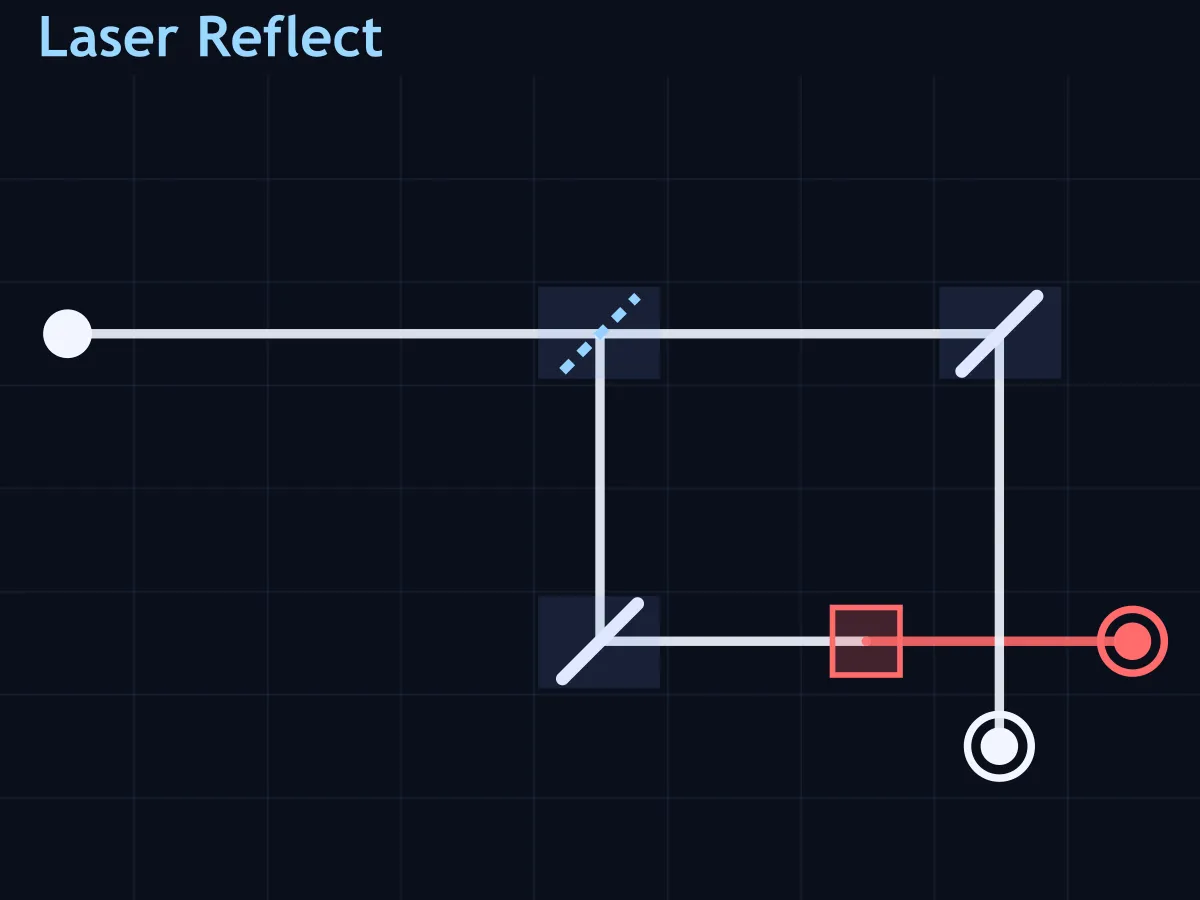






Laser Reflect is a free online logic puzzle about routing a beam. Each level gives you a handful of mirrors you can turn a quarter at a time, and the beam does the rest: it travels in straight lines, bends off the diagonals, and stops at walls. What lifts it above a wire-routing exercise is the three pieces that are not mirrors. A splitter makes two beams out of one, so a single emitter can light two targets at opposite ends of the board. A filter colours a white beam and stops a beam of any other colour, which turns the order you meet things in into part of the puzzle. And a target is lit only by its own colour, so a beam arriving in the wrong colour is not a near miss — it is an answer to a different question. The whole beam is traced from scratch after every turn, which keeps the rules honest: there is no incremental update to get wrong, and the trace is a pure function of the board. It is also what lets the test suite brute-force all eight levels — every setting of every turnable piece, two hundred and fifty-six boards at most — and check that each level is solvable, that each has a solution inside its stated par, and that no level has so many answers that turning at random gets there. That check paid for itself twice: it found a level whose decoy target could never be lit at all, and another whose every route ran into a wall.
How to play Laser Reflect
- Press Play. The emitter is the filled circle with a line coming out of it — that is where the beam starts.
- Click any mirror on a lit plate to turn it a quarter. Fixed pieces have no plate and cannot be turned.
- A mirror is a diagonal, so turning it twice puts it back where it was. There are really only two settings.
- The beam travels in straight lines, bends off mirrors, and stops at walls.
- A target is the ring. It lights up only when a beam of its own colour reaches it.
- A filter is the coloured square. It turns a white beam that colour, and stops a beam of any other colour dead.
- A splitter is the dashed diagonal. The beam passes through it and a copy bounces off, so one emitter can light two targets.
- Every target on the board has to be lit at once. Lighting one and losing another is not progress.
- The turn counter and the level par are at the top. Solving inside par is worth more.
- Eight levels, each introducing one idea: a corner, two corners, a wall, the splitter, the filter, two colours at once, and then the long route.
Tips
- Work backwards from the target. There are usually only two ways into it, and that fixes the last mirror before you touch anything.
- A mirror has two settings, not four. If a quarter turn seems to do nothing, it is because you turned it onto the same diagonal.
- Check the colour before the geometry. A route that reaches a red target with a white beam is the wrong route however neat it looks.
- Filters are one-way conversions: white becomes red, and red is stopped by a blue filter. The order you pass through them in is the puzzle.
- On a splitter level, solve the harder branch first. The easy one usually has several answers and the hard one has exactly two.
- Par is generous by one or two turns. If you are well over it, the route you are building is probably the long way round a wall you could go the other side of.
- Reset costs nothing but the turn count, and the turn count only affects the bonus — there is no penalty for exploring.
- The beam is re-traced after every single turn, so you can always see the consequence immediately. Turn one thing and look.
FAQ
Is Laser Reflect free to play?
Yes. It runs free in your browser with no download, no install and no account.
Why does turning a mirror sometimes do nothing?
Because a mirror is a diagonal and a quarter turn can put it onto the same diagonal it was already on. There are two settings, reached in four presses.
What does the dashed diagonal do?
It is a splitter: the beam goes straight through it and a copy bounces off. That is how one emitter lights two targets at once.
What are the coloured squares?
Filters. A white beam passing through one comes out that colour, and a beam of any other colour is stopped. Targets only light for their own colour.
Do I have to light every target?
Yes, all at once. Lighting one and losing another is not partial progress — the level is solved when every ring on the board is on.
Are the levels definitely solvable?
Yes, and that is checked rather than assumed. The test suite brute-forces every setting of every turnable piece on all eight levels. It found two levels that were not: one with a target that could never be lit at all, and one whose every route ran into a wall.
What does par mean?
The number of turns the intended solution takes. Solving at or under par is worth the most points; going over it costs some of the bonus, not the level.
Can the beam get stuck in a loop?
It can go round one, and the trace handles it — a splitter and two mirrors make a loop very easily. The beam remembers where it has been in each direction, so the trace always finishes.