
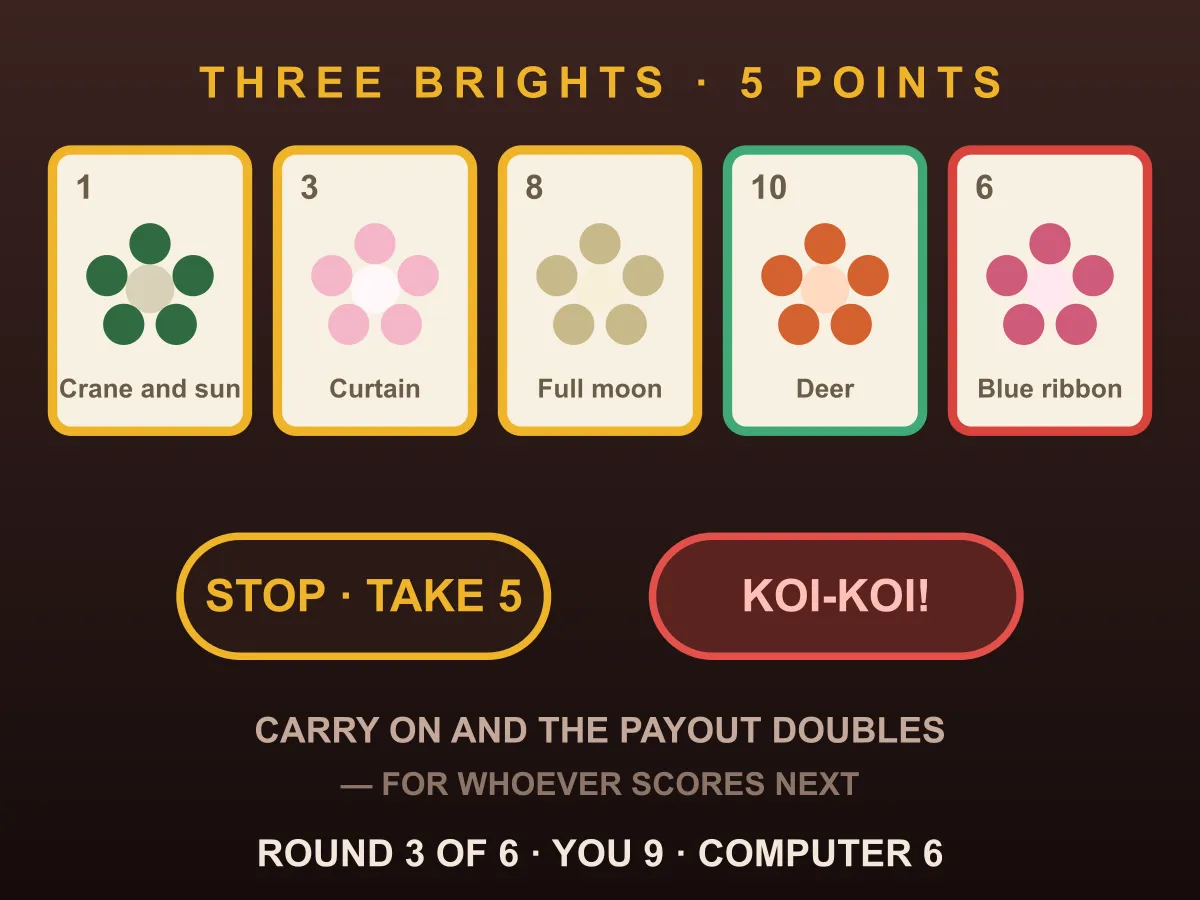



Koi-Koi is a free online version of the Japanese hanafuda game, played head to head against the computer with the traditional forty-eight-card flower deck — four cards for each month of the year, five brights, nine animals, ten ribbons and the rest plain. A turn is always the same two beats: play a card from your hand and take any card on the table of the same month, then flip the top of the deck and do the same again. Match nothing and your card stays on the table for your opponent. What you are collecting are yaku, the scoring sets: three brights, the boar-deer-butterfly, the three red poetry ribbons, the three blue ones, five animals, ten plain cards. The moment you make one you face the decision the game is named after — bank it and take the round, or call koi-koi and carry on for something bigger, which doubles the payout for whoever eventually scores. That may not be you. Six rounds, and the higher total takes the match. Every card here is drawn from simple shapes rather than copied from a published deck, and the Rainman rule is in: he joins the five-bright set and the rainy four, but never the dry three or four.
How to play Koi-Koi
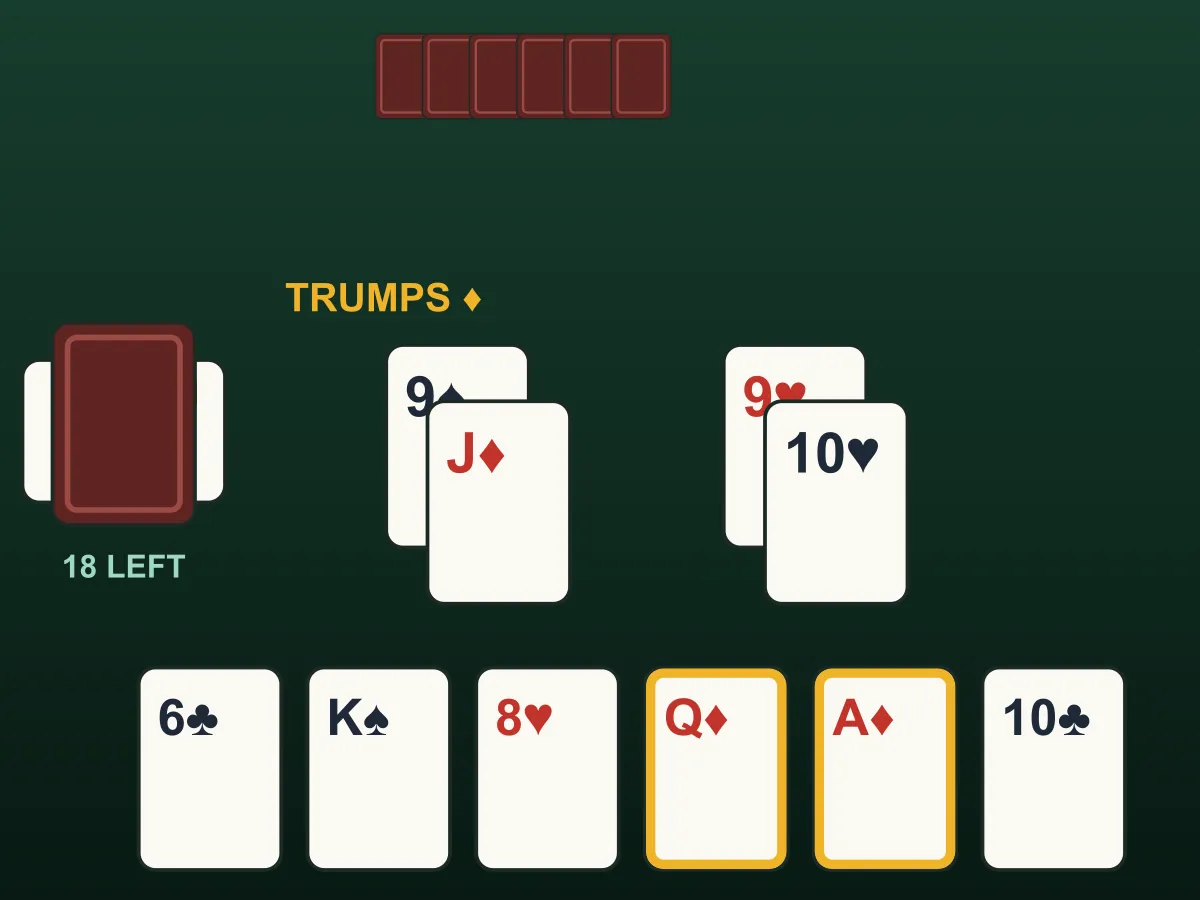
- Press Play. You and the computer get eight cards each, eight more are laid face up between you, and the rest is the deck.
- The deck has four cards for each month. Matching is always by month, never by picture — the number in the corner of each card is its month.
- On your turn, play a card from your hand. If a card of the same month is on the table you take both; if two match, you choose which to take.
- Cards in your hand whose month is already on the table are ringed, so you never have to count all twelve months by eye.
- Then the top card of the deck is flipped and does exactly the same thing. That second beat is why a turn can win you four cards or none.
- Anything that does not match stays on the table, where your opponent can take it.
- Collect sets, called yaku. Three brights is 5, four is 8, all five is 10. Boar, deer and butterfly together is 5, and so is each trio of ribbons.
- Five animals, five ribbons or ten plain cards are worth 1, with one more for every extra card past the fifth or tenth.
- The Rainman — the bright in month eleven — joins the five-bright set and the "rainy four", but never the dry three or four. A fourth bright can be worth less than three.
- The moment you make a new set, you choose: stop and bank the points, or call koi-koi and play on for a bigger set.
- Every koi-koi doubles the payout — but for whoever ends up scoring, which may be your opponent. Six rounds, and the higher total wins the match.
Tips
- Take the bright, every time. Ten points sits behind five of them and nothing else in the deck is worth that, so a bright on the table outweighs almost any other capture.
- Watch which months are gone. Once all four cards of a month are off the table, a card of that month in your hand can never be played into anything.
- Ribbons are the quiet yaku. Three of one colour is five points and the computer will happily let you have them while it chases brights.
- Count the deck flip as half your turn. A card that matches nothing gives your opponent two chances at it, not one.
- Say koi-koi early and stop late. A single point on turn two is worth gambling; five points with three cards left in hand is not.
- The danger of koi-koi is not the doubling, it is the handing over. Your opponent scoring after your call takes double, and you take nothing at all.
- Hold a spare card of a month you have already collected. It stops the opponent using the last one and can be dumped safely when nothing else fits.
- Plain cards add up. Ten of them is a point and every one after that is another, and they are the cards nobody else is fighting you for.
FAQ
Is Koi-Koi free to play?
Yes. It runs free in your browser with no download, no install and no account. Nothing is wagered and nothing pays out.
What are hanafuda cards?
A Japanese deck of forty-eight cards, four for each month of the year. There are five brights, nine animals, ten ribbons and twenty-four plain cards, and matching is always by month.
What does koi-koi mean?
Roughly "come on, keep going". When you make a scoring set you may bank it and end the round, or say koi-koi and play on for a bigger one — which doubles the payout for whoever finally scores.
What happens if I call koi-koi and lose?
You get nothing, and your opponent takes their own points doubled. That is the whole risk: calling it hands the doubling to whoever scores next, and it may not be you.
How do the scoring sets work?
Three brights 5, four 8, five 10; boar-deer-butterfly 5; three poetry ribbons 5; three blue ribbons 5; five animals, five ribbons or ten plain cards 1, plus one for each extra card.
Why is my fourth bright worth less than three?
Because of the Rainman, the bright in month eleven. He counts in the five-bright set and in the "rainy four" for 7, but never in the dry three or four — so picking him up as your fourth turns an eight into a seven.
Is this the real hanafuda art?
No. Every card here is drawn from simple shapes — a bloom, a month number and a caption — rather than copied from any published deck. The composition of the deck is the traditional one; the pictures are this site's own.
How long is a match?
Six rounds, and the higher total wins. A round ends when someone banks a set or the cards run out, so it usually takes a minute or two.