
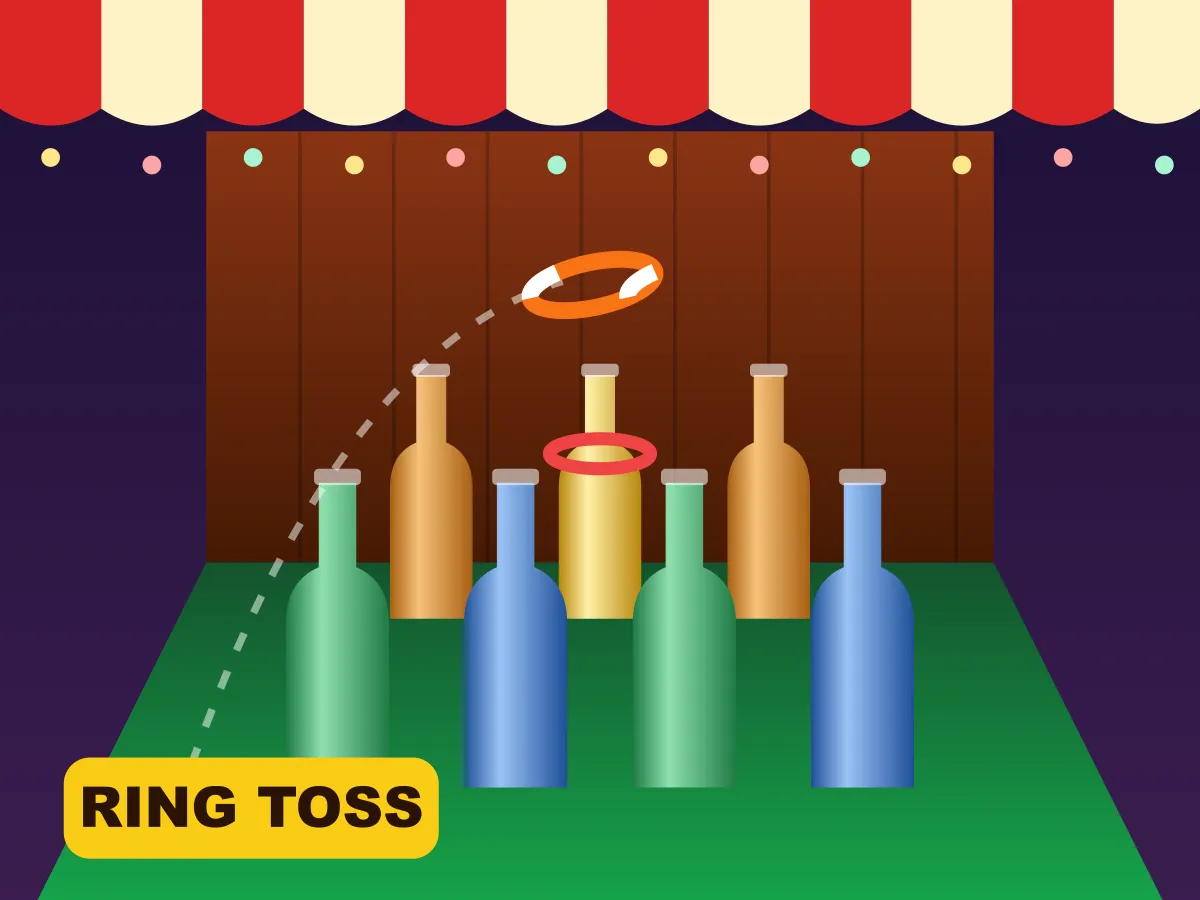
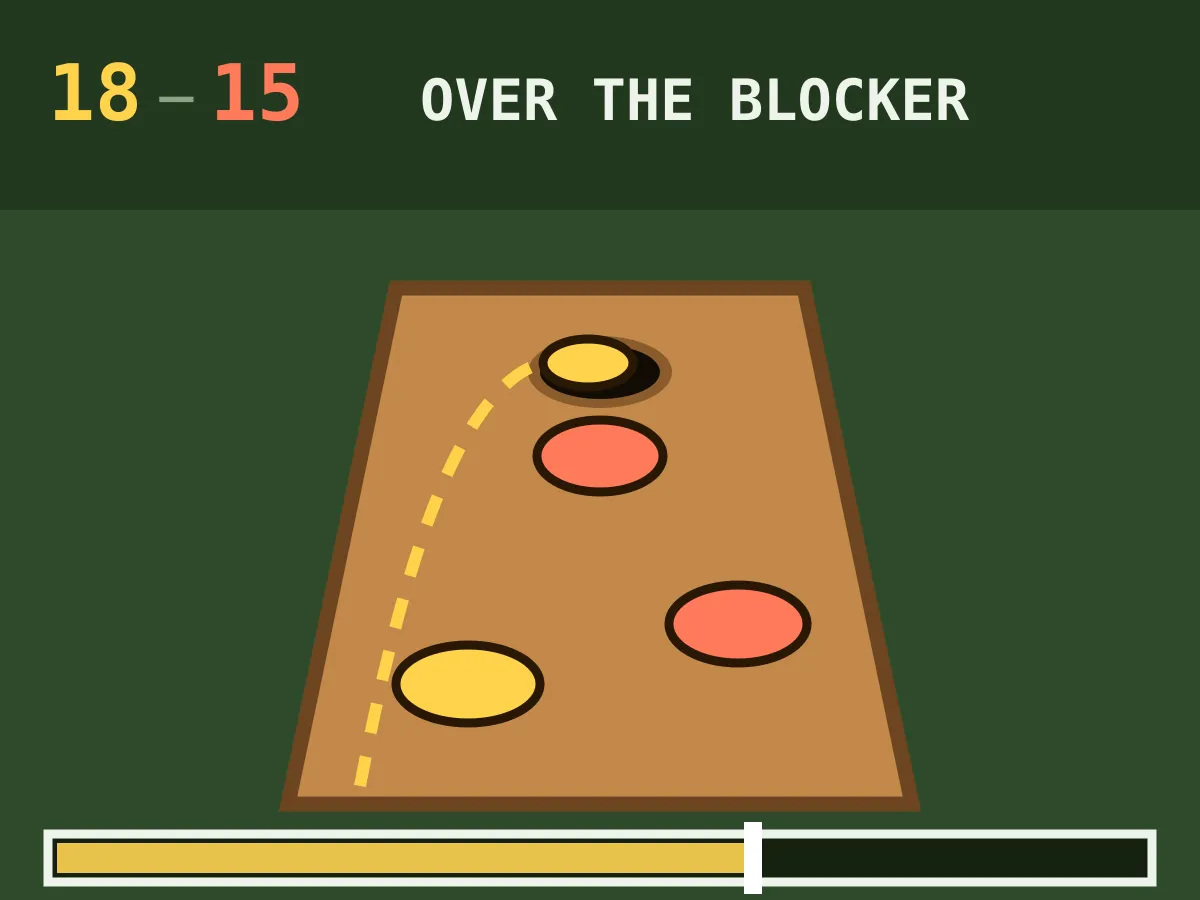





Ring Toss is the carnival classic, free to play online with no download and no sign-up: throw a ring so it drops cleanly over the neck of a glass bottle. Aim along the table, choose a high lob or a fast flat throw, then stop the sweeping power meter when the ghost ring sits on a neck. Rings rattle off rims, lean against bottles and slide off the table just like the real booth. Twelve booths add gold bottles, crosswinds and sliding shelves, and a duel mode pits you against five computer throwers.
How to play Ring Toss
- Each booth gives you six rings (four at the first) and a table of bottles. The number on a bottle is what it pays: green bottles 1 point, amber 2, blue 3 and gold 5. Every bottle pays once, so a second ring over a bottle you have already won scores nothing.
- Aim by tapping or dragging on the booth (the dotted line shows your heading), or with the left and right arrow keys; hold Shift for bigger steps. Pick Lob for a high, steep throw or Flat for a low, fast one with the buttons, L, or the up and down arrows.
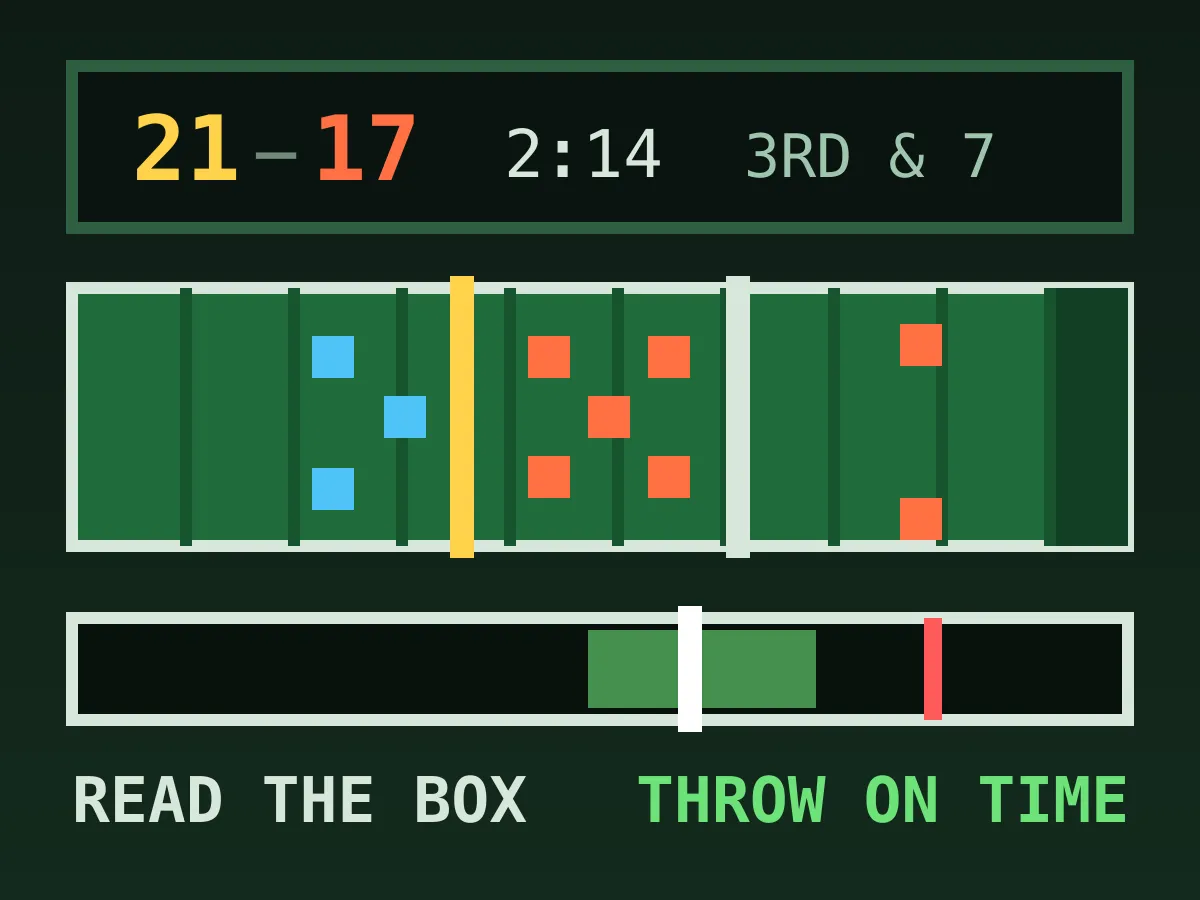
- Hold Throw (or Space) and the power meter sweeps up and down while a ghost ring and its shadow slide along the table. Let go when the ghost sits over the neck you want — it turns green when it would come down over a neck in still air. You can also tap Throw once to start the meter and tap again to throw.
- A ring scores only if it settles around a neck. A ring that bounces off a rim, comes to rest on top of the bottles, leans against one or slides off the table scores nothing.
- When your rings are gone the booth gives you one, two or three stars depending on your score; the thresholds are shown next to your points. One star clears the booth and opens the next. Later booths add a crosswind (the wind tag shows its direction and strength, and it changes every ring), a faster meter and shelves that slide from side to side.
- In Duel you and a computer thrower take turns at the same table, five rings each. A bottle belongs to whoever rings it first, and the higher score wins. Beat a rival to meet the next one.
Tips
- Use the lob by default. It comes down steeply, so it drops over a neck from more angles and lands dead instead of skidding off the table.
- Switch to Flat in a strong wind. A flat ring spends far less time in the air, so the wind carries it a third as far — but it has to get past the front row, so save it for the near bottles.
- Aim off into the wind. A strong gust carries a lob several centimetres sideways, and the ghost ring does not allow for it.
- Lead a sliding shelf: aim where the bottle will be when the ring arrives, about three quarters of a second after you let go for a lob.
- Take the near bottles first. They are the easiest to ring, and once they are won the rest of the booth is yours to gamble on gold.
- A rim shot is not always lost: a ring that clips the neck from inside the hole is pushed toward the bottle and often drops on.
FAQ
Is this ring toss game free to play online?
Yes. Ring Toss is free in any modern browser, with no download, no account and nothing to buy. Your unlocked booths, your best stars and a booth in progress are saved in your browser, so you can close the tab and carry on later.
Does Ring Toss work on a phone?
Yes. On a phone you tap a bottle to aim and hold the big Throw button; the booth fills the screen in portrait. On a computer you can play with the mouse, or entirely with the keyboard: arrow keys to aim, L to switch throws, Space to throw.
Why does my ring bounce off when it looks like a hit?
Because the hole in the ring is only a little wider than the neck. The ring is 11.4 cm across but its hole is 8.6 cm, and the neck is 3 cm thick, so the centre of the ring has to come down within 2.8 cm of the middle of the neck to drop cleanly. Just outside that, the rim lands on the neck: from inside the hole it is knocked toward the bottle and may still drop on, from outside it is knocked away.
How are the stars worked out?
They are measured, not made up. Every booth was played 200 times by each of three computer stand-ins — a casual, a steady and a sharp thrower that plan the same way and differ only in how steady the hand is. One star is the casual thrower’s median score (but always at least one ringer), two stars the steady thrower’s and three stars the sharp thrower’s; where two of them tie, the higher star asks for one point more. On the first booth that is 1, 2 and 3 points.
Lob or flat: which throw is better?
The lob is the safer throw in still air: it drops almost straight down onto a neck and lands dead. The flat throw is fast and low, so it is the one to use in a strong crosswind, which carries a lob about three times as far sideways. Its weakness is the front row: a flat ring aimed at a back bottle will often clip a nearer one first.
How good are the computer throwers in Duel?
There are five — the Rookie, Regular, Hustler, Carny and Ringmaster — and they differ only in how steady the hand is: timing on the meter, aim, reading the wind and leading a moving bottle. Measured over 200 duels a pairing with the first throw alternating, each beats the one before it: the Regular scores 65% against the Rookie, the Hustler 61% against the Regular, the Carny 72% against the Hustler and the Ringmaster 74% against the Carny (a draw counts as half).
Does throwing first matter in a duel?
A little: the first thrower gets the first pick of the easy bottles. When the Hustler played itself 200 times, the thrower who went first won 104 duels and the one who went second 91, with 5 drawn. So you alternate: you throw first in your first duel against a rival, the rival throws first in the rematch.