





Home / Sports / Pixel Football Coach
Pixel Football Coach is a free online retro football game that runs in your browser with no download and no account. You only ever coach one side of the ball — your offence, four downs at a time — and the other team answers with the same rules. Every pass play is a race between two clocks. The pocket collapses sooner the more defenders crowd the line, and each route comes open at its own moment: the quick out at 0.75 seconds, the crosser at 1.35, the deep shot at 1.85. Let the ball go as the receiver breaks open and it is complete; let it go early and you are throwing into coverage that has not been beaten yet; hold it and you are on the floor. That is why the pre-snap read is the game rather than decoration. Against nine in the box the pocket is gone in 1.2 seconds, which is before the deep receiver has finished running — the play is not a bad idea, it does not exist, and the button says so. Between snaps you spend what you earn: a point for every first down and three for every touchdown, put into your arm for a wider window, your line for more time, or your legs for the run that punishes a light box. Six defences get harder in exactly two ways, both of which feed straight into those two clocks — more bodies at the line, and a secondary that sits deeper. A touchdown is six, and what it is finally worth is your call: the kick is nearly free, going for two is one more snap against a goal-line front.
How to play Pixel Football Coach
- You coach the offence only. Four downs to make ten yards, and the other team answers with a drive of its own played out under the same rules.
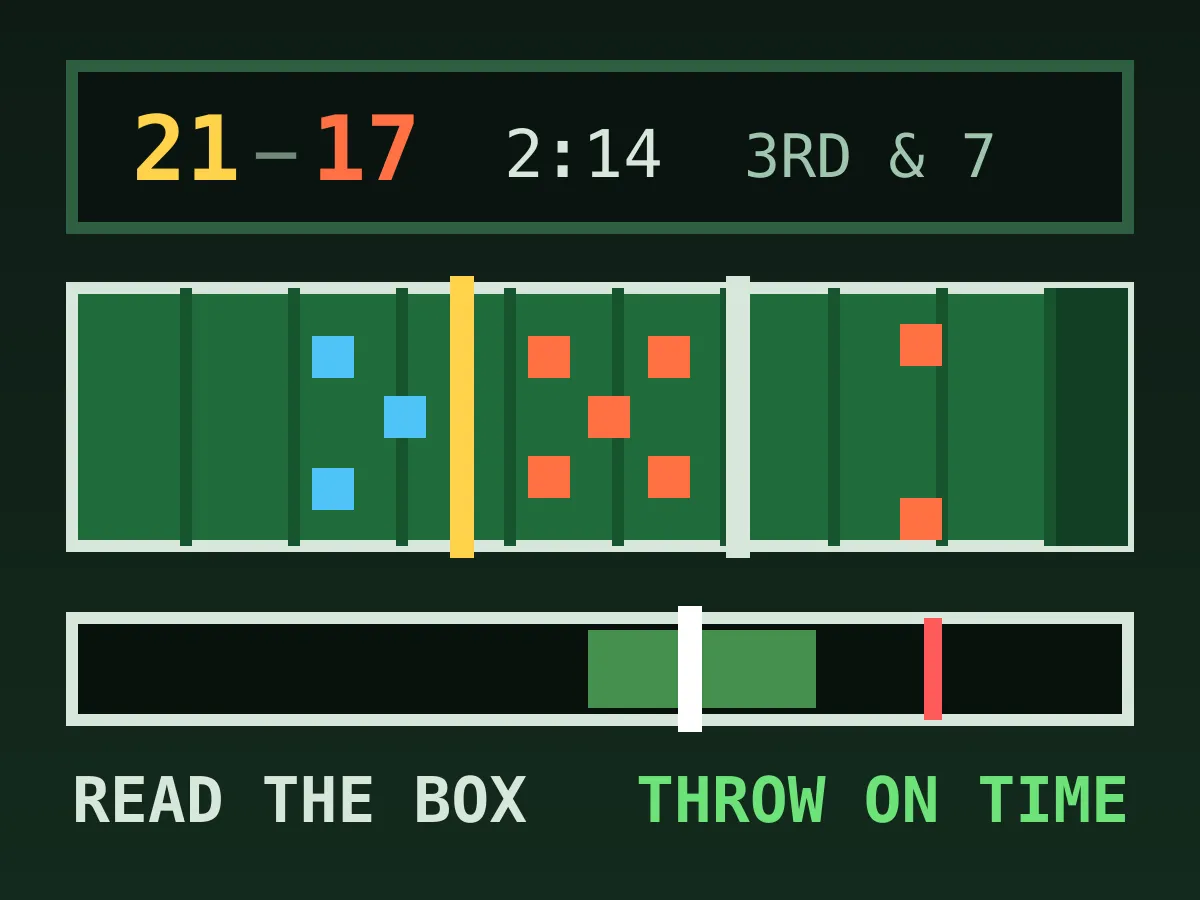
- Read the box first. The line under the field says how many defenders are crowding it and how deep the secondary is sitting — those two numbers decide everything else.
- More defenders at the line means less time. The pocket holds about 2.45 seconds against nobody and loses roughly an eighth of a second for every defender in the box.
- Each route opens at its own moment: the quick out at 0.75 seconds, the crosser at 1.35, the deep shot at 1.85. A route greyed out as "No time" is one the pocket will not survive long enough to throw.
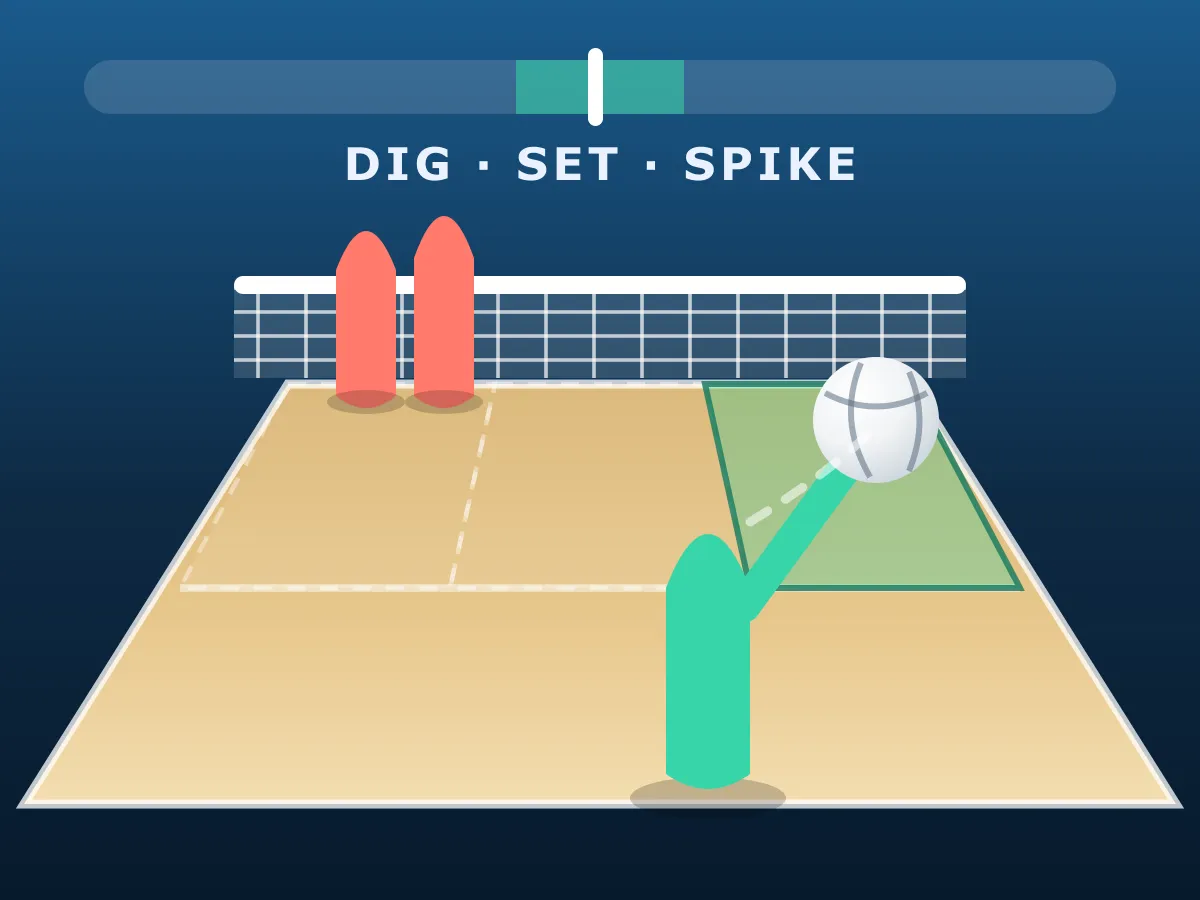
- Press THROW, space or enter when the white marker reaches the green stripe. The nearer the middle of it you let go, the further the ball carries after the catch.
- Let it go early and you are throwing at a receiver who is still covered — that is the only way to be intercepted, and it gets more likely the deeper the safeties play.
- Hold it past the red mark and you are sacked. The clock keeps running; an incompletion stops it.
- Run the ball when the box is light. A run ignores the timing entirely, and it is the answer to a defence selling out against the pass.
- Spend what you earn: a point for each first down, three for a touchdown. Arm widens the throwing window, Line buys time in the pocket, Legs gets more out of the run. Five each is the cap.
- A touchdown is six. Take the near-free kick for one, or go for two with one more snap from the two against eight in the box.
- Seven minutes on the clock. Most points wins, and level is a tie.
- Beat an opponent to unlock the next. Progress is kept in your own browser.
Tips
- The box tells you what to call before you have thought about it: five or fewer, run it; six or more, the ball has to come out fast.
- A deep shot against a light box is the cheapest big play in the game, because that is the one look where the pocket outlasts the route.
- Put your first two points into Line if you want the deep ball at all. It is the only thing that puts the deep shot back on the table against six or more in the box.
- Arm is worth most against a deep secondary, because that is exactly what narrows the window you are trying to hit.
- When the safeties are deep, stop reaching for it. Early throws into a two-high look are where interceptions come from, and a five-yard completion is not a failure.
- On fourth and short outside field-goal range, going for it is usually better than the punt — you are giving them the ball either way, and the clock is shorter than it looks.
- Going for two is not a gamble when you are down two, five or ten: the kick leaves you needing the same number of scores and the two does not.
FAQ
Is Pixel Football Coach free to play?
Yes. It runs in your browser with no download, no plugin, no sign-up and nothing to buy. The first opponent is open straight away and the rest unlock by winning.
Do I play defence as well?
No — you only coach the offence, which is the whole idea. The other team plays its possessions out under exactly the same rules yours are, against an average defence, so their score is produced by the same model rather than invented.
What decides whether a pass is complete?
When you let go of it. Every route comes open at a fixed moment and stays open for a window of about a fifth of a second — wider if you have coached your arm, narrower against a deep secondary. Throw inside that window and it is complete, and the nearer the middle you are the further it carries.
Why is a play greyed out?
Because the pocket will not last long enough to throw it. The deep route comes open at 1.85 seconds, and against nine in the box the pocket is gone in about 1.2 — so that play genuinely cannot be made until you coach your line, which buys back about a tenth of a second a point.
How do I get intercepted?
Only by throwing before the receiver has beaten his man. The risk starts around six percent and climbs with how deep the secondary is playing and how early you let it go — so a rushed deep ball against a two-high look is the most dangerous throw on the field.
How do the opponents get harder?
In two ways, and both feed the same two clocks. They put more defenders at the line, which folds the pocket sooner and takes the deeper routes away entirely, and they drop the secondary deeper, which narrows the window a throw counts as on time. Their own offence is the same at every rung on purpose.
What should I spend training points on?
Line first if you want to throw deep at all, Arm if the secondary keeps sitting back, and Legs if you keep seeing light boxes. Five is the cap on each, and points come a lot faster from touchdowns than from first downs.
How long is a game?
Seven minutes of game clock, which is five or six possessions each and a few minutes of real time. Whoever is ahead at the whistle wins, and a level score is a tie.