
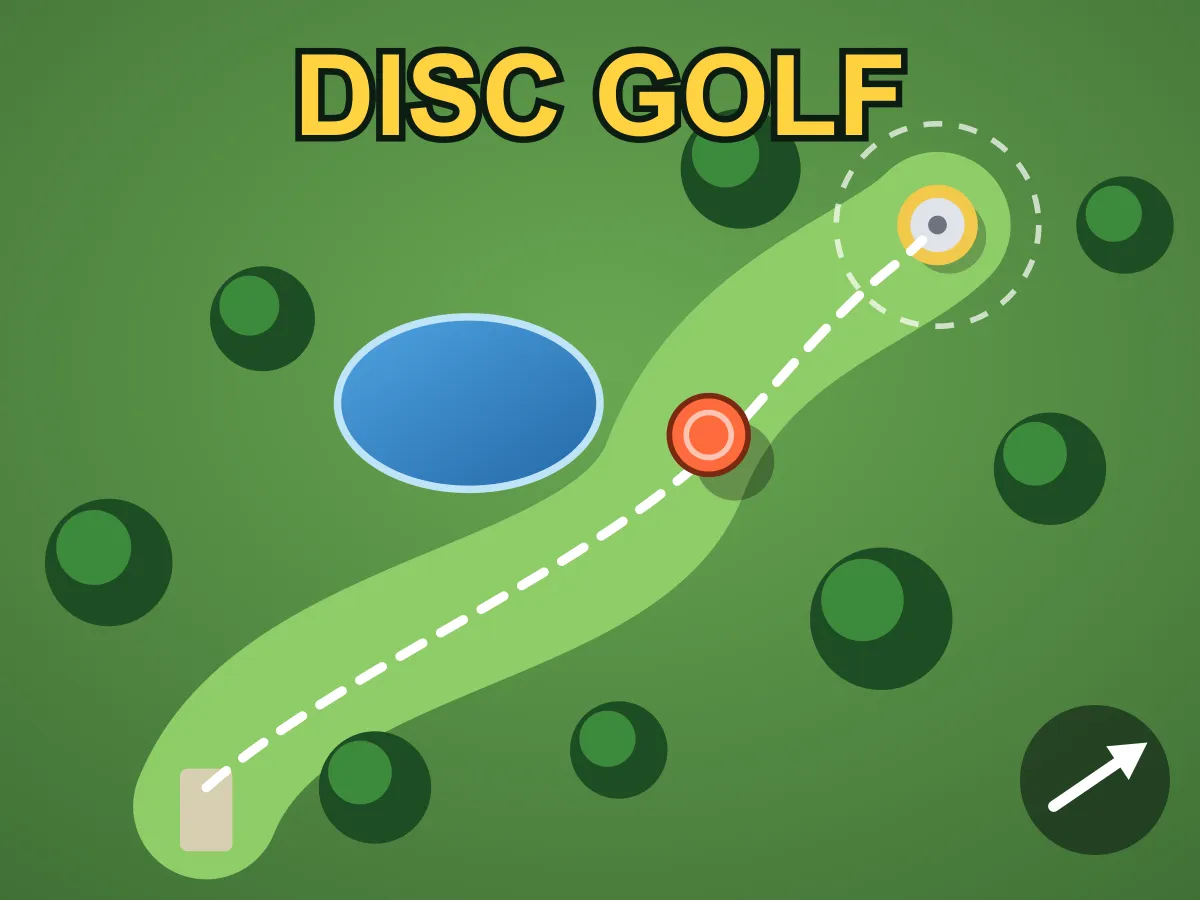






Disc Golf is a free online disc golf game seen from above, where every throw is a real flight rather than a fixed path. Choose one of three discs by its flight numbers, set the release angle, and drag on the course to aim: a dashed line shows where the throw would go in still air. Then hold to charge the power meter and let go on the notch. A driver thrown hard turns right early and fades left as it slows, hyzer curves left and anhyzer right, and the wind does the rest — a crosswind carries the disc, a headwind makes it turn and hold up longer. Trees knock a disc down, water and out of bounds cost a stroke, and a putt inside the ten-metre circle drops into the chains only at the right pace. Four courses of nine holes, from open Maple Park to the wind of Canyon Winds, each with a par and three stars to earn. No download, no sign-up — mouse, keyboard or touch.
How to play Disc Golf
- Press Tee off to start a nine-hole round. Each hole shows its par and length; the basket sits inside a dashed ten-metre circle.
- Pick a disc: the Driver (flight numbers 11, 5, -1, 2) flies furthest, the Midrange (5, 5, 0, 1) is straighter and easier to control, and the Putter (2, 3, 0, 1) is for short, soft throws. Keys 1, 2 and 3 choose them too.
- Aim by dragging on the course to where you want the disc to land, or with the arrow keys: left and right turn the throw, up and down change the distance. The dashed line is the flight in still air, with the curve of the disc and your release angle already in it — but not the wind.
- Set the release angle with the Angle buttons or Q and E. Hyzer tilts the disc and curves it left; anhyzer curves it right; flat lets the disc fly its own line.
- Hold the Throw pad or Space. The power bar climbs to full in just over a second, then falls back. Let go when it reaches the white notch — your planned distance. Early is short, late is long, and holding past full power drops it again.
- A disc that meets a tree drops beside it. Water or out of bounds costs one penalty stroke, and you play on from where it went in. A disc that stops within about a metre of the basket is dropped in for one more stroke.
- Finish all nine holes. Your score against par earns up to three stars, and one star opens the next course.
Tips
- This is a right-handed backhand throw: every disc fades left at the end of its flight, and a driver thrown near full power drifts right first. The dashed line already shows both — what it leaves out is the wind.
- Read the wind arrow in the corner before every throw. A crosswind carries the disc along with it, and a headwind makes the driver turn right more and stay up longer, so aim into a crosswind and take a little off into a headwind.
- The Midrange is the safe choice between trees: it turns less than the Driver and still carries seventy metres or more at full power.
- Use the release angle to go round trouble. Hyzer bends a throw left around a tree line, anhyzer bends it right; the dashed line shows how much before you throw.
- On long holes, full power is a risk: the meter falls back after full, so a late release loses distance. Planning a little under full leaves room on both sides of the notch.
- Inside the circle, pace matters more than line. A putt that arrives too fast sails over the basket or rattles off the pole, and one that is short lands in front.
- Water is a stroke plus the walk back. When a pond guards the basket, a lay-up short of it and a putt is often cheaper than going over.
FAQ
Is this disc golf game free to play?
Yes. Disc Golf runs free in your browser with no download, no install and no account, on a computer, tablet or phone.
What do the four flight numbers mean?
They are speed, glide, turn and fade, the way disc makers print them. Here the first two say how far and how long the disc flies; turn is how much a disc thrown hard drifts right early in the flight, and fade is how much every disc hooks left as it slows at the end. The Driver is 11, 5, -1, 2, the Midrange 5, 5, 0, 1 and the Putter 2, 3, 0, 1, for a right-handed backhand throw.
What are hyzer and anhyzer?
The angle the disc is released at. Hyzer tips the outside edge down and curves the throw left; anhyzer tips it the other way and curves it right. You can pick 15 or 30 degrees of either, or flat, and the dashed line shows the curve before you throw.
How does the wind change a throw?
The flight is worked out against the moving air. A crosswind carries the disc sideways, more the longer it flies; a headwind makes it act faster, so a driver turns right more and holds up a little longer; a tailwind brings it down a little sooner. Wind is between calm and 2.5 m/s at Maple Park and between 3 and 6.5 m/s at Canyon Winds, and the dashed line never includes it.
What happens if my disc lands in water or out of bounds?
You take one penalty stroke and play on from the last point the disc was over safe ground — where it went into the water or crossed the white out-of-bounds line. A hole ends at par plus five strokes at most, so one bad hole never runs on forever.
How does putting work?
Inside the dashed ten-metre circle you putt: the Putter is picked for you, on the same power meter. The chains catch a disc that reaches the basket at their height and slowly enough; too hard and it flies over or bounces off the pole, too soft and it lands short. Close to the basket the plan starts at the pace that drops in, so in calm air a release on the notch holes out; the wind is what you still have to read. A disc that stops within about a metre of the basket is dropped in for one stroke.
How many courses and holes are there?
Four courses of nine holes each: Maple Park (par 28), Pine Ridge (par 29), Lakeside (par 29) and Canyon Winds (par 29). Maple Park is open grass in light wind, Pine Ridge is narrow lanes through the woods, Lakeside has water on most holes, and Canyon Winds has strong wind and out of bounds on both sides.
How are the stars earned?
By your round against par. At Maple Park one star needs +4 or better, two need -1 and three need -6. Pine Ridge and Lakeside ask for +6, even par and -6, and Canyon Winds for +7, even par and -5. One star opens the next course.
How hard is it to get three stars?
The cuts were checked with test players who plan every throw, read the wind from the arrow the way a person does — misjudging how far it will carry the disc — and then release the meter unevenly. One that lets go within about 25 milliseconds of the notch and misjudges the wind by about 15% earned three stars on every course in at least six rounds out of ten; one within about 50 milliseconds and 30% earned two stars at least 85% of the time but three at most about a third of the time; one within about 90 milliseconds and 50% earned one star in at least three rounds out of five. Throwing the Driver flat and straight at the basket from everywhere outside putting range never earned three stars on any course.
Can I play on my phone?
Yes. Drag on the course with a finger to aim, tap the discs and angle buttons, and hold the Throw pad to charge, letting go on the notch. It works upright or sideways.
Is it the same round every time?
The courses never change — the trees, ponds and baskets are part of each course. The wind on each hole comes from the round: Play again keeps the same winds so you can learn them, and New wind draws a different set.
How is this different from Mini Golf?
Mini Golf on this site rolls a ball along the ground and banks it off walls. Here the disc flies: it curves by its flight numbers and your release angle, drifts in the wind, and a throw is planned on a still-air line and then made on a timed power meter.