





Rugby Try is a free online rugby game about the oldest move in the sport: two against one. You carry the ball at a defensive line with your team-mates running support either side of you, and the only way through is timing. A defender who comes up to tackle dips into it — that is your moment to pass, because once he has committed he cannot turn to the man you give it to. Pass too early and he drifts across to tackle the catcher; too late and you are held with the ball. Or step him: his lunge re-aims at you until the last instant, so a sidestep after he locks on leaves him grasping air. Every pass must go sideways or backwards — a pass to a team-mate ahead of you is a forward pass and the attack is over. A tackle ends the phase and the ball comes back from the ruck; run out of phases and they have it. Against a flat line with nobody behind it, a grubber kick can roll through for you to chase. Score tries for five points and kick the conversion for two, over eight levels from a two-on-one to a rush defence that gives you no time at all. No download, no sign-up — play with a keyboard, a mouse or a phone.
How to play Rugby Try
- Press Kick off. You are the gold player with the ball, running towards their try line; your team-mates run in support either side of you, and the red defence is in front.
- Your player runs forward by himself. Steer across the pitch with the arrow keys or W A S D — left and right when the pitch runs up the screen, up and down when it runs across — or touch or drag on the pitch. The key towards your own line slows you down.
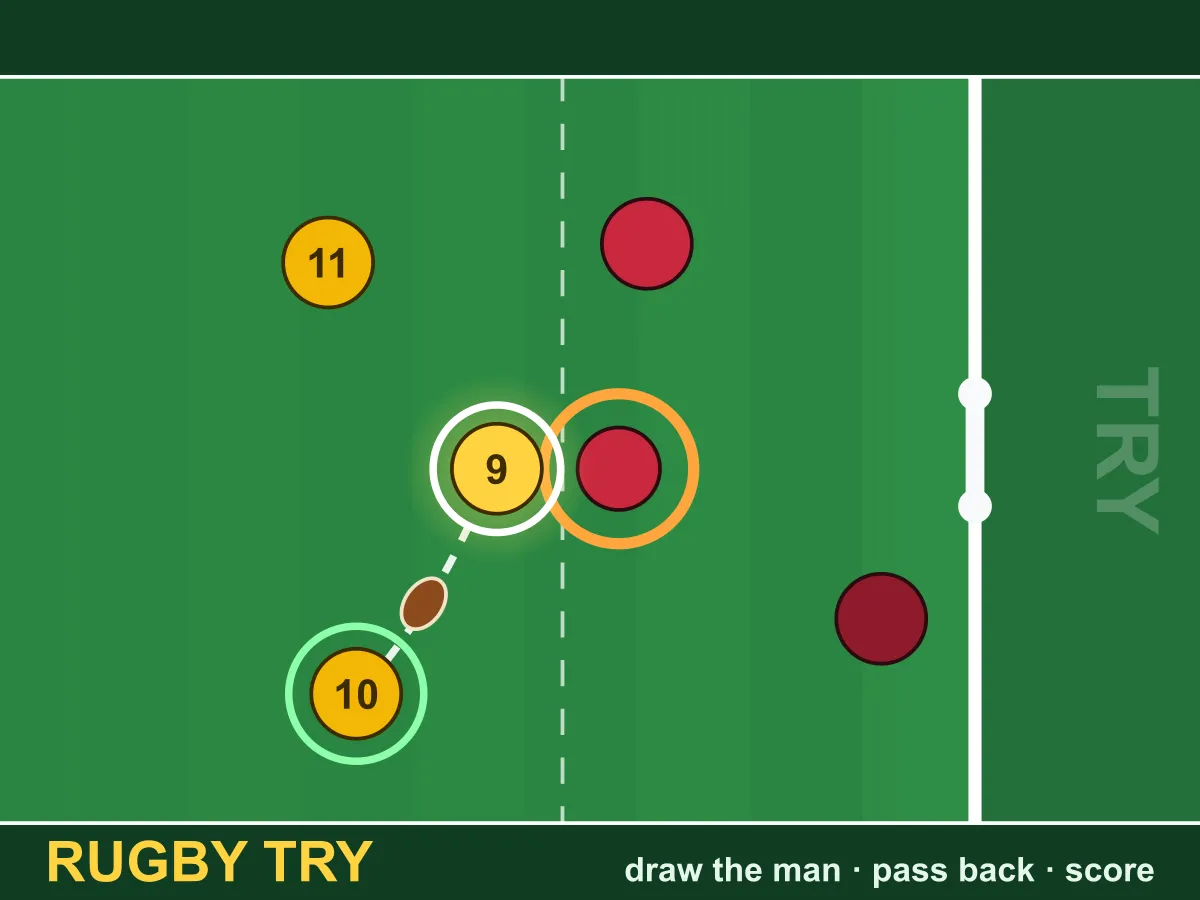
- Pass left with J and right with L, or with the two Pass pads. The ball goes to the nearest team-mate on that side. A green ring means he is behind you and the pass is fine; a red FWD ring means he is ahead of you, and a pass to him is a forward pass that ends the attack.
- Run at a defender. When he comes up to tackle he dips, and an orange ring appears round him: pass now and he cannot turn to your team-mate. When the ring turns red he has locked on to the spot where he will hit you — sidestep with K and he misses.
- A tackle ends the phase: the ball comes back from the ruck where you went down, and the defence re-sets in front of it. Each attack has a set number of phases; be tackled on the last one, run into touch or have a pass intercepted and the ball is theirs.
- Kick with Space for a grubber along the ground. Against a line that has rushed right up to you with nobody behind it, kick late — just before they reach you — and chase; the ball is whoever’s gets there first.
- Cross their try line for a try: five points. Then kick the conversion from in line with where you scored — stop the swinging needle, allowing for the wind, then stop the power bar — for two more. Three attacks make a level; one try passes it, and more points earn more stars.
Tips
- Commit the defender before you pass. Run straight at him, not away from him: a defender who is not sure you are his man does not dip, and until he dips a pass only lets him drift across to your team-mate.
- Pass on the dip, not on the hit. The orange ring is your cue; by the time he reaches you the ball should already be in the air.
- Step late. A sidestep while his ring is still orange just slows you down, and he re-aims at where you are going. Wait for it to turn red.
- Watch your support. If you slow down or jink across the pitch, your team-mates keep running and can end up level with or ahead of you — the red FWD ring. Straighten up and let them come back behind you before you pass.
- Do not spin the ball wide at once. Passing the moment you catch it moves the ball sideways and backwards while the defence drifts across and closes you down; in our tests a player who passed on every catch scored nothing from the second level on.
- Score near the posts. The conversion is kicked from in line with where you touched down, so a try in the corner leaves a long, narrow kick at an angle. Once you are clear, run round towards the middle before you ground it.
- Kick only against a rush. A grubber against a defence with a full-back behind it just hands him the ball; against a flat line that has rushed up, kicked late, it rolls into the space they left.
FAQ
Is this rugby game free to play?
Yes. Rugby Try runs free in your browser with no download, no install and no account, on a computer, tablet or phone.
How do you score a try?
Carry the ball over the opposition try line. You cannot run through a defender — touch one and you are tackled — so you get there by making defenders commit to you and passing to the team-mate they have left free, or by stepping a defender as he lunges. A try is worth five points, and the conversion kick afterwards two more.
Why was my pass called forward?
In rugby the ball may only be passed sideways or backwards. Rugby Try calls a pass forward when the team-mate you pass to is ahead of you when you let it go, and the attack ends there. Before you pass, a green ring under a team-mate means the pass is fine and a red FWD ring means it would be forward. Your support runners keep running when you slow down or cut across the pitch, which is how they end up ahead.
When should I pass?
When the defender in front of you dips into the tackle — an orange ring appears round him. From that moment he is committed to you and cannot turn to the team-mate you pass to. Pass earlier and he simply drifts across and tackles the catcher; later and he tackles you with the ball. The window is just under half a second on the first level and down to about a third of a second on the hardest defences.
How does the sidestep work?
A tackler aims his lunge at where you will be when he arrives, and keeps re-aiming until the last moment, when his ring turns red and he is locked on. A sidestep with K after that moment moves you out of his path and he misses, landing on the floor for a second or so. A sidestep before it just costs you pace, and he adjusts and makes the tackle.
When should I kick?
Against a defence that has rushed up in a flat line with nobody behind it — the Rush Defence level is built for it. Kick late, when they are almost on you: defenders who were right on top of you are caught flat-footed and take over half a second to turn, while ones still a few metres away turn at once. Kick into a man already diving at you and it is charged down. Against a full-back, a kick usually just gives him the ball.
How do the conversions work?
After a try you kick at goal from in line with where you touched down. A needle swings across the posts: stop it with Space, aiming off into the wind shown at the top, and then stop the power bar near full. A try under the posts leaves a short, straight kick; one in the corner leaves a long kick at a narrow angle, which is why it pays to run round towards the posts once you are clear.
Is this rugby union or rugby league?
It plays by the rules the two codes share: five-point tries, two-point conversions and passes that must go sideways or backwards. A tackle ends a phase and the ball comes back from a ruck, as in union, while the fixed number of phases an attack has before the ball is turned over is closer to league’s tackle count. There is no scrum, lineout or contest for the ball at the breakdown.
How do I get three stars?
Score enough points over the level’s three attacks — the targets are shown on the scoreboard. One try passes a level and unlocks the next. The targets were set from test players with different reaction times over 40 matches per level and checked on 40 more: from the second level on, the quickest earns three stars in most matches and a steady one in at most half of them, while the steady one earns two stars in most matches up to the last two levels. A slow one earns two stars on the first level but in at most one match in ten from the second to the seventh; on the last level, against a rush with nobody behind it, its grubber kicks earn two in nearly two matches in five.
Can I just run straight or pass all the time?
No. A player who runs straight and never passes or steps is tackled every phase and scored no tries at all in our tests, on any level. One who passes the moment he catches the ball does well enough against the single defender of the first level, and scored nothing from the second level on: the defence drifts across while the ball goes sideways and backwards, and picks off the passes.
Can I play rugby on my phone?
Yes. Held upright, the pitch runs up the screen: touch or drag on it to steer, and use the Pass, Step and Kick pads underneath. Held sideways, the pitch runs across and the scoreboard and pads move to the sides.