
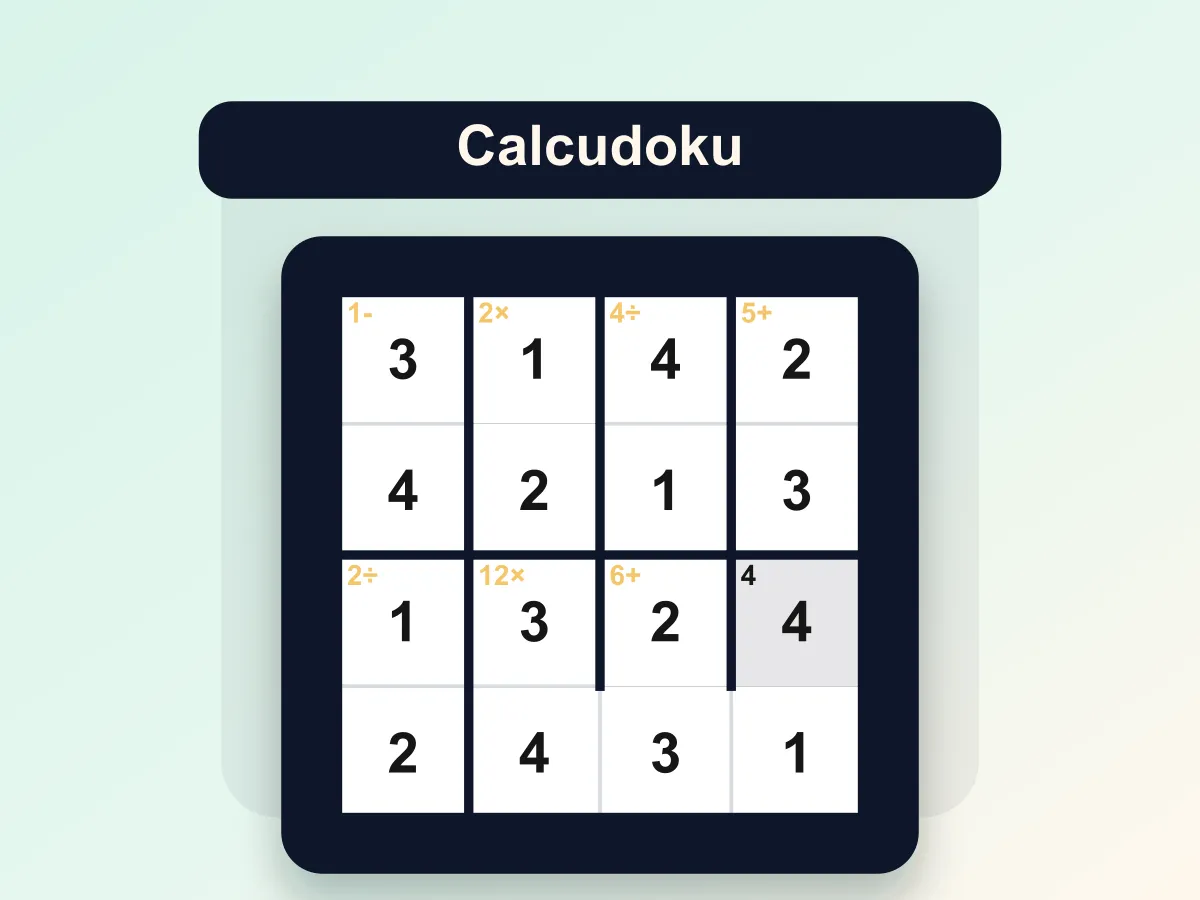









Calcudoku is a math logic puzzle: fill an N×N grid with digits 1 through N so no number repeats in any row or column, just like Sudoku. The twist is the bold-outlined "cages" carved into the grid — each one shows a target number and an operator (+, −, ×, ÷), and the digits inside it must combine to hit that target using every cell in the cage. A single-cell cage is a free space: its target is simply the answer. No pencil marks, no timers ticking against you — just row/column logic plus arithmetic, playable free in the browser with no download or sign-up.
How to play Calcudoku
- Pick a level, then look at the grid: it's divided into bold-outlined "cages", each labeled in its top-left cell with a target number and an operator (+, −, ×, ÷).
- Tap a cell to select it, then tap a digit from the number pad (or press a number key) to fill it in.
- Fill the whole grid so every row and every column contains each digit from 1 to the grid size exactly once, and every cage's digits combine via its operator to reach its target.
- A single-cell cage shows only a number — no operator — because that digit is the only possible answer for that cell.
- The puzzle is solved the moment every row, column, and cage checks out; mistakes and time are tracked so you can beat your own best run.
Tips
- Start with cages that only have one legal combination — on a 4×4 grid (digits 1-4), a 2-cell "7+" can only be 3+4, and a 2-cell "3×" can only be 1×3, so those cells are effectively solved before you touch anything else.
- Subtraction and division cages always have exactly 2 cells, so their target directly tells you the *difference* or *ratio* between two digits — list the few pairs that work, then use the row/column constraints to pick between them.
- Once a row or column has all but one digit placed, the last cell is forced — fill those in first before spending a hint on a cage you haven't fully thought through.
FAQ
Is Calcudoku free to play?
Yes. Calcudoku is completely free to play online with no download, no account, and no in-game purchases.
Does Calcudoku work on mobile?
Yes, it works on touch devices as well as desktop with mouse and keyboard.
How is Calcudoku different from Sudoku?
Both fill a grid with no repeated digits per row or column, but Sudoku also has fixed 3×3 boxes and starts with some digits already given. Calcudoku has no boxes and usually no starting digits at all — instead, the grid is divided into "cages" that must satisfy a math target using +, −, ×, or ÷, and that arithmetic is the main tool you use to deduce the answer.
What do the numbers and symbols in each cage mean?
The number is the target the cage's digits must reach, and the symbol is the operation used to combine them (+ sum, − difference, × product, ÷ quotient). A cage with no symbol is a single cell whose target is simply its answer.