







Home / Reaction / Ragdoll Crash Lab
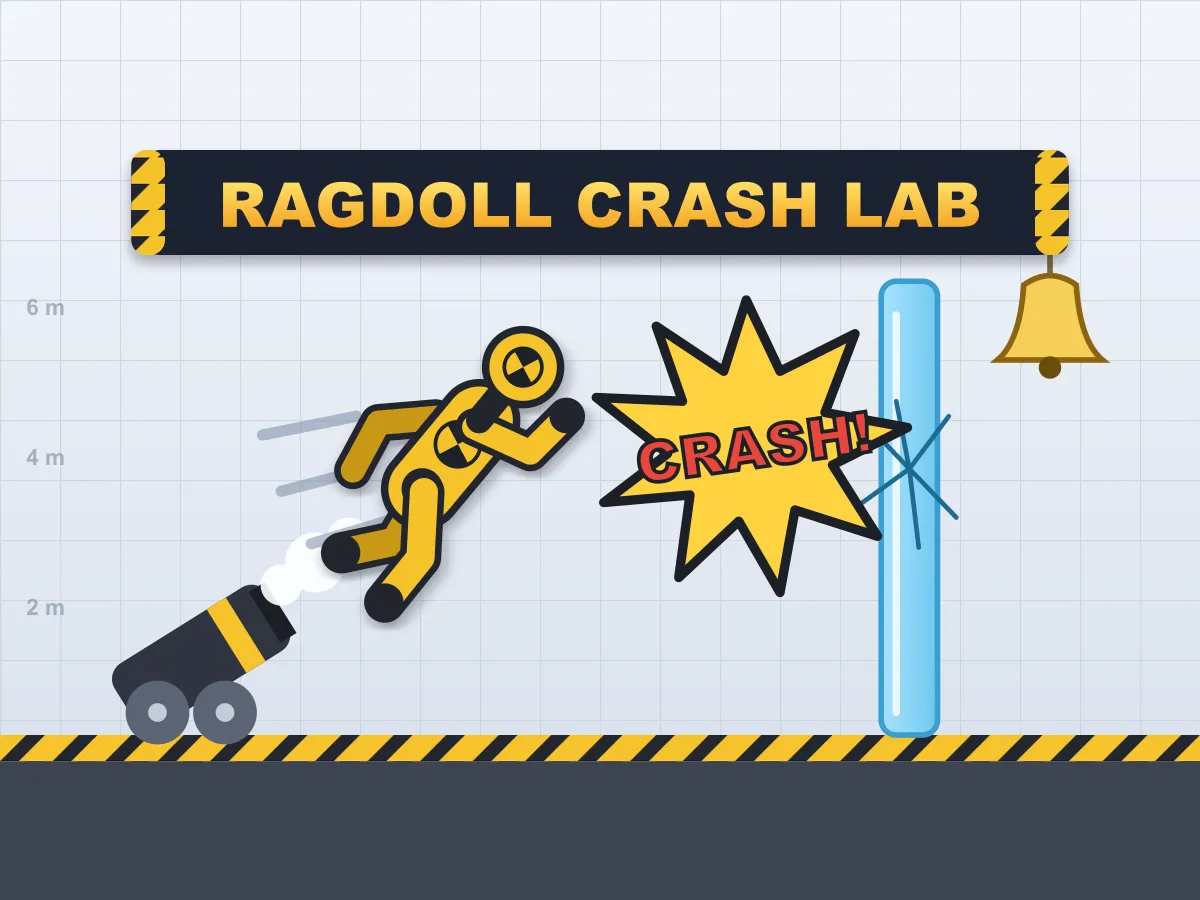
Ragdoll Crash Lab is a free ragdoll physics game you play online in your browser, with nothing to download. You run a crash-test lab: pick a launcher, set the angle and the power, fire a floppy crash test dummy across the room and watch it tumble, bounce and smash into walls, stairs, glass and gadgets. Every impact faster than a jog scores, and the faster the hit, the more it is worth — a head-first hit counts double, the torso one and a half times a limb, and lab glass pays 60% more than brick. Big hits, and every spring, bumper or hammer that fires, raise a combo multiplier up to ×3, so one launch that chains a spring into a bell into a staircase can score several times more than a straight shot into the wall. The lab has twenty tests in four tiers — Basics with the cannon, Launchers where you choose between the cannon, a catapult and a shove off the roof, Gadgets where you drop a spring, fan, swinging hammer or bumper into a marked slot, and Finals that mix everything. Each test gives you three dummies and a goal: a score to beat, bells to ring, or a bucket to land in. Pass it and your best crash earns one to three stars. Between tests there is a free-play ragdoll sandbox with unlimited dummies, where every gadget you have unlocked can go in any slot. The physics runs on a fixed clock with no randomness, so the same shot always crashes the same way, and you can replay your best crash from the result card. It plays with a mouse, a keyboard or a finger on a phone.
How to play Ragdoll Crash Lab
- Read the test. The bar at the top names the goal — a score to beat, every bell to ring, or the bucket to land in — and shows your three crash test dummies.
- Pick a launcher if the test offers more than one: the cannon on the floor fires fast and flat or high, the catapult throws from a platform and sends the dummy tumbling, and the roof shove drops it from height. Tap a launcher in the lab, use the buttons under it, or press 1, 2 or 3.
- Aim. Drag anywhere in the lab: the direction from the launcher to your finger sets the angle and the distance sets the power. The minus and plus buttons, or the arrow keys, fine-tune both one step at a time (hold Shift for five). The dotted arc shows how the launch starts out.
- Drop in a gadget. From the Gadgets tier on, dashed squares mark slots. Tap one (or press G, H, J or K) to cycle through what it can hold — spring, fan, swinging hammer or bumper — or leave it empty.
- Fire. Press Fire, Space or Enter. The dummy flies, crashes and tumbles until it comes to rest; big hits slow time down for a moment, and Skip jumps straight to the end.
- Read the crash report: impact points, air time, the combo multiplier, bells and the bucket, and whether the goal was met.
- Adjust and fire again. Your best passing launch is the one that counts, so once the goal is met you can use the remaining dummies to chase a bigger crash, or press Finish test.
- Pass the test to open the next one and earn up to three stars. Fail it and Try again gives you three fresh dummies. The Sandbox button opens free play with unlimited dummies.
Tips
- Hit hard, not far. A fast launch that meets a wall, the stairs or the glass scores far more than a soft lob that lands gently — points rise much faster than speed does, so full power is usually right for a score goal.
- Lead with the head. The head counts double and the torso one and a half times an arm or a leg, so a launch that arrives head-first is worth more than one that lands feet-first.
- Chain the combo. Every big hit and every spring, bumper or hammer that fires adds ×0.25 to the whole crash, up to ×3. One launch that bounces off a spring into a wall into the stairs beats three separate crashes.
- For bells, watch where the dotted arc points rather than where the dummy lands. A bell rings at the lightest touch from any part of the body, so passing through is enough.
- For the bucket, come in steep. A dummy skidding in sideways bounces out; one dropping in from above folds up and stays. From the cannon that usually means a high angle, and where a catapult or a roof shove is on offer, try those too.
- A gadget only fires twice per launch, and needs a moment to recharge, so aim to hit each one once on the way past instead of trapping the dummy on it.
- Swinging hammers keep time from the moment you fire. If a hammer hit misses, change the power by a few steps — that changes when the dummy arrives — rather than the angle.
- The physics has no dice: the same launcher, angle, power and gadgets always crash the same way. When a shot passes, note its numbers — the game remembers your last aim on every test.
FAQ
Is Ragdoll Crash Lab free to play online?
Yes. Ragdoll Crash Lab is completely free to play in your browser, with nothing to download or install, no account and nothing to buy. Open the page, press Play and the first crash test is ready; your progress is kept on your own device.
How do you play Ragdoll Crash Lab?
Each lab test gives you three crash test dummies and a goal: beat a score, ring every bell, or land in the bucket. Pick a launcher, drag in the lab to set the angle and power, drop gadgets into the marked slots, and press Fire. The dummy is a ragdoll, so it tumbles, bounces and crashes on its own; your job is to set up the launch so the crash meets the goal. Your best passing launch decides the stars.
How is the crash score worked out?
Every time a part of the dummy hits something faster than a jog, that impact scores, and the points rise much faster than the speed: a hit twice as fast is worth several times more. Head hits count double and the torso one and a half times an arm or a leg. Lab glass pays 60% more than a brick wall, foam pays much less. Time in the air adds 40 points a second and every bell adds 300. The impact and air points are then multiplied by the combo.
How does the combo multiplier work?
The combo starts at ×1. Every big hit — a really fast one, at most one counted every quarter of a second — adds ×0.25, and so does every spring, bumper or hammer that fires. It tops out at ×3. Because it multiplies the whole crash, a launch that chains several big hits and gadgets is worth far more than the same hits spread over separate launches.
What do the spring, fan, hammer and bumper do?
The spring fires the whole dummy away from its pad at high speed. The fan blows everything in front of it, so it can lift a dummy over a wall. The swinging hammer smacks the dummy the way it is swinging, so the timing of your launch matters. The bumper kicks the dummy straight away from it, like a pinball bumper. Each one fires at most twice per launch, so nothing can trap a dummy bouncing forever.
Which launcher should I use?
The cannon sits on the floor and covers everything from a flat, fast shot to a high lob — the best for raw impact. The catapult throws from a raised platform and adds a tumble, which is good for high bells and soft landings. The roof shove pushes the dummy off a building, so its speed comes from the height: perfect for staircases. Where a test offers several, choosing the right one is half the puzzle.
How many tests are there, and how do stars work?
Twenty lab tests in four tiers of five: Basics, Launchers, Gadgets and Finals. Meeting the goal with any of your three dummies passes the test and earns one star; two and three stars need a bigger passing crash. The star marks were measured, not guessed: three stars is the median passing crash of a player who aims very precisely at the best shot, and two stars sits halfway down to what a steady, less precise player usually manages.
Is there a ragdoll sandbox mode?
Yes. The Sandbox button opens a free-play room with every launcher, four gadget slots, two bells, a staircase and a glass wall. There is no goal and the dummies never run out; the game just keeps your best sandbox crash. Gadgets appear in the sandbox as you reach the tests that introduce them: the spring at test 11, the fan at 12, the hammer at 13 and the bumper at 14.
Why does the same shot always land the same way?
The physics runs on a fixed clock of 240 steps a second with no random numbers anywhere, so a launch is completely decided by the launcher, the angle, the power and the gadgets. That is what makes the lab a puzzle rather than a lottery — and it is how the result card can replay your best crash exactly. A one-degree change can still send a tumbling ragdoll somewhere quite different, which is what keeps it interesting.
Can I play Ragdoll Crash Lab on my phone?
Yes. On a phone or tablet you drag in the lab to aim, tap the dashed slots for gadgets and tap Fire. Upright, the controls sit under the lab; turned sideways, the lab fills the screen and the controls move to a column beside it. On a computer you can also play with the mouse or entirely from the keyboard.
Is my progress saved?
Yes, in your browser on this device: the tests you have opened, your best stars and crash on each, the last aim you used on every test, and your best sandbox crash. Clearing your browser data starts the lab over from the first test.
How is this different from other ragdoll games?
Most ragdoll games online are races or climbs where you steer the ragdoll — like Ragdoll Race and Ragdoll Puzzle Climb on this site. Here you never steer it: the dummy is the projectile, the crash is the score, and the game is setting up the launch and the gadgets so physics does something spectacular. If you like ragdoll sandboxes on Roblox, it is the same kind of fun in a browser, but Ragdoll Crash Lab is an original game and is not affiliated with Roblox or any Roblox experience.