







Home / Simulation / Haystack Automator
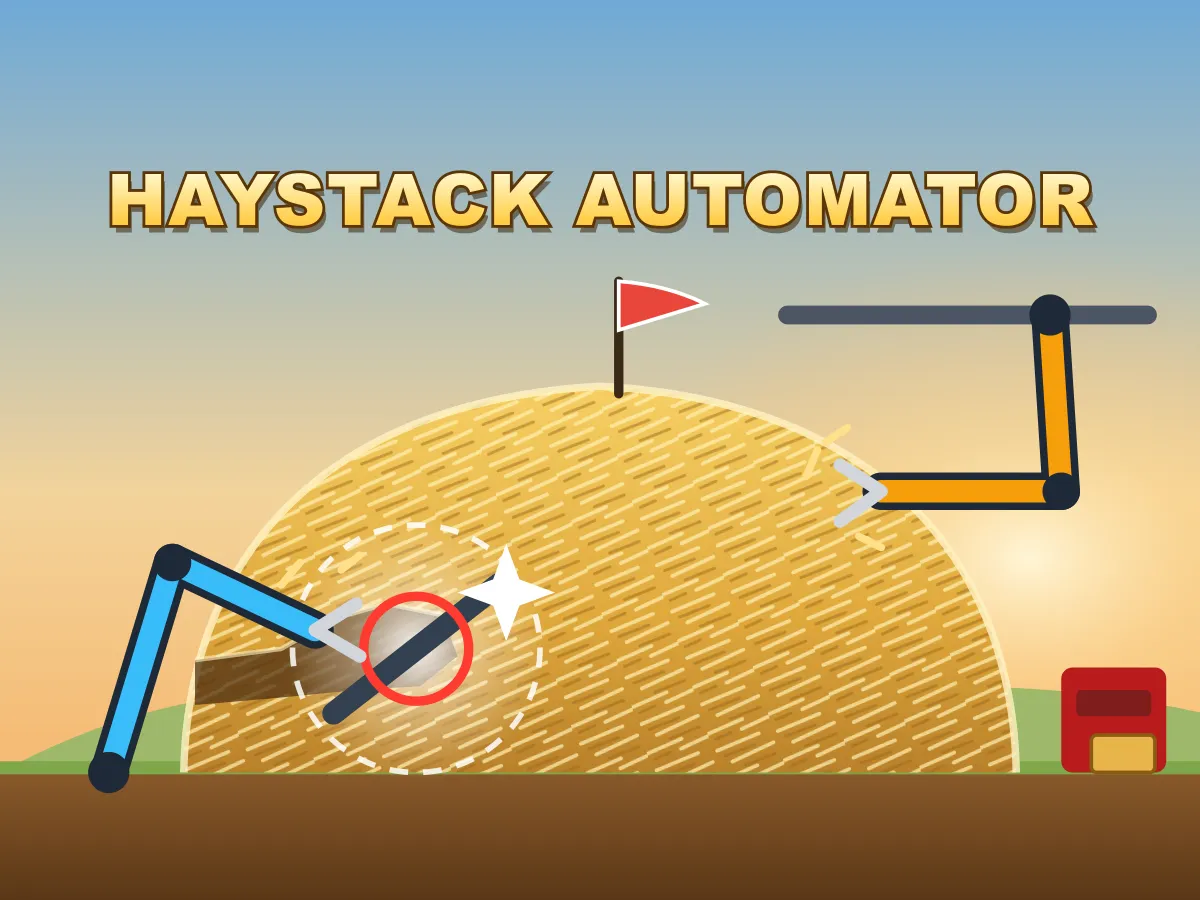
Haystack Automator is a free needle in a haystack game you play online, in your browser, with nothing to download. You wake up in front of a giant haystack, over four million straws packed into one golden dome, and somewhere inside it are 24 needles. Find them all. At first you dig by hand: hold the mouse or your finger on the hay and the pitchfork strips it away, six forkfuls a second, and every straw you dig sells on the spot. A metal detector rides on your pointer and beeps faster as you sweep it along the open hay near a hidden needle, and a needle starts to glint as soon as open air reaches its cell. Every needle you pull out pays a bounty, and the needles are also what grows your factory: the first one opens robot arms that dig wherever you plant the red flag and a motor that doubles them, three needles open a conveyor and baler that sell straw for more, six open a scanner that spots the next needle for you, and ten open an autopilot that walks the flag from needle to needle on its own. The real decision is what to automate next, and where to point it. Machines aimed at the wrong straw make you rich and find nothing: our bots that never moved the flag dug out the whole stack before the last needle came free, while a player who follows the beeps and flags each glint reaches the last needle with well under half of the haystack dug. It is part automation game, part idle digging game and part hot-and-cold search, and a full haystack takes about 15 minutes. Progress saves in your browser, and it plays on phones and tablets with touch as well as on a computer with a mouse or the keyboard.
How to play Haystack Automator
- Hold on the hay to dig. The pitchfork digs six times a second wherever you hold, and a tap digs once. Only straw that touches open air can be dug, so holding on a spot deep inside the stack digs the open straw nearest to it, and you tunnel your way in.
- Start with the glint near the top of the stack: that is the first needle, sticking out of the surface. Dig its cell out and the needle is yours, with a bounty of coins as big as the straw it was hiding in. Every straw you dig also sells for a coin the moment it comes loose.
- Sweep the metal detector along the open hay. It beeps, and its ring turns from yellow to orange to red, as you get closer to a hidden needle. It reaches 2 cells into the straw at first and 4 once it is upgraded. A needle right next to the detector, or whose cell meets open air, starts to glint so you can see it.
- Spend coins in the workshop, on the right of the field (or under it on a phone). Its stages open as you find needles: Robot Arms and the Arm Motor at 1 needle, the Conveyor and Baler at 3, the Scanner at 6 and the Autopilot at 10.
- Robot arms dig 40 straw a second each, always at the straw nearest the red flag, and every Arm Motor level doubles them. Right-click a cell, or pick Flag and tap, to move the flag onto a glint or a beep, and the arms tunnel straight to it.
- The Conveyor carries straw to the Baler, and baled straw sells for ×2 at first and up to ×6. Whatever the conveyor cannot carry still sells loose for 1 coin, so nothing is ever wasted. The Scanner spots the shallowest hidden needle every 40 seconds (every 10 at its best), and the Autopilot moves the flag to the nearest glinting needle by itself.
- Find all 24 needles to finish the haystack. The card shows your time and your stars: three stars under 18 minutes, two under 28. Start a new haystack and the needles hide somewhere else.
- On a keyboard: the arrow keys move a cursor over the stack, hold Space to dig there, F puts the flag down, the number keys 1 to 8 buy from the workshop list, A switches the Autopilot on or off and M mutes the sound.
Tips
- The first needle is a head start. It glints near the crown from the beginning, and the straw it was buried in plus its bounty come to 1,400 coins, enough for the first Pitchfork upgrade at 1,200.
- Point the machines. The flag decides which straw the robot arms eat: left on the crown they dig a crater that only earns money, moved onto a glint or the detector's hottest spot they tunnel to a needle. Our bots that never moved the flag dug out the whole haystack and took about a third longer than ones that aimed.
- Buy by payback, not by price. Always buying the cheapest thing in the workshop felt busy but finished about 2 minutes later than buying whatever paid for itself fastest.
- Do not skip automation. A player who only ever upgraded the pitchfork and the detector needed more than twice as long to find all 24 needles as one who bought robot arms.
- Buy the Conveyor and the Baler as a pair. Neither earns anything on its own, and the baler only pays extra on as much straw a second as the conveyor can feed it, so once your machines dig faster than that, the next coin goes into the conveyor.
- The deepest needles hide low in the middle of the stack, where the straw is packed hardest and a single cell can hold over 170,000 straws. Keep the detector on the edge of each new tunnel: those needles only start to beep once the open hay comes within its range.
- Let the Autopilot finish. Once the Scanner and the Autopilot are running you can take your hands off the stack: our hands-free bot still found every needle, about 4 minutes behind one that kept hunting with the detector.
FAQ
Is Haystack Automator free to play?
Yes. Haystack Automator is free to play online in your browser, with no download, no account and no in-game purchases. Every coin comes from the haystack itself: the straw you dig and the bounties on the needles you find.
How do you play Haystack Automator?
Hold on the hay to dig it away with a pitchfork, listen to the metal detector to find where a needle is hiding, and dig its cell out. The straw you dig sells for coins, and the coins buy machines: robot arms that dig at a flag you place, a conveyor and baler that sell straw for more, a scanner that spots needles and an autopilot that moves the flag for you. Find all 24 needles to finish the haystack.
How do I find the needles in the haystack?
Sweep the metal detector along the open hay: it beeps faster and its ring goes from yellow to red as you get closer, up to 2 cells into the straw (4 when upgraded). A needle glints as soon as open air reaches its cell or the detector touches the hay right next to it. From 6 needles on, the Scanner spots the shallowest hidden needle for you every 40 seconds, down to every 10. A needle is yours when its cell is dug out.
Why can I not dig the straw I am pointing at?
Only straw that touches open air can be dug. If you hold on a spot deep inside the stack, the pitchfork digs the open straw nearest to it instead, so you tunnel toward the spot cell by cell. The robot arms work the same way toward the flag. Straw deeper in the stack is packed tighter, from 700 straws a cell on the surface to over 170,000 in the middle at the bottom.
What do the robot arms do, and how do I move the flag?
Each robot arm digs 40 straw a second, always at the straw nearest the red flag, and each Arm Motor level doubles every arm, up to ×64. To move the flag, right-click a cell, or press the Flag button and tap the stack, or press F on a keyboard. Put it on a glinting needle or where the detector beeps and the arms tunnel straight there.
What should I buy first?
The first needle pays for the first Pitchfork upgrade (1,200 coins). After that, the first Robot Arm costs 5,000 coins and each extra arm costs 15% more than the last, so compare it with the next Pitchfork or Arm Motor by how fast each pays for itself. Our measured bots found that buying by payback finished about 2 minutes sooner than always buying the cheapest thing.
How do the Conveyor and the Baler work?
Loose straw sells for 1 coin. The Conveyor carries up to 400 straw a second to the Baler at its first level, rising to 99,774 at its last, and baled straw sells for ×2 with the first Baler and up to ×6. Anything the conveyor cannot carry still sells loose, so they never cost you straw, but neither earns anything without the other.
How long does it take to find all 24 needles?
A steady player who follows the detector and keeps the flag on the needles finished in about 15 minutes in our measured runs, and a clumsy first-timer in about 22. Three stars take under 18 minutes and two stars under 28. A player who never bought a machine needed about 38 minutes.
Does the haystack keep digging when I close the page?
No. Your haystack, coins, machines and needles are saved in your browser and come back when you return, but the machines only dig while the game is open, so nothing is earned while you are away. The clock only runs while you play, too.
Can I play Haystack Automator on my phone?
Yes. Hold your finger on the hay to dig and the detector reads wherever you touch; use the Flag button to place the flag with a tap. On an upright phone the workshop sits under the field, and on a phone on its side it moves to a column on the right.
Is this the Find The Needle game from Steam?
No. Haystack Automator is our own browser game built around the same idea, a needle hunt in a haystack that you slowly hand over to machines, and it is not affiliated with Find The Needle or its developers. If you were looking for a find the needle game or a haystack simulator to play online without installing anything, this is a free 2D take on it, with its own machines, art and rules.
How is it different from other idle and mining games?
In most idle games the money is the goal. Here it is a side effect: every straw you sell is straw that was in the way, and the game ends when the 24th needle comes out. That makes where you dig as important as how fast, which is why the detector and the flag matter more than the shop. Our bots that dug blind cleared the entire stack; the ones that aimed found everything with well under half of it dug.