
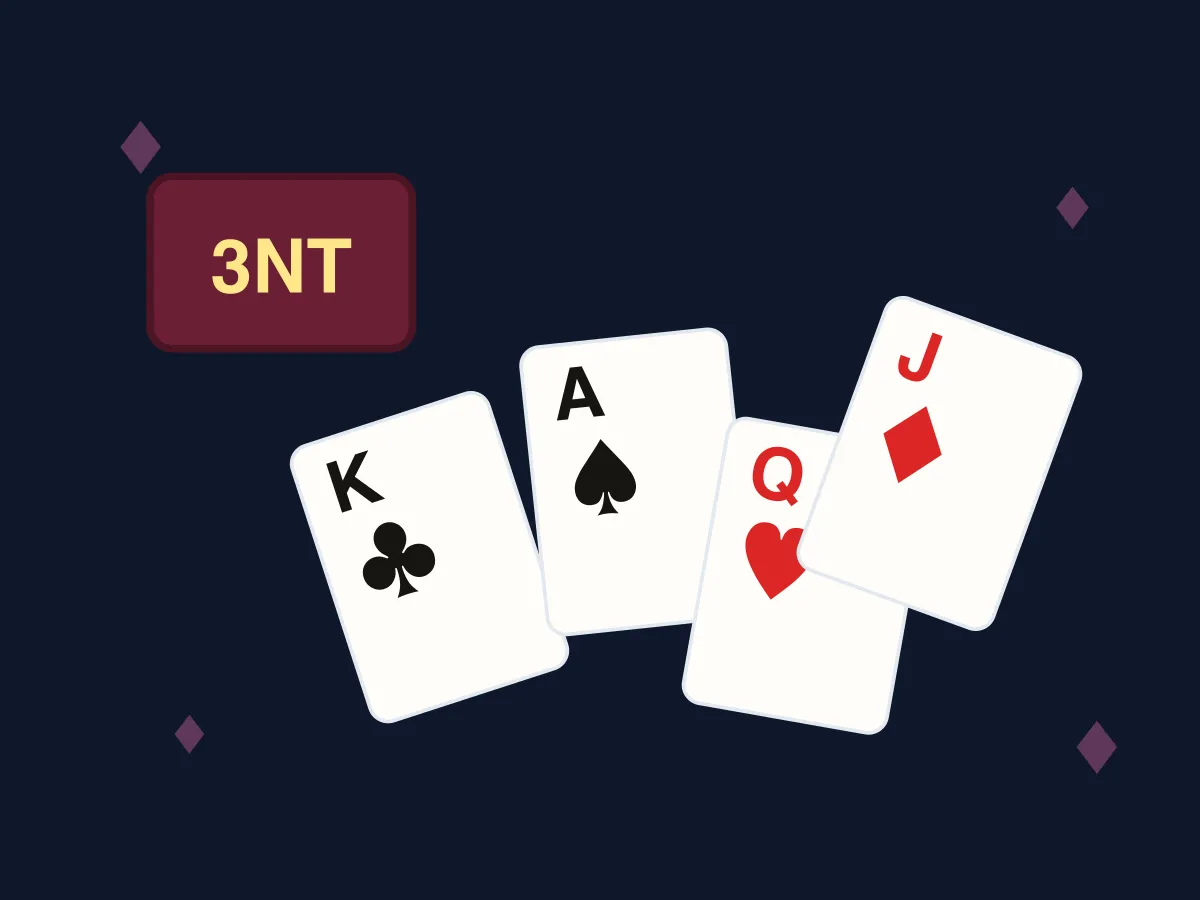


Bridge is a free online card game for one player. You sit South with a computer partner, Skye, against a computer pair, Reid and Wynn — no download, no sign-up and no other players to wait for. Each deal opens with an auction: every bid names a level from 1 to 7 and a strain — clubs, diamonds, hearts, spades or No Trump, lowest to highest — and must outrank the last, until three passes in a row end it. The final bid is the contract, and the side that won it must take 6 plus the level in tricks out of 13. Declarer plays their own cards and the face-up dummy across the table, everyone follows suit when they can, and the contract suit is trump. Scoring uses the standard non-vulnerable values: 20 a trick in the minors, 30 in the majors, 40 then 30 in No Trump, a 300 bonus for game, 500 and 1000 for slams, and 50 a trick to the defenders when a contract goes down. There is no doubling and no vulnerability. Each level is a match to 500 points, and 15 levels take every computer seat, your partner included, from careless to precise.
How to play Bridge
- You sit South and your partner Skye sits North, across the table. Reid (West) and Wynn (East) are the rival pair. All 52 cards are dealt, 13 to each seat, and the dealer moves one seat clockwise every hand.
- The auction starts with the player to the dealer's left and goes clockwise. On your turn choose a level (1-7) and a strain that outranks the current highest bid, or pass. Strains rank clubs, diamonds, hearts, spades, then No Trump, so 1♠ beats 1♥ and 2♣ beats 1NT.
- The auction ends after three passes in a row following a bid. If all four players pass without bidding, the hand is thrown in and redealt.
- The last bid is the contract. The partnership that made it must take at least 6 plus the bid level in tricks between their two hands — 9 tricks for 3NT, 10 for 4♠, all 13 for a grand slam at the 7 level.
- Whoever on the winning side first named the contract's strain becomes declarer. Their partner's hand turns face-up as the dummy, and declarer plays cards from both hands. If you win the contract you play Skye's cards as well as your own; if Skye declares, your hand is the dummy and Skye plays it.
- The player to declarer's left leads the first trick. Everyone must follow the suit led if they can; if not, they may play any card. The highest trump wins the trick, or the highest card of the suit led if no trump was played. In a No Trump contract only the suit led can win.
- Make the contract and your side scores 20 a trick bid in clubs or diamonds, 30 in hearts or spades, and 40 for the first No Trump trick then 30 for each after, plus the same rate for every overtrick. Add 300 if the bid tricks are worth 100 or more (a game), otherwise 50, and a further 500 for a small slam or 1000 for a grand slam.
- Fall short and the defending side scores 50 for every trick the contract went down.
- A level is a match to 500 points. After any hand in which either side reaches 500, the side with more points wins the match; win it to unlock the next level's sharper table.
Tips
- Count your high card points before bidding — an ace is worth 4, a king 3, a queen 2, and a jack 1 — and only open the bidding with around 13 or more.
- Support your partner's suit when you can — three or more cards in it plus a decent hand is usually enough reason to raise rather than bid your own suit.
- Bid game when your side has the values for it. 3NT, 4♥, 4♠, 5♣ and 5♦ all collect the 300 bonus instead of 50, so a made 4♠ scores 420 while 2♠ with two overtricks scores only 170. With no doubling, going one down in 4♠ costs just 50.
- Prefer 3NT or a major-suit game over a minor. 5♣ needs 11 tricks to score 400; 3NT needs 9 tricks for the same 400.
- Read Skye's bids at the higher levels: Skye opens with 13+ points in its longest suit, raises your suit only with three or more cards and at least 6 points, jumps two levels with 13+, and bids No Trump over you with 16+. A pass after your bid usually means no three-card fit and under 16 points, not necessarily a weak hand.
- When the rivals reach a game contract, think about outbidding them. Undertricks are only 50 each here, so going two down in your own contract costs 100, while letting them make 4♥ gives them 420.
- Every computer seat plays to win each trick it can: it leads its highest card, usually outside trumps, and follows with the cheapest card that beats the table. It never ducks to keep a winner for later, so rival aces tend to fall early and your kings and queens become winners once they do.
- Once you can see the dummy, count how many tricks your side actually needs and plan which suit to establish first instead of just playing your highest card every trick.
- On defense, follow suit low when you can't beat the trick and save your high cards for when they'll actually win — burning a winner early gives the declarer a trick for free.
FAQ
Is Bridge free to play?
Yes. Bridge is completely free to play online with no download, no account, and no in-game purchases. All 15 levels are included and unlock one at a time as you win matches, and your progress is saved in your browser.
How do you play Bridge for beginners?
Bridge is played in two parts. First comes the auction, where the four players bid for the right to name trumps and promise a number of tricks. Then the 13 tricks are played: follow suit if you can, highest card of the suit led wins unless someone trumps. Start on Level 1, where every computer seat makes frequent mistakes, open the bidding with about 13 high card points, and raise your partner when you hold three of their suit.
How does bidding work in Bridge?
Each bid names a level from 1 to 7 and a strain. The level is how many tricks over six your side promises, so 2♥ promises 8 tricks with hearts as trump. Strains rank clubs, diamonds, hearts, spades, No Trump, and every bid must be higher than the last — a higher level, or the same level in a higher strain. Three passes in a row after a bid end the auction, and four passes with no bid mean a redeal.
What is the dummy in Bridge?
The dummy is declarer's partner. Once the auction ends, that hand is laid face-up on the table and declarer chooses every card played from it, so one player runs both hands of the partnership. In this game you will see the dummy above your own hand. When Skye declares, your hand becomes the dummy and Skye plays it; when you declare, you tap Skye's cards as well as yours.
What does making a contract mean?
It means the declaring side took at least as many tricks as it bid for: 6 plus the contract level. Bid 3NT and you need 9 of the 13 tricks; bid 4♠ and you need 10. Making it scores the contract's trick value plus a bonus, and every trick beyond the target is an overtrick worth the same per-trick rate. Taking fewer means the contract went down, and the defenders score 50 for each missing trick.
How is Bridge scored in this game?
Tricks bid in clubs or diamonds are worth 20 each, in hearts or spades 30, and in No Trump 40 for the first and 30 after that. If those bid tricks total 100 or more — 3NT, 4♥, 4♠, 5♣ or 5♦ and up — you add a 300 game bonus, otherwise 50. Small slams add 500 and grand slams 1000. So 3NT made exactly scores 400, 4♠ scores 420 and 2♥ with one overtrick scores 140.
Can I play Bridge alone online?
Yes, that is exactly how this version works. You play South with a computer partner against two computer opponents, so you never need three other people, a lobby or a scheduled game. The computer seats never look at any hand but the one they are playing, and a match to 500 usually takes 15 to 25 minutes.
Does this version include doubling or vulnerability scoring?
No — this is a simplified contract Bridge. There is no double or redouble, no vulnerability and no rubber: each hand is scored on its own, so a part-score never carries over toward game. The computer seats use a plain point-count bidding method rather than a full convention system such as Stayman or Blackwood, and the dummy turns face-up as soon as the auction ends rather than after the opening lead.
What is the difference between Bridge and Whist or Spades?
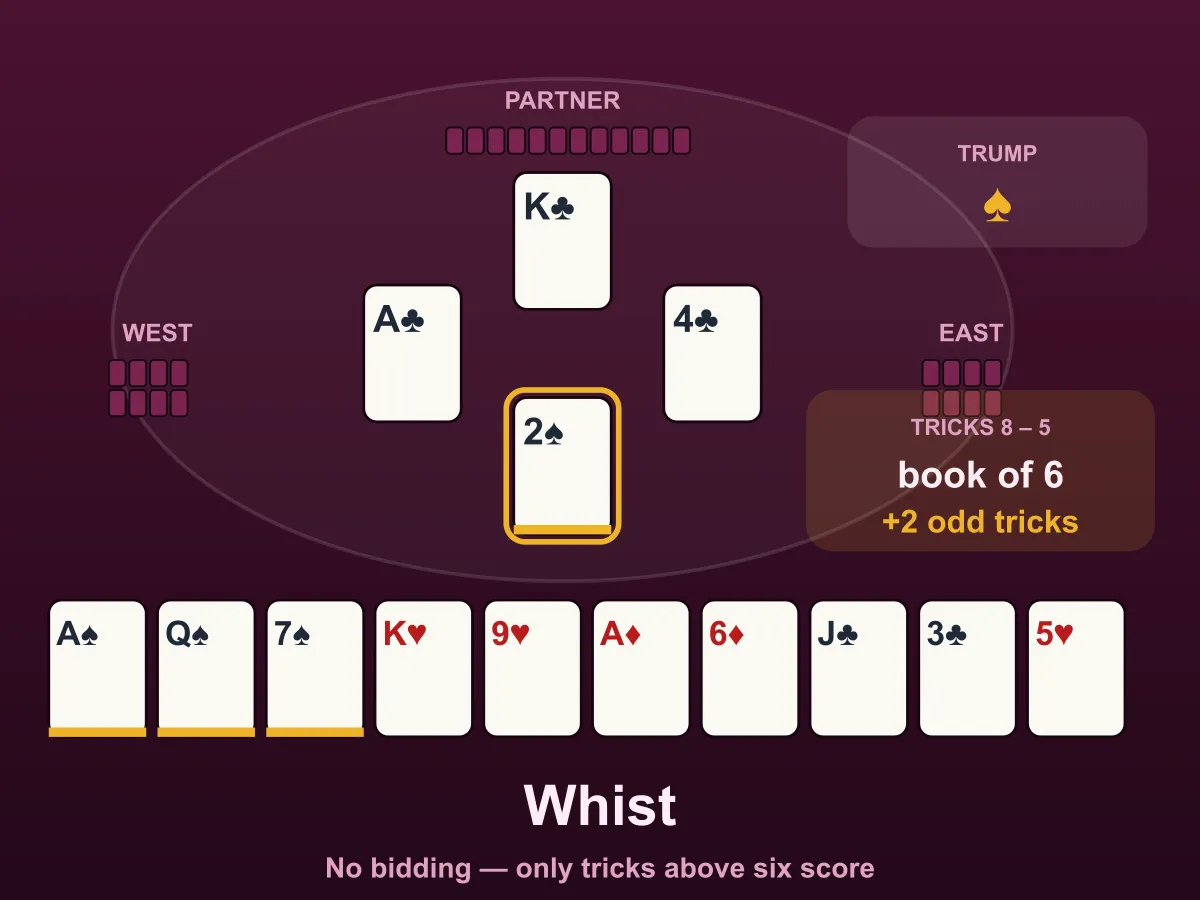
All three are partnership trick-taking games with 13 tricks a hand. Whist is Bridge without the auction or the dummy: nobody bids, and every player plays their own cards. Spades replaces the auction with a simple trick count per player and always uses spades as trump. If Bridge feels heavy, Whist is the same trick play without the bidding; for a different partnership bidding game, try Five Hundred or Euchre.
How many levels does Bridge have?
There are 15 levels. Every level plays a full match to 500 points, but every seat — including your partner — bids more accurately and plays more precisely with each table. On Level 1 a computer seat follows its plan only 15% of the time and otherwise bids roughly or plays a random legal card; by Level 15 it follows its plan on every call and every card.
Does Bridge work on mobile?
Yes — bidding and every card play is a single tap, so it plays the same on phones, tablets, and desktop. The bidding box shows every level and strain as its own button, disabled when it does not outrank the current bid, and the dummy sits in its own row above your hand so both are easy to tap on a small screen.