



Spades is a free online card game for one player. You and a computer partner, Ace, take on a computer pair, Duke and Vex — no download, no sign-up and no lobby to wait in. All 52 cards are dealt, 13 to each seat, and every player bids how many tricks they expect to take, from Nil up to 13. The other three bids stay hidden until you lock yours in, so you bid your own hand rather than answering theirs. Spades are always trump and cannot be led until one has been played to a trick, unless you hold nothing else. You and your partner add your bids into one team target: make it for 10 points a bid trick plus 1 for every extra trick, or lose 10 a trick if you fall short. Extra tricks are bags, and every ten bags costs 100 points. A Nil bid scores 100 if you take no tricks at all and loses 100 if you take even one. Each level is a match to 500 points, and 15 levels sharpen every computer seat, your partner included, from careless to exact.
How to play Spades
- You sit South with your partner Ace across the table; Duke and Vex are the rival pair. All 52 cards are dealt, 13 to each seat.
- Look at your hand, then bid how many of the 13 tricks you think you'll take, from 1 to 13 — or bid Nil to gamble on taking zero tricks. The computer seats have already bid; all four bids are revealed together once you choose yours.
- The first lead moves one seat clockwise every hand: you lead the first hand, West the second, and so on. After that, whoever wins a trick leads the next one.
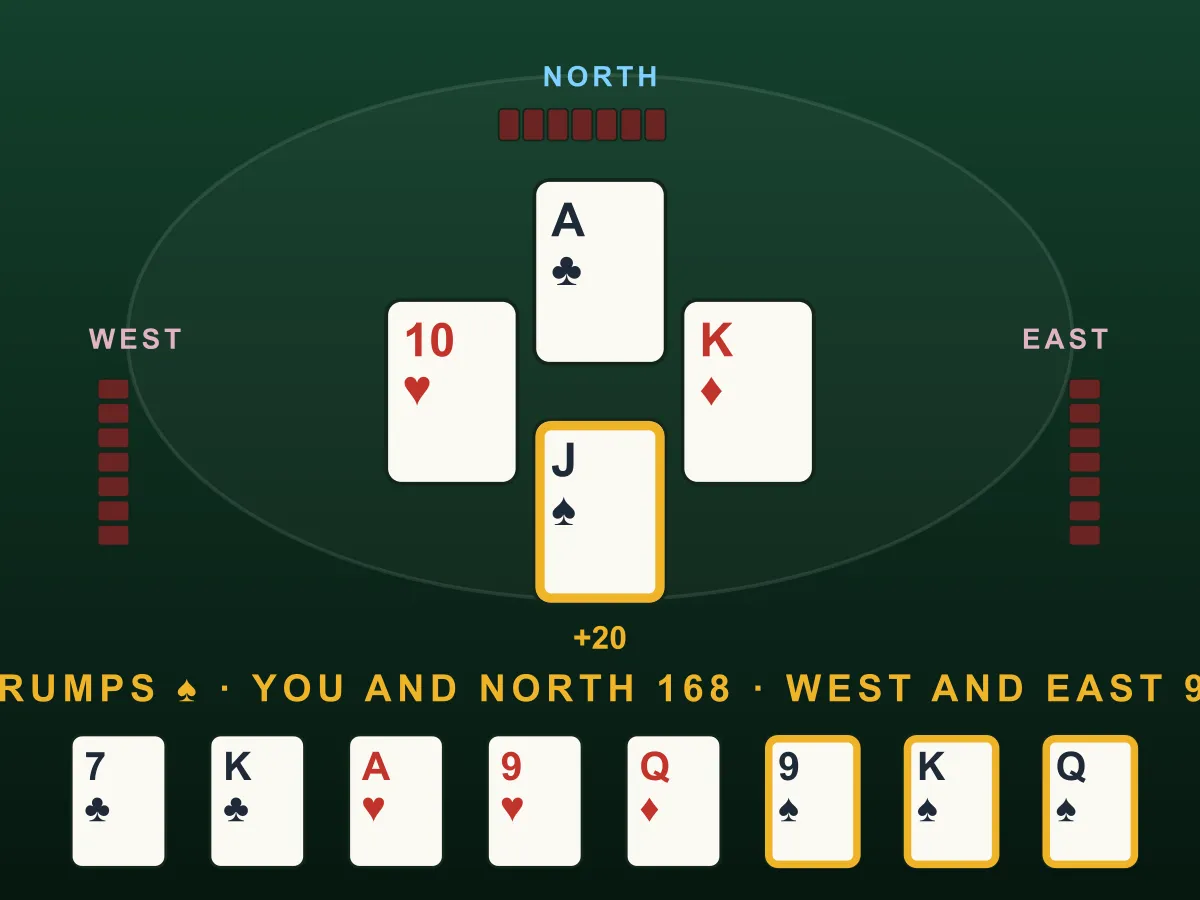
- Spades are always trump: any Spade beats every card of another suit, and the highest Spade played wins the trick outright. With no Spade in the trick, the highest card of the suit led wins.
- Spades can't be led until one has been played on an earlier trick (broken), unless that's the only suit left in your hand.
- Follow the suit that was led whenever you can; if you're void in that suit, you may play anything, including a trumping Spade — even before Spades are broken.
- Your team scores by its combined bid: make it for 10 points per bid trick plus 1 per extra trick (a bag), or lose 10 points per bid trick if you fall short. Bid 4 and take 6, for example, and your team scores 42 and picks up 2 bags.
- Bags carry over from hand to hand, and every 10 your team collects costs a 100-point penalty. A Nil bid is scored separately: +100 if that player takes no tricks, -100 if they take any.
- A level is a full match to 500 points. After any hand in which either team reaches 500, the team with more points wins; win to advance to the next level's sharper table.
Tips
- Count your sure winners before bidding — Aces, a guarded King, and every high Spade — rather than just counting how many cards you hold.
- Extra Spades beyond your first few are worth real bidding value even if they're low, since trump length lets you win tricks you'd otherwise lose.
- Bid your own hand. You never see Ace's bid before choosing yours, and Ace bids without seeing yours, so shading your bid down in the hope that your partner covers the difference usually leaves the team short.
- Once your team has already made its bid, start ducking instead of winning — every trick past your bid is a bag, and bags add up to a 100-point penalty. Ace does the same: once the team target is met, it stops chasing tricks and ducks wherever it can.
- Missing your bid costs far more than a bag. Falling one short on a team bid of 6 turns +60 into -60, while one bag costs a single point now and a tenth of a penalty later, so when in doubt take the trick.
- If you bid Nil, play your lowest safe card all game and let your partner cover the tricks — winning even a single trick breaks the bid.
- Set a rival Nil by leading low and staying under it. A computer Nil bidder throws its highest card that will not win, and once it runs out of safe cards it has to take the trick.
- The computer seats chase tricks only while their own team is short of its bid. When the rivals have made their target they start ducking, so if your team still needs tricks, that is the moment your middling cards win cheaply.
FAQ
Is Spades free to play?
Yes. Spades is completely free to play online with no download, no account, and no in-game purchases. All 15 levels are included and unlock one at a time as you win matches, and your progress is saved in your browser.
How do you play Spades?
Spades is a four-player partnership game. Each player gets 13 cards and bids how many tricks they will take. Then 13 tricks are played: follow the suit led if you can, otherwise play anything. Spades are always trump, so the highest Spade in a trick wins it, and if none was played the highest card of the suit led wins. Your team scores by taking at least its combined bid, and the first team to 500 points wins the match.
How does bidding work in Spades?
Every player bids a number from 1 to 13, or Nil for zero, based only on their own hand. In this game the three computer seats bid first in secret, and all four bids are shown once you pick yours. You and your partner then add your two bids together into one team target — bid 3 and Ace bids 4, and your team needs 7 tricks between you. A Nil bid does not count toward that total.
What is a Nil bid in Spades?
Nil is a promise to take no tricks at all. If the Nil bidder gets through all 13 tricks without winning one, their team scores 100 points; if they win even one, the team loses 100. Their partner's bid then becomes the team target on its own. This version has regular Nil only — there is no Blind Nil, and any tricks a failed Nil bidder takes still count toward the team total.
What are bags in Spades, and what is sandbagging?
A bag is any trick your team takes beyond its combined bid. Each one is worth 1 point, but bags pile up across the whole match, and every time your team reaches 10 it loses 100 points and the count drops back by 10. Sandbagging means deliberately underbidding to pick up easy overtricks — it works for a while, then the penalty arrives. Your bag count is shown on your team's score chip.
Can you lead spades?
Not at first. Spades cannot be led until one has been played to an earlier trick, which is called breaking spades, unless your hand holds nothing but Spades. You may always trump with a Spade when you cannot follow the suit led, even before they are broken, and doing that breaks them for every player for the rest of the hand.
What wins a game of Spades?
Points. Each level is a match to 500, and after any hand in which either team reaches 500, the team with the higher total wins the match. A tie goes to your team. Scores can drop below zero from missed bids, failed Nils and bag penalties, but there is no automatic loss at a negative score here — the match simply carries on until somebody reaches 500.
What is the difference between Spades, Hearts and Bridge?
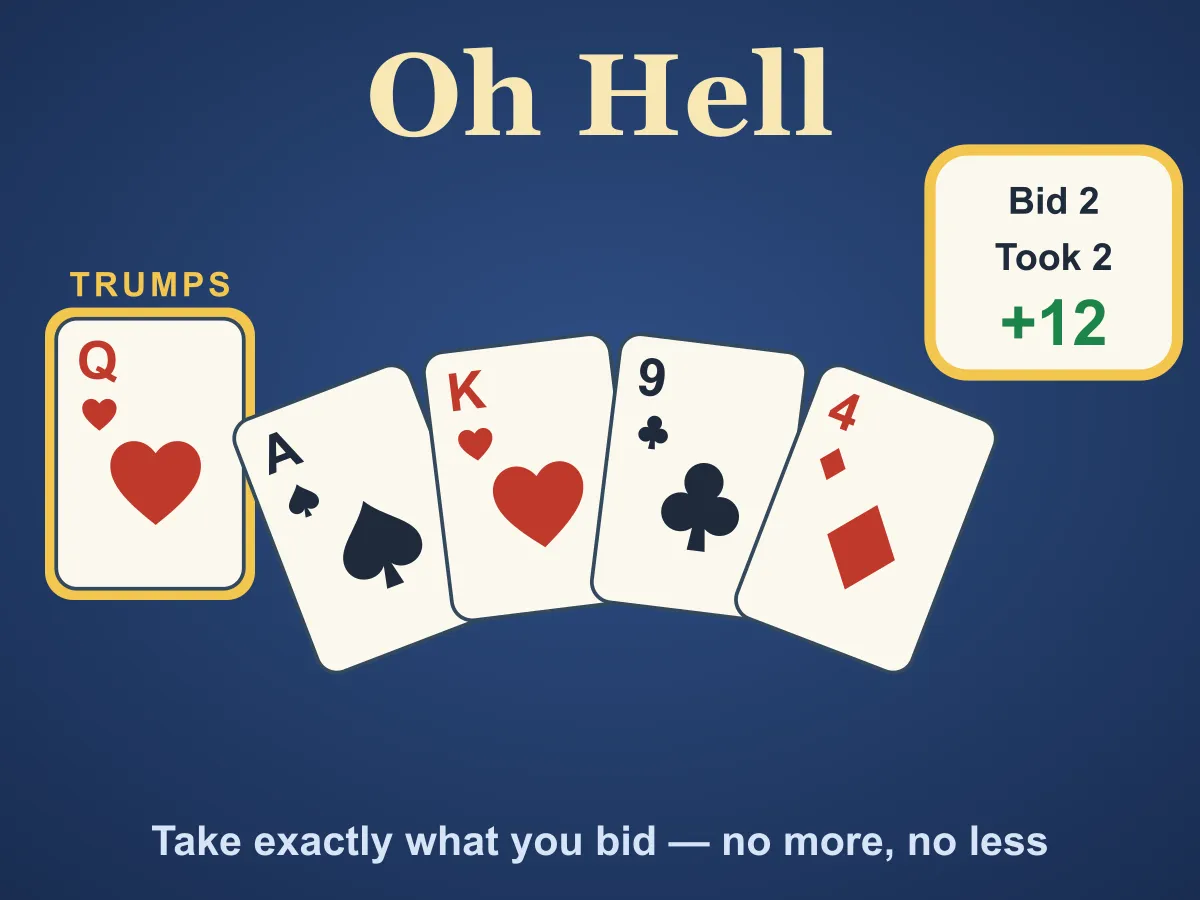
All three use 13 tricks a hand, but they reward different things. In Hearts there are no partners and no bids, and you try to avoid taking hearts and the Queen of Spades. In Bridge an auction decides the trump suit and one player runs both partnership hands. Spades fixes the trump and asks each player for a simple trick count. If you like exact bidding, Oh Hell makes you hit your number precisely.
Can I play Spades with friends online?
This version pairs you with a computer partner against two computer opponents, so there's no lobby or waiting for other people — you can start a match and play a full game any time, alone. The computer seats only ever look at their own cards and the cards already played.
How many levels does Spades have, and what changes between them?
There are 15 levels. Every level plays a full classic partnership match to 500 points, but every AI seat — including your partner — bids more accurately and plays a tighter, more precise game with each table. On Level 1 a computer seat uses its considered bid and play only 15% of the time, otherwise bidding a rough guess or playing a random legal card; by Level 15 it plays its considered move every time.
Does Spades work on mobile?
Yes — every action is a single tap, from choosing your bid to playing a card from your hand, so it plays the same on phones, tablets, and desktop. Only the cards you are allowed to play are active on your turn, so you cannot lead a Spade too early or fail to follow suit by accident.