
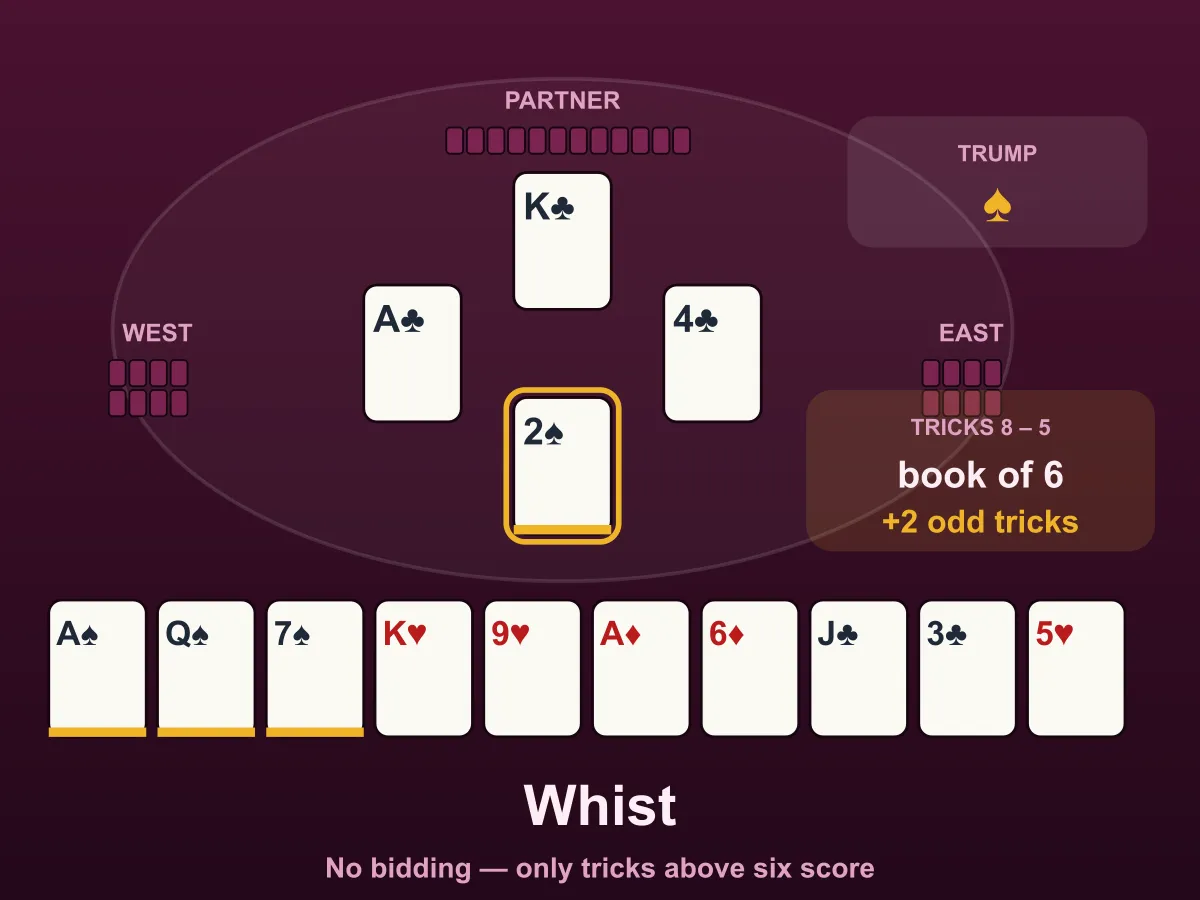



Whist is the classic English partnership trick game and the direct ancestor of Bridge — but where Bridge front-loads an auction, Whist has no bidding at all. The whole deck is dealt out, thirteen cards each, and the dealer turns their last card face up to fix the trump suit for the hand. Then you simply play: follow the suit led if you can, highest card takes the trick, and any trump beats any plain card. The scoring is where the game gets its character. The first six tricks are called the book and are worth nothing; only the odd tricks above six count, so a 7-6 hand is a single point and a clean sweep is seven. You partner the player opposite against two computer opponents. Twelve levels sharpen the table from beginners to opponents that track voids and lead long suits. No download, no account.
How to play Whist
- All 52 cards are dealt, thirteen to each of the four players. You partner the player sitting opposite you.
- The dealer turns their own last card face up — its suit is trump for the hand. That card stays in the dealer's hand and is played like any other.
- The player to the dealer's left leads the first trick. Everyone plays one card in turn, clockwise.
- You must follow the suit that was led if you hold a card in it. If you cannot, you may play anything, including a trump.
- The highest trump wins the trick. If nobody trumps, the highest card of the suit led wins. Aces are high. Whoever wins leads the next trick.
- After thirteen tricks, count up. The first six tricks are the book and score nothing — only the odd tricks above six count, so eight tricks is worth two points.
- Play hands until one side reaches the level target: 3 points on the first two levels, then the traditional 5, and 7 on the later ones.
Tips
- Count trumps. There are thirteen, and once you know how many have gone you know whether your plain-suit Aces are safe to cash.
- Lead your longest suit. After the first two rounds of it the other players are likely out, which turns your small cards in that suit into winners.
- Watch who fails to follow suit — that player is void and will trump that suit next time it is led. From level 7 the computer tracks exactly this against you.
- Do not waste a high card on a trick your partner already holds. Throwing your lowest card instead keeps the high one for a trick you actually need.
- Remember the book. Six tricks is worth nothing at all, so the whole game is about the seventh onwards — a hand that looks close at 6-6 is still entirely up for grabs.
- The trump suit in your hand is marked with a gold band so you can see your trump length at a glance without re-reading the suits.
FAQ
Is Whist free to play?
Yes. Whist is completely free to play online with no download, no account, and no in-game purchases.
Does Whist work on mobile?
Yes. Cards respond to tap and the thirteen-card hand wraps onto two rows on narrow screens, so it plays the same on phones, tablets and desktop.
How is Whist different from Bridge?
Whist has no auction and no dummy. Trump is decided by turning the dealer's last card rather than by bidding, nobody declares a contract, and all four players play their own cards throughout. Scoring is simpler too: you just count tricks above six. Bridge grew out of Whist by adding the bidding, and most of Bridge's complexity lives there.
What is an odd trick in Whist?
Any trick above the first six. The first six tricks a side takes are called the book and score nothing; each trick after that is an odd trick worth one point. So seven tricks scores 1, nine tricks scores 3, and taking all thirteen scores 7.
How is trump decided in Whist?
By the deal itself. The dealer deals their own last card face up, and that card's suit is trump for the hand. The card is not set aside — it belongs to the dealer's hand and gets played normally. Because the deal rotates, every player takes a turn at the small advantage of knowing one trump is theirs.
Do you have to follow suit in Whist?
Yes, if you can. If you hold a card of the suit that was led you must play one. Only when you are void in that suit may you play anything else, and that includes trumping the trick. Failing to follow when you could is a revoke, which is penalised in club play — this version simply prevents it, so illegal cards are dimmed.
What about honours in Whist?
This version does not score honours. In the older long-whist game, holding three or four of the top trump cards was worth bonus points, but that rewards the deal rather than the play and it was dropped from most modern short-whist scoring. Only odd tricks count here.
How many levels does Whist have?
Twelve, and what changes is the table rather than the rules. The first three levels simply play their highest legal card. From level 4 the computer wins tricks as cheaply as it can, and from level 7 it tracks which suits each player has shown void, leads its long suits and ducks when its partner already holds the trick.