
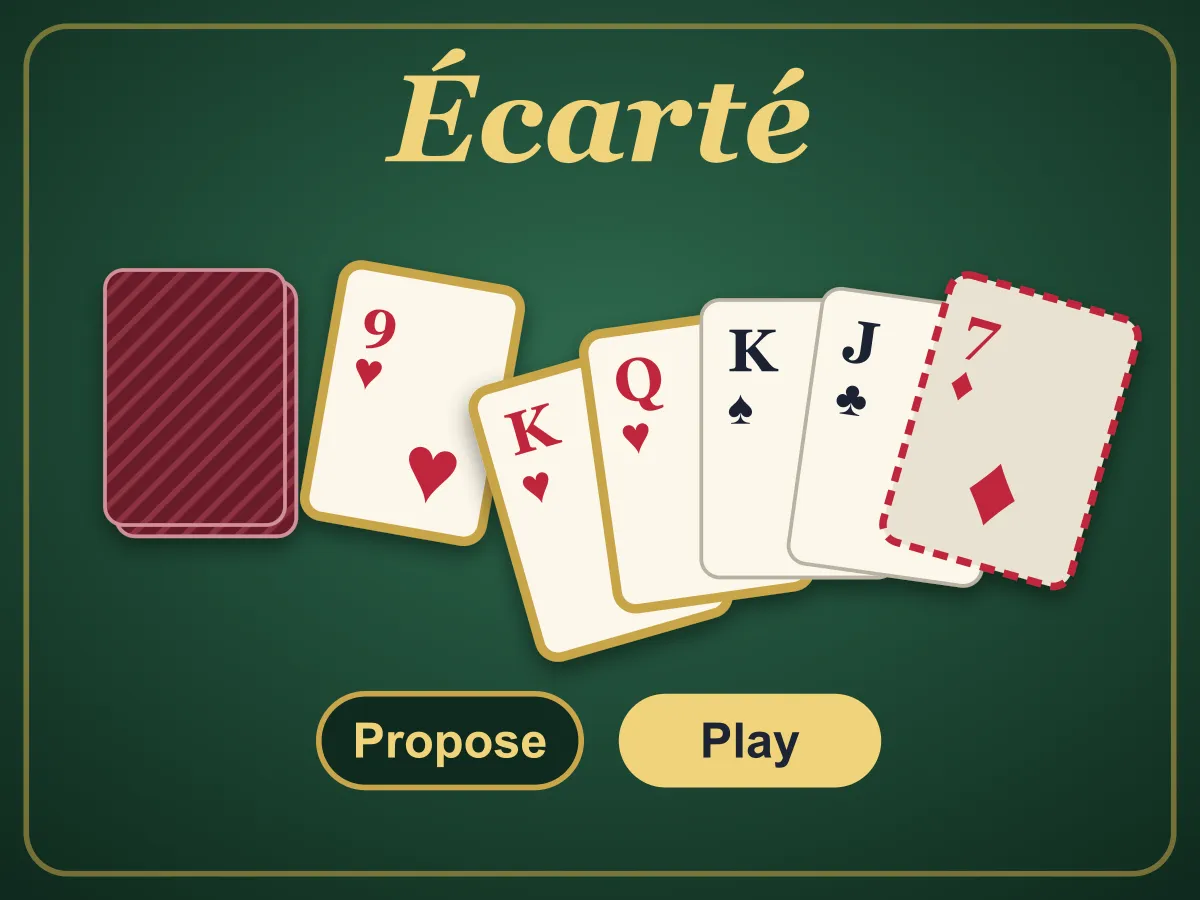




Écarté is a free online version of the French two-player card game, played head to head against the computer in your browser with no download or sign-up. It uses a 32-card piquet pack — seven up to king in each suit — with one twist in the ranking: the king is highest and the ace sits between the jack and the ten. Each hand is short: five cards each, dealt three and two, with the next card turned face up for trumps. Then comes the decision the game is named after, the écart or discard. The non-dealer may play at once or propose; the dealer may accept, and both throw away cards and draw fresh ones from the stock, or refuse and force play. Five tricks follow under strict rules — follow suit, beat the card led if you can, trump if you are void. Three or four tricks score a point, all five score two, the king of trumps is worth a point to whoever holds it, and anyone who plays without an exchange and then loses gives away two. First to five points wins.
How to play Écarté
- Press Play. You and the computer get five cards each from a 32-card pack, and the next card is turned face up to set trumps. If it is a king, the dealer scores a point straight away.
- Learn the ranking first: king, queen, jack, ace, ten, nine, eight, seven. The ace is below the jack in écarté — it is not the top card.
- The non-dealer decides first: Play the hand as dealt, or Propose an exchange. Playing without proposing is a stand — if you then fail to take three tricks, the dealer scores two points instead of one.
- If you are the dealer and the computer proposes, Accept or Refuse. Refusing the first proposal is also a stand, with the same two-point penalty if you then lose the hand.
- After an accepted proposal, tap the cards you want to throw away and press Exchange; you draw the same number from the stock. The non-dealer must change at least one card, the dealer may keep all five. The non-dealer may then propose again while the stock lasts.
- Whoever holds the king of trumps scores a point for it as they play their first card. The game announces it for you.
- The non-dealer leads the first trick. You must follow suit and must beat the card led if you can; if you have none of the suit, you must play a trump if you have one. The winner of each trick leads the next.
- Win three or four of the five tricks for one point, all five — the vole — for two. The deal then passes to the other player, and the first to five points wins the game.
- On a keyboard, keys 1 to 5 pick the cards in your hand from left to right, Enter takes the highlighted action, P proposes and R refuses.
Tips
- Count trumps before anything else. Two trumps and a king in a side suit is usually strong enough to play without proposing; a single small trump usually wants an exchange.
- Remember that the ace is only the fourth-best card in its suit. An ace with no king or queen behind it wins far fewer tricks than it does in whist or bridge.
- Throw away boldly. Keep trumps and kings, keep a queen if you like it, and swap the rest — four new cards are often better than four small ones.
- As dealer, refuse only with a genuinely good hand. Refusing stops the non-dealer improving, but if you then take fewer than three tricks it costs you two points.
- Lead your strongest suit early. Your opponent has to follow and has to beat your card if able, so a king or queen led draws out exactly the cards you want to see.
- Watch what your opponent cannot do. A player who fails to follow suit is void in it, and one who follows low against your card had nothing able to beat it.
- Keep a trump back when you can. With only eight in the pack and five cards a hand, the last trump often decides the third trick — and the point.
- At four points, a held king of trumps wins the game on your first card. Hold on to one if the exchange hands it to you.
FAQ
Is Écarté free to play?
Yes. It runs free in your browser with no download, no install and no account. There is nothing to buy and nothing is wagered; the score is only points toward five.
Which rules does this Écarté use?
Classic two-handed écarté: a 32-card pack ranked king, queen, jack, ace, ten, nine, eight, seven; five cards each with a turned-up trump; proposals and exchanges until someone stands or the stock runs out; a point for the king of trumps; one point for three or four tricks, two for all five, two against a player who stood and failed; game to five.
What does écarté mean?
It is French for "discarded" or "set aside", from écarter, to discard. The name comes from the exchange at the heart of the game, where players throw away cards and draw new ones.
Why is the ace below the jack?
That is simply the écarté ranking: king highest, then queen, jack, ace, ten, nine, eight and seven. Players coming from whist, bridge or poker misread it more than any other rule, which is why trumps are rimmed in gold and the help text repeats the order.
What is a proposal, and when should I refuse one?
The non-dealer proposes to ask for an exchange. If the dealer accepts, both may swap cards with the stock; if the dealer refuses, the hand is played as dealt. Refuse only when you are confident of three tricks, because a dealer who refuses the first proposal and then loses the hand gives away two points instead of one.
How does the king of trumps score?
Whoever holds it scores one point, announced as they play their first card — including a king drawn during the exchange. If the turned-up card itself is the king, the dealer scores the point at once.
Do I have to win the trick if I can?
Yes, when following. You must follow suit and play a higher card of that suit if you hold one. If you have none of the suit led you must trump if you can; only with neither may you play anything.
How strong is the computer?
It decides every proposal, refusal and card by dealing out the hidden cards many times over, consistent with everything it has seen, and solving each deal exactly. It never looks at your hand or the stock. It chooses its discards by the usual rule of thumb: keep trumps, kings and queens.
How is Écarté different from Euchre or Bezique?
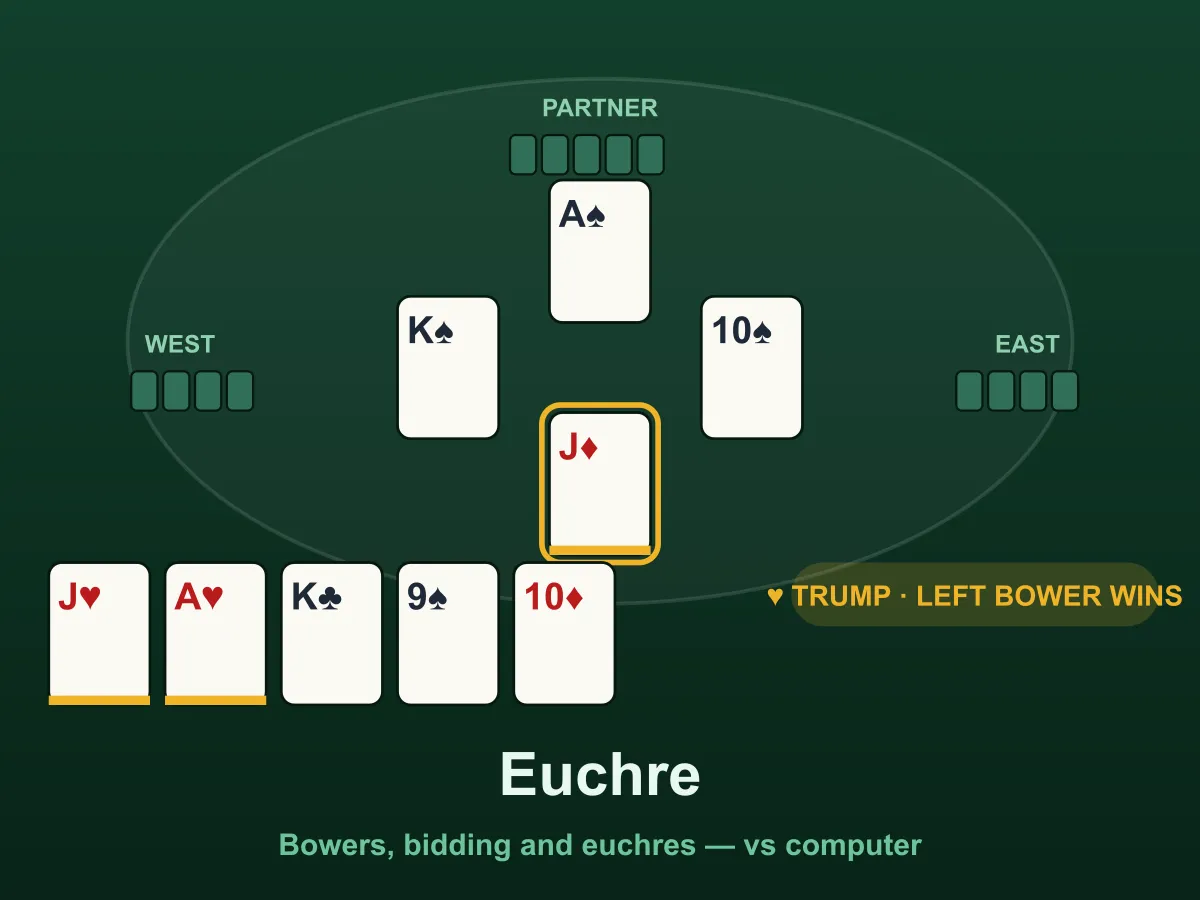
Euchre is a four-player partnership game with bowers and a 24-card deck; Bezique is a long two-player game of melds and brisques. Écarté is two players, five cards, no melds and no bidding — just the exchange, five tricks and a race to five points, usually settled in a few minutes.