


Oh Hell — also known as Oh Well and Up and Down the River, and a close cousin of Nomination Whist — is a free online version of the trick-taking card game where the whole skill is taking exactly the number of tricks you promised. You play against two to four computer players with a standard 52-card pack. Each hand the deal changes size — at most tables one card each, then two, climbing to the table's top and back down again — so you have to judge a one-card gamble and a seven-card hand in the same sitting. After the deal the next card is turned up for trumps. Everyone bids how many tricks they will take, from zero up, and the dealer bids last and is on the hook: the dealer may not bid the number that would make the bids add up to the tricks available, so at least one player at the table is always going to miss. Then you play: follow suit if you can, the highest trump wins, otherwise the highest card of the suit led. Take exactly your bid and you score ten plus the bid; take any other number and the hand scores nothing. Six tables, from a three-player kitchen game to a four-player run from thirteen cards down to one, against rivals who bid by feel, count their tricks, or count every card.
How to play Oh Hell
- Press Play and pick a table. You play against two to four computer players, each for themselves; the table you win opens the next.
- Each hand deals a different number of cards. The first four tables start at one card each and climb to the top and back down; The Sharks starts at seven, goes down to one and back up; Down the River starts at thirteen and goes down to one. The line beside the table picker shows which hand you are on and how many cards it has.
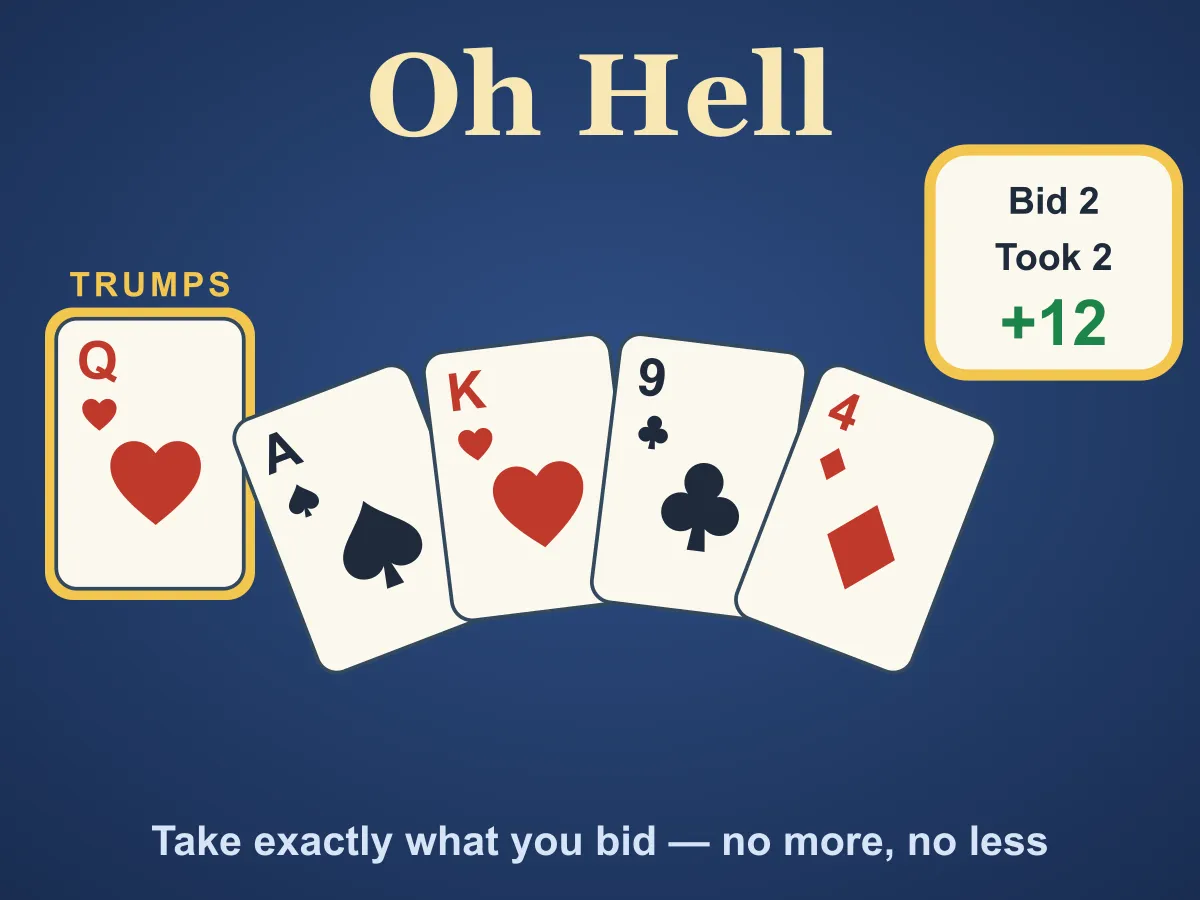
- After the deal the next card of the pack is turned face up, and its suit is trumps for that hand. When the deal uses the whole pack there is nothing left to turn, and the hand has no trumps.
- Bidding starts to the left of the dealer and goes round once. Say how many tricks you will take — any number from zero to the number of cards you hold — by tapping it or pressing its key; for 10 to 13, type both digits.
- The dealer bids last and is on the hook: the dealer may not bid the number that would make everyone's bids add up to the tricks in the hand. When you deal, that bid is crossed out on the bid strip.
- The player left of the dealer leads the first trick. Follow the suit led if you can; if you cannot, play anything, including a trump. Cards you may play rise in your hand — tap one, or press its number.
- The highest trump wins the trick; with no trump in it, the highest card of the suit led wins. Aces are high. Whoever wins the trick leads the next.
- Take exactly your bid and you score 10 plus the bid — a bid of zero made is worth 10, a bid of three made is worth 13. Take any other number, over or under, and that hand scores nothing. Your bid turns green once you have it and is struck through once it can no longer come true.
- After the last hand the highest total wins (a tie for first counts as a win). Win for a star, and win by the table's margin for two or three.
Tips
- Count the aces and the high trumps first; they are the tricks you can promise. Kings in a suit you hold only once or twice often get trumped.
- Zero is a real bid, and often the best one on a weak hand: ten points for taking nothing is as good as a bid of zero ever gets, and weak hands are easy to duck with.
- Once you have your bid, duck everything. Throw your highest card that will still lose, so it cannot win a trick for you later.
- Still short? Win as cheaply as will hold — the lowest card that beats the trick when you play last, a sure winner when others still have to play.
- Short suits are useful either way: out of a suit, you can trump in when you need a trick, or throw away a dangerous high card when you do not.
- On the hook as dealer, look at the total the others have bid. If the tricks are over-bid, someone else will have to take more than they want — lean low; if under-bid, the tricks have to go somewhere — lean high.
- Watch the other bids on the table. A player who has made their bid will duck, and one still short will fight for tricks; plan which of them will take the trick you want to lose.
- One-card hands are mostly nerve: an ace, or a high trump, is a bid of one; anything else is usually zero.
FAQ
Is Oh Hell free to play?
Yes. It runs in your browser with no download, no sign-up and nothing to buy. All six tables are included and open one after another as you win them.
Is Oh Hell the same game as Up and Down the River or Nomination Whist?
Oh Hell, Oh Well, Up and Down the River and Blackout are the same game under different names. Nomination Whist is a close cousin — the bidding and the hook are the same, but it is usually scored with a point for every trick taken plus a bonus for an exact bid, where here only an exact bid scores. The rules differ in small ways from table to table; this version uses the most common ones: exact bids score 10 plus the bid, the dealer is on the hook, and the hand size climbs and falls from table to table.
What is the hook rule?
The dealer bids last and may not bid the number that would make the total of all bids equal the number of tricks in the hand. It means the bids can never all come true — someone at the table is going to take more or fewer tricks than they said. When you deal, the barred bid is crossed out on the bid strip, and the line above it says what the others have bid so far.
How is Oh Hell scored?
Take exactly the number of tricks you bid and you score 10 plus the bid. Take any other number — one too many is as bad as one too few — and you score nothing for that hand. Scores add up over every hand at the table, and the highest total wins.
What happens when there is no card left to turn for trumps?
The hand is played with no trumps, and the highest card of the suit led wins every trick. Here that happens on the first hand of the last table, where four players are dealt thirteen cards each and the whole pack is in play.
How is this different from Spades or Whist?
Whist has no bidding at all, and in Spades you bid with a partner, spades are always trumps and extra tricks still score. In Oh Hell everyone plays for themselves, trumps change every hand, the hand size changes every hand, and only an exact bid scores — so ducking tricks matters as much as winning them. Spades and Whist are both on this site too.
How good are the computer players?
Measured on the same deals, at a table of club players: the club player takes exactly its bid on a little over half its hands, the beginner on a little under half, and the card counter on about seven hands in ten. In the same seat with the same cards, the card counter comes out ahead of the club player on about seven deals in ten. Playing your seat, the card counter wins about two matches in three at the first table and about one in five at the last, where three card counters sit against it.
Does the computer cheat?
No. It never sees your cards or the undealt ones. The card counter keeps track of every card played and of which suits each player has shown out of, then plays out likely deals of the cards it cannot see to choose its bid and each card.
Does it work on a phone?
Yes. Held upright, the rivals sit across the top, the trick and the trump card in the middle, and your hand along the bottom; held sideways, the table is on the left and your bids and cards on the right. Every bid and card is a tap, and a keyboard works too: number keys bid and play, arrow keys move between cards.