
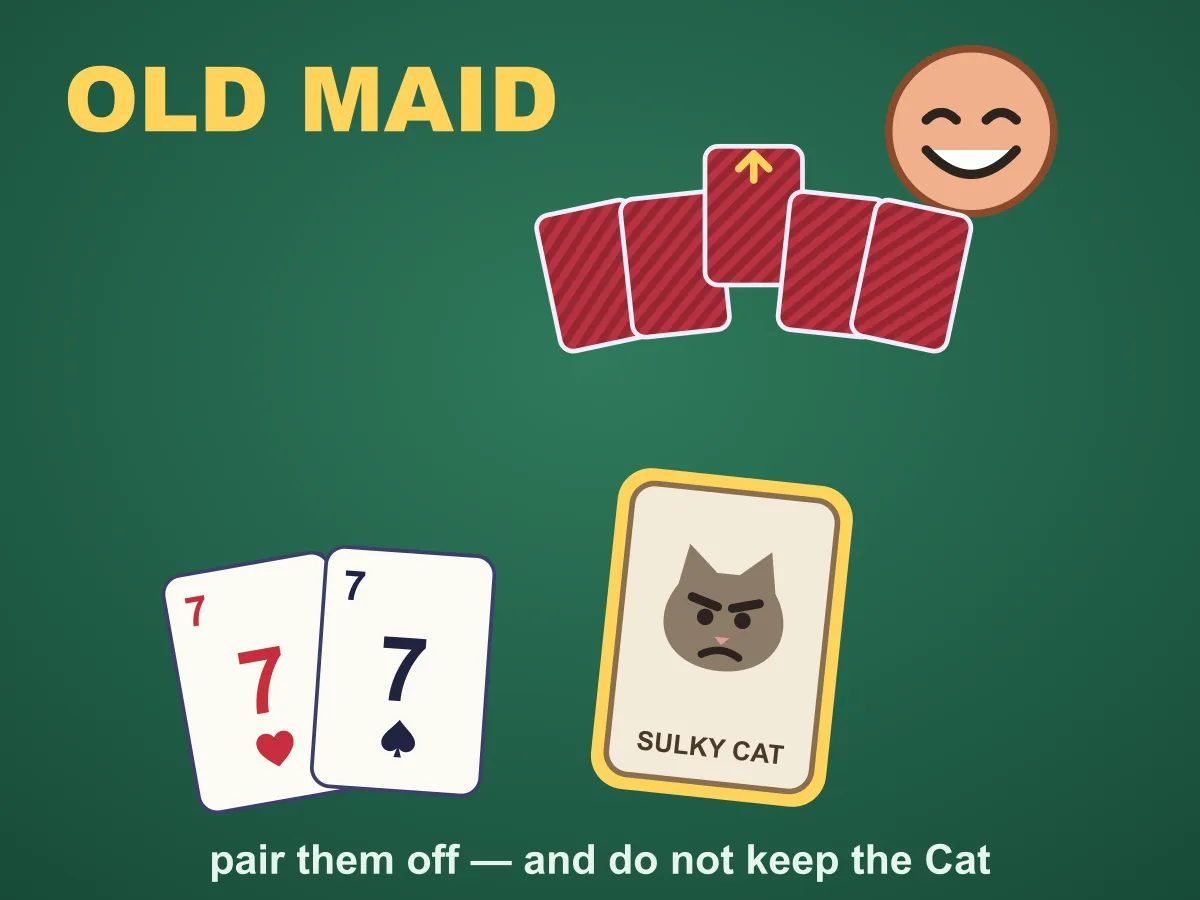


Old Maid is the classic card game for kids and families: every card pairs by rank except one odd card, and whoever is left holding it when everyone else is out loses the deal. Here the odd card is a Sulky Cat, and you play against two or three computer rivals at eight tables, five deals a table. Old Maid is mostly luck — so this version adds the skill the table game has between people. Each rival has habits: where they tuck the Cat in their hand, which of your cards they like to take, a face that gives it away when your hand hovers over it, a card that pokes up out of the fan. Reach for a card, watch the face, then take one. Hold the Cat yourself, and put it where the next player tends to pick. Nothing to download, and it plays with a tap, a click or the keyboard.
How to play Old Maid
- Press Play, pick a table and press Start. The pack — 52 cards and one Sulky Cat — is dealt out to you and your rivals, and every pair in every hand is thrown away at once.
- Cards pair by rank: two 7s, two kings. The Sulky Cat pairs with nothing, so it can only leave a hand by being drawn from it.
- On your turn you take one face-down card from the rival with the gold outline — the player before you. Tap a card once to reach for it and watch their face; tap it again to take it. You get three looks a turn; after that, a tap takes the card.
- If the card you take pairs with one you hold, the pair is thrown away for you. Then the rivals take their turns, each drawing from the player before them — the rival after you draws from your hand.
- Holding the Cat? Move it with the arrows under your hand, or tap it and then tap the spot where you want it. The rival who draws from you tends to take from one part of your hand; put it there.
- When your hand is empty you are out and safe. The last player holding a card — the Sulky Cat — loses the deal.
- A table is five deals. End no more than two of them holding the Cat for a star, which opens the next table; one for two stars; none for three.
- Keyboard: ← and → move along the rival’s cards, Space reaches for one, Enter takes it, and Shift with ← or → moves the Cat in your hand.
Tips
- Watch the face. Most rivals grin more often when your hand is over the Cat than over anything else — but a grin is not proof, and some rivals grin at nothing.
- Look for a card that pokes up out of a fan at the start of your turn. With some rivals it is often the Cat; with others it means nothing.
- Rivals have favourite places for the Cat: one end, both ends, the middle. Once you know where a rival likes it, look there first and take a card from somewhere else.
- When you hold the Cat, put it where the next drawer likes to take from. Watch the notes: they say which of your cards each rival took.
- Use your looks on the cards you would least like to take, not the ones you already plan to.
- Poker Face Pat, at the last table, has no tells at all. Against her, take any card — and save your effort for passing the Cat on.
FAQ
Is Old Maid free to play online?
Yes. It runs in your browser with no download, no sign-up and nothing to buy. All eight tables are included and open one after another.
What are the rules of Old Maid?
Every card is dealt out, and each player throws away the pairs in their hand. Then, in turn, each player draws one face-down card from the player before them and throws away any pair it makes. A player with no cards left is out. One card in the pack has no partner, so eventually one player is left holding it alone — that player loses the deal. Classic Old Maid takes a queen out of the pack so that one queen ends up unmatched; this version adds a single Sulky Cat card instead, which works the same way and is easier to spot.
Why is the game called Old Maid?
The name is a very old one, from a time when the unmatched card was a queen. It is also known as Old Bachelor, Scabby Queen and Black Peter in different countries. On this site the odd card is simply a Sulky Cat.
Is Old Maid just luck?
Mostly — and the game does not pretend otherwise. A player who takes any card, and puts the Cat just anywhere when they hold it, ends up holding it about one deal in three at a three-player table, and about one in five with four players. What you can learn are the rivals’ habits. Measured over 1,000 deals a table, a player who has learned them is left with the Cat less than one deal in six with three players, and less than one in nine with four. Nobody gets it down to never.
What are the tells, and can I trust them?
Each rival has a chance of grinning when your hand hovers over the Cat, a smaller chance of grinning anyway, a chance of letting the Cat poke up out of their fan, and favourite places to hide it. None of it is certain. The first four tables spell out the rivals’ habits on the start card; from table five you meet new faces and work them out yourself. Replaying a match deals the same cards, but the rivals’ habits play out afresh, so a replay cannot be learned by heart.
What about the last table?
Poker Night includes Poker Face Pat, who has no tells: she grins as often at any card as at the Cat, hides it anywhere, and never lets a card poke up out of her fan. She is the one you draw from, so drawing is a straight guess. You can still pass the Cat on well — Ivy draws from you, and her habits still show — which is where the skill at that table is.
How do the stars work?
Each table is five deals. End two or fewer of them holding the Sulky Cat for one star, which opens the next table; one or none for two stars; none at all for three. Old Maid is kind to beginners, so most players win most tables — three stars is where reading the rivals pays.
Can I play Old Maid with the keyboard or on a phone?
Both. On a phone or tablet every move is a tap, and held upright the table gets a taller frame so the cards stay big. On a computer, ← and → move along the rival’s cards, Space reaches for one, Enter takes it, and Shift with ← or → moves the Cat in your hand.
Is Old Maid good for kids?
Yes. It is one of the first card games children learn: the only skill needed to start is spotting pairs, and the game throws them away for you. The rivals’ tells turn it into a gentle game of reading faces.