
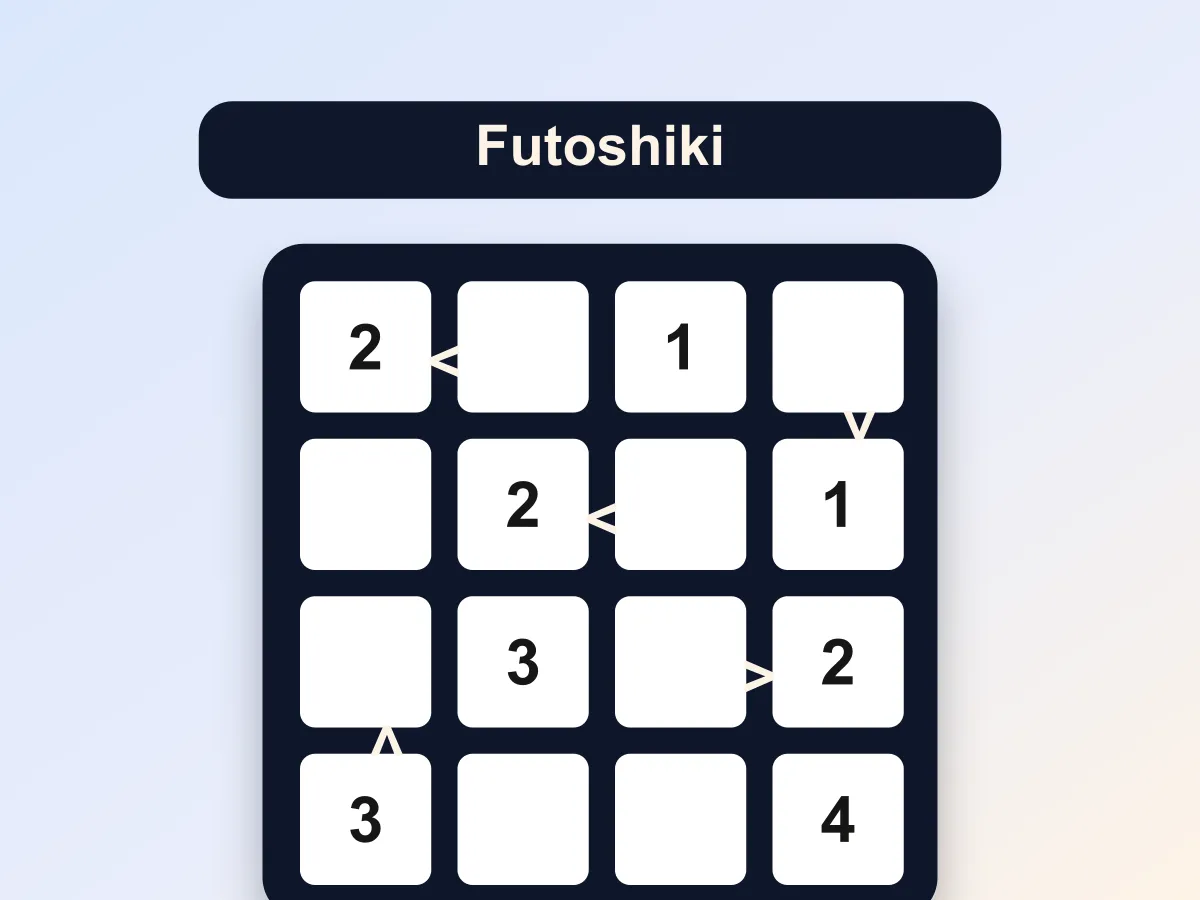



Futoshiki ("inequality" in Japanese) is a Latin-square logic puzzle: fill an N×N grid with digits 1 through N so each number appears exactly once in every row and column, just like Sudoku but with no box regions. The twist is a scattering of < and > signs printed between certain neighboring cells — every one of those signs must hold true in the finished grid, and that is the main tool for deducing where each digit belongs. Every puzzle is generated with a guaranteed unique solution across 10 levels, from a gentle 4×4 warm-up to a 7×7 grid dense with inequality chains. Free to play in the browser, no download or sign-up required.
How to play Futoshiki
- Pick a level, then look at the grid: some cells already show a digit (a "given"), and small < or > signs sit in the gaps between certain neighboring cells.
- Tap an empty cell to select it, then tap a digit on the number pad (or press a number key) to fill it in. Tap a filled cell and press Backspace/Delete, or tap it again, to clear it.
- Fill the whole grid so every row and every column contains each digit from 1 to the grid size exactly once — no repeats, same rule as Sudoku but with no box regions.
- Every < or > sign between two neighboring cells must be true for the final digits placed there — a sign pointing at a cell always points toward the smaller value.
- The puzzle is solved the instant the grid is completely filled with no row, column, or inequality violation — there is always exactly one correct arrangement of digits for every generated puzzle.
Tips
- A sign is often more useful than it looks: on a 5×5 board, a "1" can never sit on the small side of a < or > sign, and a "5" can never sit on the large side — ruling out one end of a chain narrows the other end fast.
- Chase inequality chains, not single signs — three or four cells linked by consecutive < / > signs (e.g. a < b < c < d) force a strict ordering among those cells even before you know a single row or column value.
- Once a row or column has every digit but one placed, the last empty cell is forced by elimination — sweep for those before spending a hint on a harder inequality chain.
- A "wrong" cell only turns red once it actually breaks a rule against a filled neighbor — a locally valid guess can still turn out wrong later, so don't assume a digit is safe just because nothing lit up yet.
FAQ
Is Futoshiki free to play?
Yes. Futoshiki is completely free to play online with no download, no account, and no in-game purchases.
Does Futoshiki work on mobile?
Yes, it works on touch devices as well as desktop with mouse and keyboard, with a number pad sized for tapping on small screens.
What do the < and > signs between cells mean?
Each sign sits between two neighboring cells and must hold true for whatever digits end up there — the open end of the sign always faces the larger of the two final values, and the point always faces the smaller one, exactly like a normal inequality symbol in math.
Is Futoshiki the same as Sudoku?
They share the core rule of no repeated digits in any row or column, but Futoshiki has no 3×3 box regions like Sudoku does. Instead, some neighboring cells carry a < or > sign that the finished grid must satisfy, and that inequality logic replaces the box constraint as the main solving tool.
Does every Futoshiki puzzle here have only one solution?
Yes. Every grid is generated by starting from a complete, valid solution and removing digits only while a solver confirms exactly one arrangement still satisfies every row, column, and inequality sign, so there is never any guesswork about whether a filled grid is "a" solution versus "the" solution.