
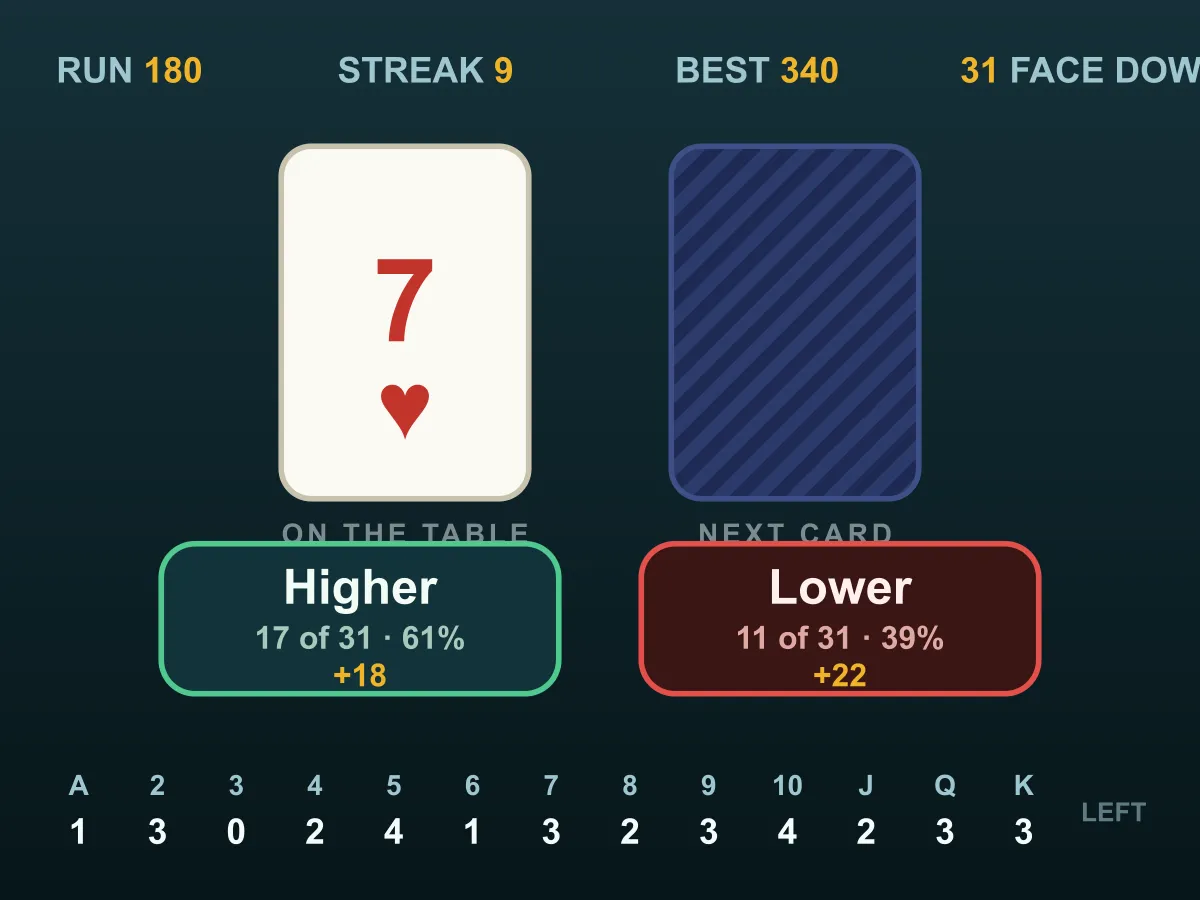






Higher or Lower is a free online card guessing game, played from a single 52-card deck dealt without replacement — and that is what turns it from a coin flip into a game. Every card that goes changes the odds on the next one, so the board shows how many of each rank are still face down, and both buttons carry the exact count and the exact percentage behind them. A correct call adds to your run; the payout is flat for a near-certainty and rises as the call gets closer, so the deck leaving you a genuinely even spot is worth more than an easy one. A wrong call loses the whole run, which is why Bank is a button you have to press: stopping on a streak of seven with a hundred points is a real decision, and pushing on for the clear-the-deck bonus is a real risk. Ties change nothing — the card moves on and your run survives — and the number of cards that would tie is printed under the table so you can see when it matters. Aces are low, so an ace and a king are the only two certainties in the pack.
How to play Higher or Lower
- Press Play. One card is turned face up and the other fifty-one stay face down — the whole game is played from that one deck, with nothing shuffled back in.
- Call Higher or Lower for the next card, with the mouse, a tap, or the up and down arrow keys.
- Each button shows the exact count behind it: how many of the cards still face down beat the card on the table, and what percentage that is.
- Aces are low and kings are high, so those two are the only cards in the pack where one of the calls is a certainty.
- A correct call adds points to your run and extends your streak. A wrong call ends the run and the points go with it.
- The payout rises as the call gets closer. A near-certainty pays the flat ten; a genuinely even spot pays up to thirty.
- A tie changes nothing at all — the card moves on, your run survives, and nothing is scored. The line under the table says how many cards would tie.
- The strip at the bottom shows how many of every rank are still face down, and dims a rank once it is gone. That is the game: it is a counting game with a guessing interface.
- Press Bank — or B — to stop and keep your run. Banked runs are the only ones that count towards your best score.
- Clear all fifty-one cards without a wrong call and there is a hundred-point bonus on top.
Tips
- Read the counts, not the card. A seven looks like a coin flip and often is not, because the deck has been eating one side of it all run.
- The percentages already do the arithmetic. If neither side is above about 60%, that is the spot to think about banking rather than the spot to be brave.
- Ties are free. On a card where four of a rank are still out, a big slice of the deck cannot hurt you, and that makes a middling call much safer than it looks.
- Bank on a number you would be annoyed to lose. There is no right streak to stop on, only the point where the run is worth more than the next ten points.
- Late in the deck the counts get lopsided fast. Twelve cards left with eight of them low turns a queen into nearly a certainty.
- The payout is a warning, not a prize. A call worth twenty-eight is one the deck thinks you will lose.
- Aces and kings are free points — take them and keep going, because they cost nothing and still extend the streak.
- The clear-the-deck bonus is a hundred, which is about ten average calls. It is only worth chasing from a long way in, not from a standing start.
FAQ
Is Higher or Lower free to play?
Yes. It runs free in your browser with no download, no install and no account. Nothing is wagered and nothing pays out — the points are points.
Is this just a coin flip?
No, and that is the point of dealing from one deck without replacement. Every card that goes changes the odds on the next, the counts are shown, and playing the counter well runs far longer than guessing does.
What happens on a tie?
Nothing. The card moves onto the table, your run and your streak survive, and no points are scored. The number of cards that would tie is printed under the table.
Is the ace high or low?
Low. That makes an ace a certain "higher" and a king a certain "lower", and they are the only two certainties in the pack.
Why do some calls pay more?
The payout rises as the chance falls, from ten for a near-certainty up to thirty for an even one. It is not a reward for gambling — the likelier side is still the right call — it just means the hard spots the deck leaves you are worth more.
What does Bank do?
Stops the run and keeps the points. Only banked runs count towards your best score, so a run you play until it busts is worth nothing however long it was.
What is the bonus for clearing the deck?
A hundred points on top, for getting through all fifty-one calls without a wrong one. It is about ten average calls, so it is worth chasing from a long way in rather than from the start.
Does it work on a phone?
Yes. The two cards sit side by side with the call buttons under them and the counting strip along the bottom; nothing needs a keyboard.