
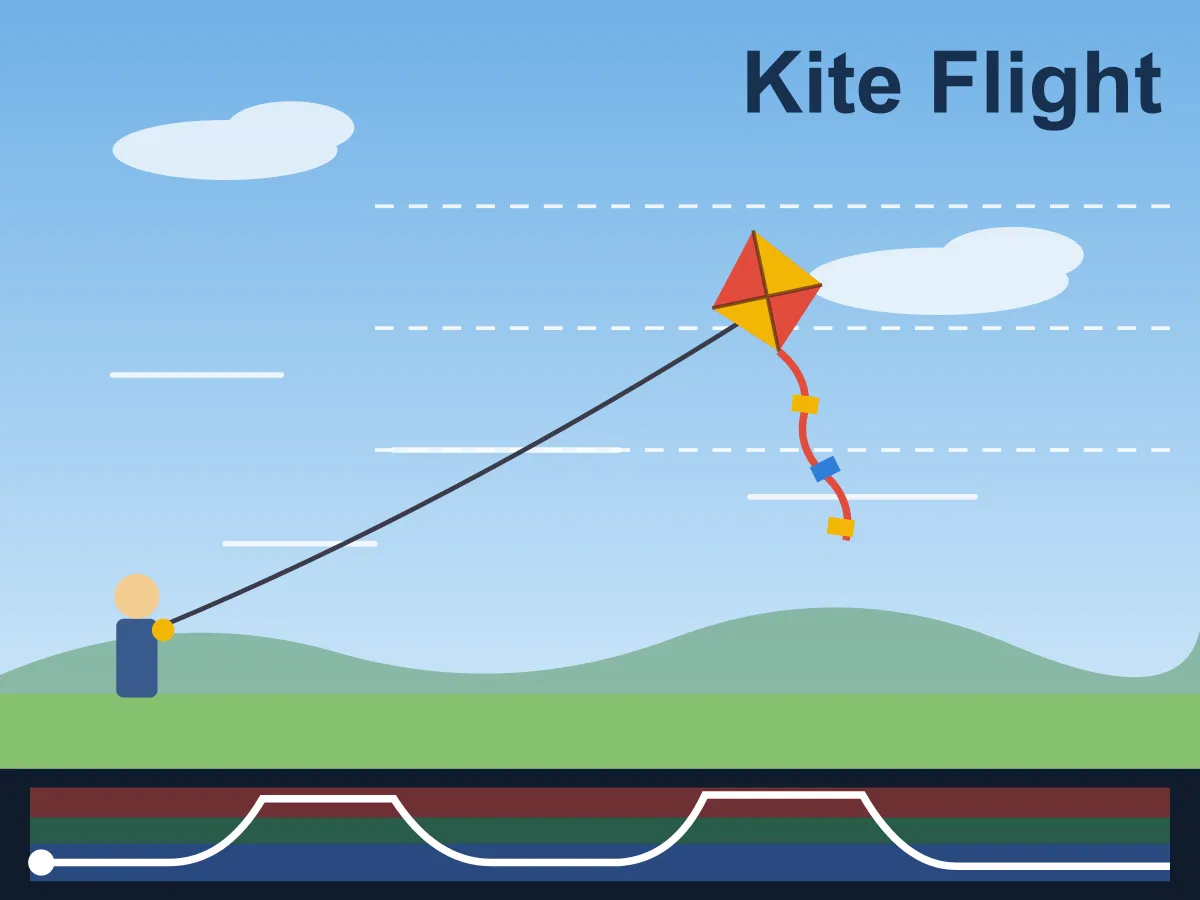






Kite Flight is a free online kite flying game about the one thing a kite flyer really controls: the line. Hold to let the line run off the reel; let go and it stays tight, pulled in a little at a time. What either does depends on the wind. The steady breeze on every field is too light to let the line run in — the kite drifts back and sinks — and every gust is too strong to hold a tight line through: it strains, and if you keep it tight too long it snaps. So the flight is the real flyer's rhythm: keep it tight, let it run the moment a gust arrives, take it back the moment it passes. Line only comes off the reel quickly in a gust, and height is line times the angle of the kite, so the kite climbs on the gusts you give line to. A strip along the bottom shows the next four seconds of wind, red where a tight line would strain and blue where a running one would sink. Eight fields — a village green, a sea wall, rice terraces, a windy hill, a harbour, a festival, dunes and a mountain pass — each with three height flags set between measured test flyers, and each gust drawn from a seed so Fly again replays the same wind and New wind blows a different one. It runs in the browser with no download and plays with a mouse, a keyboard or a finger.
How to play Kite Flight
- Press Play, then Launch — or press space or the sky. The kite leaves your hand in a steady breeze.
- There is one control. Hold — space, the up arrow, the pad under the field, or anywhere on the sky — to let the line run off the reel. Let go and the line stays tight, pulled in a little at a time.
- A tight line adds to the wind the kite feels, so it climbs. A running line takes wind away from it, because the kite drifts downwind as the line pays out.
- In the steady breeze, keep the line tight: letting it run there sinks the kite, and if it touches the ground the flight is over.
- When a gust arrives, let the line run. The reel spins, line goes out fast, and the kite climbs on it. Keep a tight line through a gust and it strains — the HUD shows STRAIN — and then it snaps.
- Watch the strip along the bottom: it shows the next four seconds of wind. Red means let it run, blue means keep it tight, green means either is safe.
- Three dashed flags mark the heights for one, two and three stars. Stars count only if the kite is still flying when the time runs out.
- Fly again replays the same wind; New wind blows a different one. One star opens the next field.
Tips
- Start letting the line run a moment before the red reaches the dot on the strip, not when you feel the strain. By then the gust is already pulling.
- Take the line back as soon as a gust fades to blue. A running line in a lull costs height fast, and the kite needs a tight line to climb again.
- The line only runs out quickly in a gust. Letting it run in the breeze gains almost nothing and drops the kite — patience between gusts is height later.
- A red, straight line and a shaking kite mean strain. Let it run at once: strain fades while the line is running.
- Tight line in a long lull still climbs. There is no need to let the line run just because nothing is happening.
- On the later fields the gusts arrive faster. Read the strip further ahead and start letting the line run on the rising edge of the red.
- The dashed purple line is your best flight on the field. Beat it, then chase the next flag.
- If a wind keeps beating you, press New wind. Every field has as many winds as you like, and the flags are the same heights on all of them.
FAQ
Is Kite Flight free to play?
Yes. It runs free in your browser with no download, no install and no account, on a computer, tablet or phone.
How do you fly the kite?
With the line only. Hold to let it run off the reel and let go to keep it tight. Keep it tight in the light breeze so the kite climbs, and let it run in every gust so it takes line and height without snapping.
Why did my kite line snap?
You kept it tight through a gust. A tight line adds to the wind the kite feels, and in a gust that is more than the line can take: it strains, then snaps. Letting the line run eases the strain.
Why does my kite keep falling?
You let the line run in a light breeze. A running line takes wind away from the kite, and in anything less than a gust that leaves too little to hold it up. Let go of the control to keep the line tight and it climbs again.
What does the strip at the bottom show?
The next four seconds of wind, arriving at the dot on the left. Red is a gust — let the line run. Blue is a light breeze — keep it tight. Green between is safe either way.
How high can the kite fly?
Three stars take it past a hundred metres on the later fields. Height is line times the kite's angle, and line only goes out fast in a gust, so the height you reach is the gusts you caught.
How are the stars decided?
By the peak height of a kite brought home, against three flags per field. The flags were set from test flyers: a flyer that ignores the wind can still pass the first flag on the first two fields — holding on a steady rhythm does it in a little under half its flights — but on the third field it is under one flight in ten and after that almost never. A flyer with slow hands passes the first flag reliably, and three stars need quick hands that let the line run right on the edge of each gust.
Is the wind the same every time?
Fly again replays exactly the same wind, so you can learn a flight. New wind blows a different one on the same field, with the same flags.
How long is a flight?
From 45 seconds on the first field to just over a minute on the last. There is nothing chasing you — only the wind.