




Cribbage is the 400-year-old two-player card game built around a scoring board. Each player is dealt six cards and throws two into the crib, a fifth hand that belongs to the dealer. A starter card is cut, and then the pegging begins: you alternate laying cards face-up, calling the running total, and scoring for every fifteen, pair, run and thirty-one you make along the way. When the cards run out you count your hand again against the starter, in the fixed order non-dealer, dealer, crib — an order that decides plenty of close games, because the moment somebody reaches the target the game stops. Twelve levels take you from a 61-point board against a loose opponent to the full 121-point game against one that guards its crib and never leads a five. No download, no account.
How to play Cribbage
- Both players get six cards and choose two to throw into the crib. The crib is a fifth hand that the dealer scores at the end, so throw generously into your own and carefully into theirs.
- A starter card is cut from the rest of the deck. If it is a Jack, the dealer immediately scores 2 for "his heels".
- Pegging: take turns laying a card face-up and adding its value to a running count. Face cards count 10, Aces count 1. You may never take the count past 31.
- Score as you play — 2 for making the count exactly 15, 2 for a pair, 6 for three of a kind, 12 for four, and one point per card for a run of three or more played in a row, even out of order.
- Reach exactly 31 and score 2. If neither player can lay a card without busting 31, whoever played last scores 1 for the go, and the count resets to zero.
- When both hands are empty it is the show. Each player counts their four kept cards together with the starter: 2 for every combination adding to fifteen, 2 per pair, one per card for runs, 4 for a four-card flush (5 with the starter), and 1 for nobs — the Jack matching the starter's suit.
- The show is counted non-dealer first, then dealer, then the crib. First to the target — 61 on the early levels, then the standard 121 — wins immediately, even mid-count.
Tips
- Fives are gold. A 5 combines with all sixteen ten-value cards for fifteen, so keep them in your hand and never throw one into the opponent's crib.
- Never lead a 5 in pegging. Whatever ten-value card they hold makes fifteen and takes 2 points off you for nothing.
- Watch the count as it approaches 21. Leaving it there invites a ten-card for exactly 31, so it is often better to play a bigger card earlier.
- Throw to the crib according to whose it is. Adjacent cards and pairs are worth a lot in a crib; giving them to the opponent's is the biggest single leak in beginners' play.
- Being non-dealer late in a close game is an advantage, because you count first and the game stops the moment someone reaches the target — a dealer with a monster hand can lose before ever showing it.
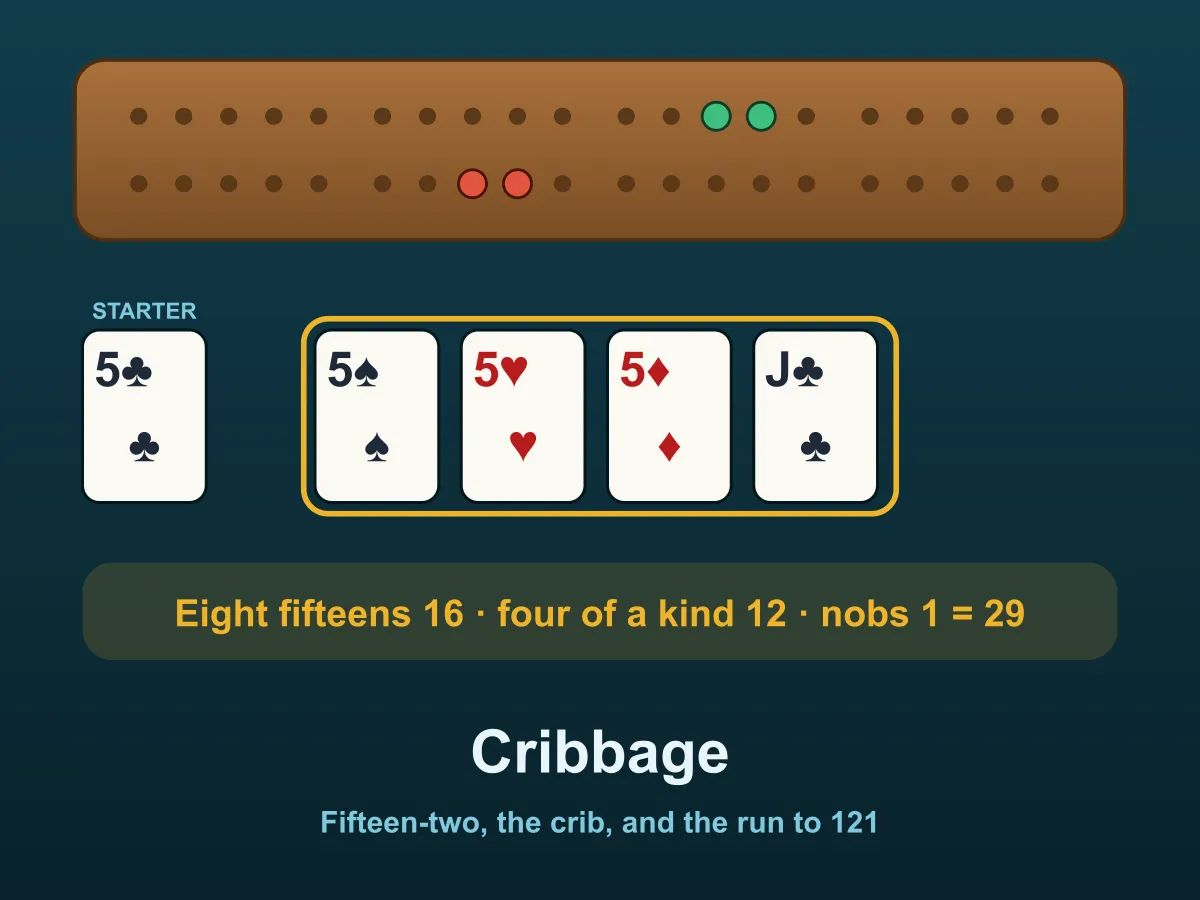
- The classic 29 hand is three fives, the Jack matching the starter's suit, and the fourth five cut. It happens roughly once in 216,000 deals, so do not wait for it.
FAQ
Is Cribbage free to play?
Yes. Cribbage is completely free to play online with no download, no account, and no in-game purchases.
Does Cribbage work on mobile?
Yes. Every card responds to tap and the layout wraps to fit narrow screens, so it plays the same on phones, tablets and desktop.
What is the crib in Cribbage?
The crib is a fifth hand made from the two cards each player throws away at the start. It belongs to the dealer, who counts it as a bonus hand at the show along with the starter card. Because the deal alternates, the crib alternates too — which is why you throw helpful cards into your own crib and junk into your opponent's.
How does pegging work in Cribbage?
Players alternate laying cards face-up onto a running total that may never pass 31. You score 2 for hitting exactly 15, 2 for a pair (6 for three of a kind, 12 for four), one point per card for a run of three or more, and 2 for hitting exactly 31. When neither player can lay a card without busting, the last to play scores 1 for the go and the count restarts at zero.
What counts as a run in Cribbage pegging?
Three or more consecutive ranks played in a row, and they do not have to arrive in order — 5, 7, 6 is a run of three worth 3 points. A repeated rank breaks it, so 5, 6, 6 is not a run. In the show, runs are counted with multiplicity: a hand of 4-5-5-6 contains the run 4-5-6 twice, so it scores 6 for runs plus 2 for the pair.
What is the highest possible Cribbage hand?
29 points. It needs three fives and the Jack of one suit in hand, with the fourth five cut as the starter in that same suit as the Jack. That gives eight different fifteens for 16, four of a kind fives for 12, and one for nobs. There is no 30-point hand — 19 is the famous impossible score, which is why players jokingly call a hand worth nothing "a nineteen hand".
Why does the non-dealer count first in Cribbage?
Because it is a real advantage and the rules deliberately give it to the player who does not have the crib. The game ends the instant somebody reaches the target, so in a close finish the non-dealer's hand is counted while the dealer's hand and crib may never be counted at all. This version enforces that order and stops scoring at the target exactly as the rules require.
How many points do you play to in Cribbage?
121 in the standard game — twice round a traditional board — or 61 for a shorter game once round. This version uses 61 on the first four levels and 121 from level 5 onward.
How many levels does Cribbage have?
Twelve, and what changes is the opponent rather than the rules. The early levels keep a fairly random four and lay their first legal card. From level 4 the computer keeps whichever four cards score best across every possible starter, and from level 7 it also weights its discard by whose crib it is and avoids the classic pegging mistakes.