







Home / Simulation / Mars Colony
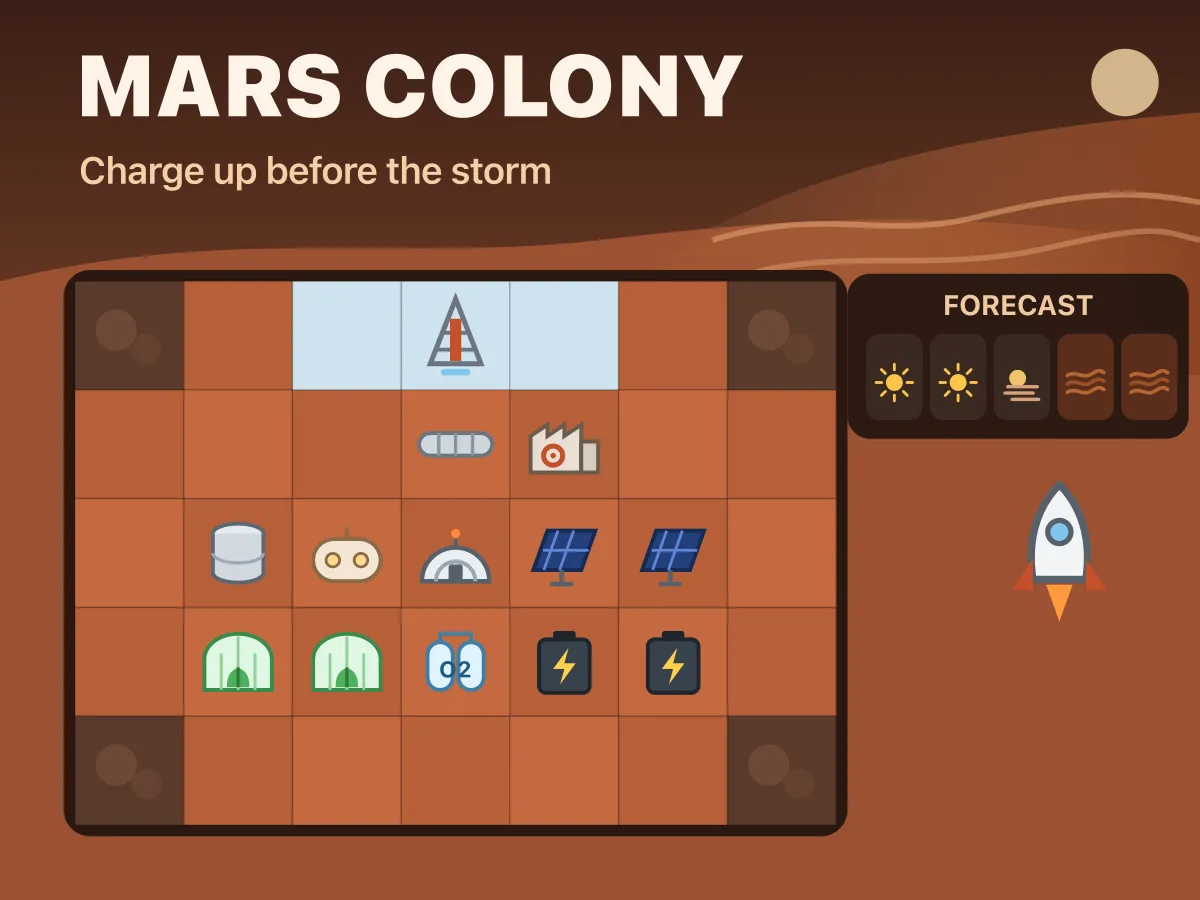
Mars Colony is a free survival builder you play in your browser, one sol — one Martian day — at a time. Every colonist uses a unit of oxygen, water and food each sol, and whoever the stores cannot cover is flown home. Build ice drills on the ice, oxygen plants and greenhouses to turn that water into air and food, and solar arrays to run it all. Then watch the forecast: a dust storm cuts every array to a quarter of its power for sols on end, so the batteries have to be charged, the tanks full and the machines that can wait switched off before it arrives. Supply rockets bring parts and new colonists every four sols — as many as you have beds for, or fewer if you choose — and every colonist is a point, while every one flown home costs one. Eight missions add long storms, meteor strikes, ice out on a crater rim and a forecast that sees only three sols ahead. No download, no sign-up, and it plays on a phone.
How to play Mars Colony
- Read the mission card and press Land. You start with three colonists, a hub with beds for three and a small reactor, some stores and a pile of parts. The card says how long the mission lasts, how far the forecast sees, and how many dust storms and meteor showers are coming.
- Build life support first: an ice drill on the ice (6 water a sol), an oxygen plant (5 oxygen) and a greenhouse (4 food, 5 beside a habitat), each of which uses 2 power, and a solar array to run them (4 power on a clear sol). Choose a module in the console and tap a square next to the colony — every module has to join onto the others.
- Watch the stocks and the outlook line. Each stock shows what it gains or loses on a sunny sol and in a storm, and the outlook plays the forecast forward: if a stock will run short, it says on which sol and how many colonists would be flown home.
- Get ready for storms before they arrive. In a dust storm each solar array gives 1 power instead of 4, so build batteries (15 power each) and fill them in the sunshine, add tanks (12 more of everything) and switch off machines whose stores are full. Power goes to drills first, then oxygen plants, greenhouses and workshops.
- Plan for the rockets. One lands every four sols with parts and two to five colonists; they stay if there are beds — build habitats for 4 more — and you can choose to take fewer. A rocket that lands as the last sol ends only leaves colonists the stores could feed, with everyone else, for one more sol. A meteor knocks out the module it lands on until you repair it for half its price.
- Press End sol. The sol plays out: power, then the machines, then the crew, then any rocket. When the last sol ends, your score is the crew still living there less everyone who was flown home, and it earns up to three stars.
Tips
- Build the drill, oxygen plant and greenhouse on sol one, and a solar array for every two machines. A machine with no power to run on sits idle and makes nothing.
- Keep a little more sunshine than you use. Spare power on a clear sol is what charges the batteries; with none spare, a battery is an empty box.
- When a storm shows in the forecast, stop growing and start storing: batteries first, then solar to fill them, and a tank or two if the crew is big.
- In a storm, switch off what can wait. Water tanks full? Switch the drills off and give their power to the oxygen plants and greenhouses. Workshops are always the first to go.
- Put greenhouses beside habitats — they grow a unit more food a sol there.
- Do not take colonists you cannot keep. Leaving them on the rocket costs nothing; taking them and flying them home costs a point each.
- Save a few parts for repairs on meteor missions. A knocked-out drill in the middle of a storm is how colonies are lost.
- On the short-sighted missions, a storm still raging at the edge of the forecast can run on for sols more: the mission card says how long they can last.
FAQ
Is Mars Colony free to play?
Yes. Mars Colony runs free in your browser with no download, no install and no account, on a computer, tablet or phone.
What happens when oxygen, water or food runs out?
The colonists the stores cannot cover that sol are flown home, and each one costs a point off your score. If the last colonist leaves, the mission is lost. A colony that builds nothing is gone within five sols.
How do I survive a dust storm?
Get ready before it comes. The forecast shows it a few sols ahead; in a storm each solar array gives 1 power instead of 4, so charge batteries in the sunshine beforehand, fill the tanks, and during the storm switch off the machines whose stores are full so the power goes where it is needed. The outlook line tells you, sol by sol, whether what you have is enough.
Why is my machine idle?
It could not get the power or the water it needs that sol. Power goes to the machines in a fixed order — ice drills, then oxygen plants, then greenhouses, then workshops — out of what the colony made that sol and what is in the batteries, and oxygen plants and greenhouses each need one water as well. An idle machine is marked with a yellow "!".
How do I get more colonists?
A supply rocket lands every four sols with parts and two to five colonists. They stay if there are free beds: the hub has three, and each habitat adds four. You can set the rocket card to take fewer, which costs nothing — only colonists who are flown home cost you points. A rocket that lands as the final sol ends is the exception: its colonists count only if the stores could feed the whole colony, them included, for one more sol.
What do meteors do?
On meteor missions the forecast warns of a shower on a sol, but not where it will land. A strike knocks out the module it hits until you repair it for half its build price. A knocked-out battery or tank holds nothing while it is down, so any stock above what the rest of your stores can hold is lost. The hub is never damaged.
How do I get three stars?
Stars are the colony score at the end: colonists still there, less anyone flown home. The marks were set with test commanders on sites the marks were not taken from. One who reads the forecast — charging batteries before a storm, switching machines off in it and taking only the colonists it can keep — earns two stars at least seven times in ten on every mission and three at least three times in ten. One who grows as fast as the parts allow and ignores the forecast does about as well on the first two missions, and from the fourth on rarely earns more than one star: nearly every such colony ends up flying people home.
Is it the same mission every time?
Fly again replays the same site, weather, rockets and meteors, so the same moves bring the same sols and a better plan shows. New site draws a different site, a different run of weather, a different rocket manifest and different meteors.
Is Mars Colony realistic?
It is a game, not a simulation: the numbers are chosen to make a fair puzzle, not taken from real Mars missions. The ideas are real ones, though — dust storms that choke solar power for days, water mined from ice and split into oxygen, food grown under lights, and supplies that come only when the planets line up.